Updated on September 22, 2026


The Working Holiday Visa is a great way to travel abroad, immerse yourself in a new culture, and earn money at the same time.
Are you a young person interested in applying for the 2026 Working Holiday Visa in Canada? This comprehensive guide is designed specifically for you. Whether you’re from the UK, Australia, Ireland, or any of the 36 eligible countries, this page covers everything you need to know about the Working Holiday Visa Canada 2026. Here, you’ll find detailed information on eligibility, the application process, key requirements, benefits, and practical tips for making the most of your Canadian adventure.
Working Holiday Visa Canada 2026: At a Glance
Who is eligible, how to apply, what are the key requirements, and what is the process for the 2026 Working Holiday Program in Canada. Find here a quick summary, and in detail information below.
- Age Limits: Most applicants must be between 18 and 30 or 35 (inclusive), depending on their country of citizenship. Most nationalities must apply before their 36th birthday.
- Nationality Requirements: You must be a citizen (with a valid passport) of one of the 36 countries that have a bilateral youth mobility agreement with Canada. Applicants for the Canadian Working Holiday visa must hold a passport from a country with a youth mobility agreement with Canada.
- Open Work Permit: The Working Holiday Visa provides participants with an open work permit, allowing them to work for any employer in virtually any location across Canada.
- Health Insurance: Health insurance is mandatory for all Working Holiday Visa participants in Canada and must cover the entire duration of your stay.
- Proof of Funds: You must provide proof of at least CAD $2,500 in support funds to apply for the Working Holiday Visa.
- Application Steps:
- Create an online profile through the IRCC system.
- Enter the IEC pool and wait for an Invitation to Apply (ITA).
- If you are selected, you have 10 days to accept and 20 days to submit your application with required documents.
- Pay the application and biometrics fees.
- If approved, receive a Port of Entry (POE) letter to enter Canada.
- Fees: The total application fee is approximately CAD $284.75, plus a biometrics fee of CAD $85 (unless you have provided biometrics in the last 10 years). The total cost can be around CAD $369.75, including all fees.
- Duration: The visa allows you to stay in Canada for 12 to 24 months, depending on your nationality.
- No Dependants: Applicants must not be accompanied by dependants, including spouses or common-law partners.
- Limited Spots: Each participating country has a limited number of spots available, which can affect your chances of selection.

What is the Working Holiday Visa in Canada?
The Working Holiday is one of the most popular categories within the International Experience Canada (IEC) program, which is developed and managed by the Canadian government through the International Mobility Program (IMP). The Working Holiday Visa provides participants with an open work permit, allowing them to work for any employer in virtually any location across Canada.
This program allows participants to stay in Canada for a duration of 12 to 24 months, depending on their nationality. Most countries have different agreements with Canada, which affect the duration and availability of the visa. However, the final length of the stay may vary depending on multiple factors.
You can apply for a Working Holiday visa at any time of the year, but applying early is recommended to improve your chances.
Canada has reciprocal agreements with participating countries, meaning young Canadians can also participate in working holiday programs in other partner countries, and popular destinations for Canadian working holidaymakers include Australia, New Zealand, and the UK.
Other Alternatives to the Working Holiday Program
In addition to the Working Holiday stream, the IEC program includes two other categories designed to support different types of work and learning experiences:
- Young Professionals: This category targets post-secondary graduates who wish to gain career-relevant experience in Canada. Unlike the Working Holiday category, participants in the Young Professional category must have a pre-arranged job offer in their field of study or career. Successful applicants receive an employer-specific work permit, meaning they are tied to one employer for the duration of their stay.
- International Co-op (Internship): This stream is designed for students enrolled in a post-secondary institution in their home country who need to complete a work placement or internship as part of their academic curriculum. To qualify for the International Co-op category, applicants must have a signed job offer that aligns with their academic program. Work permits under this category are generally valid for up to 12 months, although this may vary by country.
Benefits of a Working Holiday in Canada
- Legal Protection: Participants in the program are protected by Canadian labor laws, ensuring minimum wage and safe working conditions.
- Job Flexibility: The Working Holiday Visa allows for job flexibility, enabling participants to change jobs and locations freely during their stay.
- Regional Experience: This program offers the flexibility to work in more than one location, so you can experience different regions of Canada during your stay.
- Earn While You Travel: This type of visa allows participants to earn money through legal employment, which can be used to fund their travels within Canada.
- Access to Job Databases: Working holiday visa holders can access in-country job databases for the duration of their visa to find additional employment opportunities.
What are the Requirements for a Working Holiday Visa in Canada?
To be eligible to apply for an IEC Working Holiday Visa in Canada, candidates must:
- Be a citizen (with a passport) of one of the 36 countries that have a “bilateral youth mobility agreement” with Canada OR be from the United States and apply through a recognized organization. Here is the list of participating countries:
| Andorra | Germany | Norway |
| Australia | Greece | Poland |
| Austria | Hong Kong | Portugal |
| Belgium | Iceland | San Marino |
| Chile | Ireland | Slovakia |
| Costa Rica | Italy | Slovenia |
| Croatia | Japan | South Korea |
| Czech Republic | Latvia | Spain |
| Denmark | Lithuania | Sweden |
| Estonia | Luxembourg | Switzerland |
| Finland | Netherlands | Taiwan |
| France | New Zealand | United Kingdom |
| Check here the full list of requirements per country |
||
- For some IEC categories, such as Young Professionals, applicants may also need to demonstrate relevant professional experience related to their studies or training.
- Have a valid passport for the duration of your stay in Canada (the work permit issued will be of the same length as the validity of the passport).
- Be between the ages of 18 and 30 or 35 (inclusive) when your profile is selected from the pool. Most nationalities must apply for the Working Holiday Visa before their 36th birthday. The age limit depends on the applicant’s country of citizenship, as outlined in our International Experience Canada country list.
- Have the equivalent of at least CAD$2,500 on landing to help cover initial expenses. You will need to provide a recent bank statement as proof of funds.
- Take out health insurance for the full duration of their Working Holiday Visa in Canada (participants will have to present evidence of this insurance at the point of entry in Canada). View providers on our page or get a free comparative quote for IEC health insurance.
- Be admissible to Canada.
- Not be accompanied by dependants.
- Pay the appropriate fees: working holiday visa total is CAD$369.75, including CAD$184.75 for processing fees, CAD$100 for the open work permit holder fee and CAD$85 for biometrics.
- Citizens of certain countries are also required to be residents in their country of citizenship at the time they apply for their Working Holiday Visa in Canada.
To get a full list of all the documents you will need and more details, check out this guide about the documents for your IEC work permit application.
How can I apply for a Working Holiday visa for Canada?
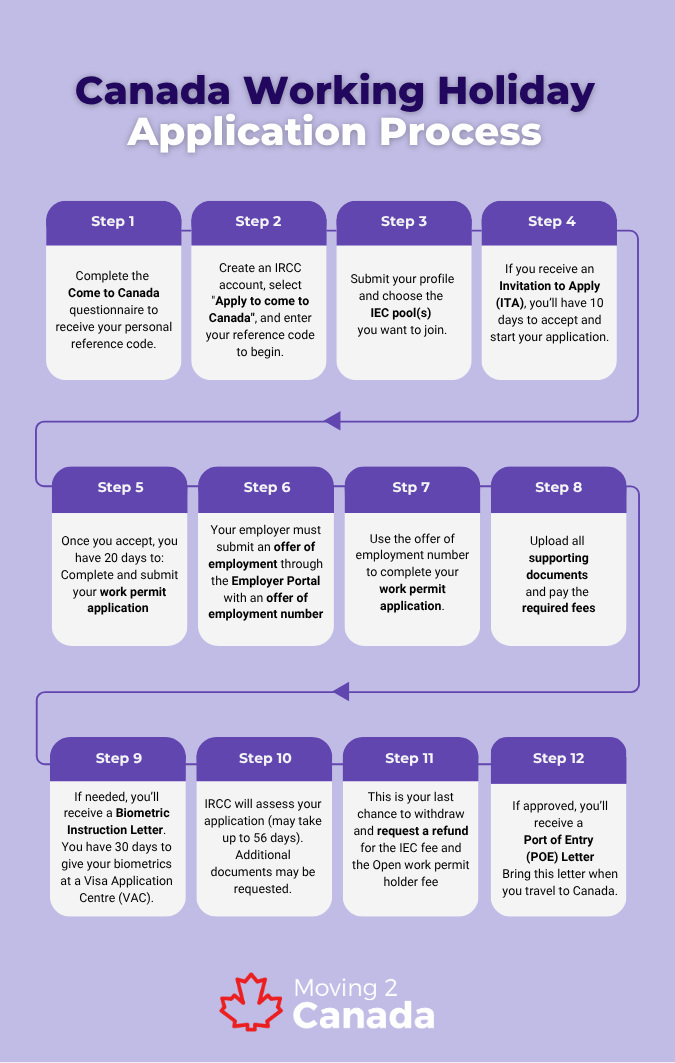
The application process for a Working Holiday visa is managed through the Immigration, Refugees and Citizenship Canada (IRCC) online system and it can take 2-3 months in total. Here is the full process step by step.
Step 1: Become A Candidate in the IEC Canada Pools
- Complete the Come to Canada questionnaire. This is used as an initial assessment of your eligibility for an IEC work permit. If you meet the criteria, you’ll receive a personal reference code.
- Enter this code to create your account and build your IEC visa profile.
- Submit your profile and choose the IEC pool(s) you want to be in. Some candidates will only be eligible for one pool, while some may be eligible for more.
Once you receive an ITA, you have 10 days to accept and start your application for a Work Permit in Canada, or to decline the invitation. If you do not accept or decline the invitation within the 10 days, your working holiday IEC profile will be removed from the pool.
Step 2: Apply for an IEC Work Permit
- Once you press the ‘Start Application’ button to formally accept the ITA, you’ll have 20 days to gather the required documents and submit your work permit application and pay any relevant fees.
- For the IEC Young Professional and International Co-op categories, your employer also needs to pay the CAD$230 employer compliance fee through the employer portal before the 20 days expire. They’ll need to send you the Offer of Employment number they receive so you can enter this in your application.
- Gather and upload all the documents (e.g. police or medical certificates) requested by IRCC. If you don’t have these immediately, you can upload proof that you’ve applied for a police certificate or medical exam.
- Pay relevant fees.
- Submit your application.
- IRCC will assess your application and may request additional documents.
Step 3: Approval
You will receive a Port of Entry (POE) letter if approved, in your account. At this point, you can book your travel to Canada (or organize to leave Canada and re-enter).
Step 4: Enter Canada
To successfully enter Canada on your IEC work permit, you will need to bring all of the following documents required for your arrival in Canada:
- Your valid passport.
- Your Letter of Introduction.
- Proof of travel insurance (health insurance) for the entire duration of your planned stay. If you are not able to get one policy to cover the entire period, you can purchase two (or more) separate policies, but you will need to prove that you’re insured for your entire stay.
- Proof of at least $2,500 CAD in your account within the last 7 days.
- Proof of onward travel or additional funds to leave Canada.
- Printed copies of your police certificate.
- Details of your country’s IEC treaty.
- Proof of medical, if needed.
How is proof of funds assessed at the Port of Entry?
When you land in Canada with your port of entry letter to activate your work permit, you must present a bank statement no older than 7 days, which shows you have the equivalent of $2500CAD. If you are unable to show this, you will not be issued your Working Holiday permit.
For more detailed information, check our article on the necessary documents and requirements for a Successful Working Holiday arrival in Canada.
After providing all the documents to an immigration officer at a Port of Entry (POE), such as an airport or border crossing, this is where you will receive your work permit!
Mandatory Insurance for Working Holiday Participants
We do really want to stress the importance of adequate health insurance coverage at this point. If you are not adequately insured, you may not receive your IEC work permit at all!
If you don’t have health insurance for the entire period, your IEC work permit duration may be shortened. In other words, if you only have insurance for 6 months but you want to stay for 2 years (and that’s what your country’s IEC agreement allows), you will only be able to stay on an IEC work permit for 6 months.
Not sure where to start? Check these resources:
- Understand the difference between Working Holiday Travel insurance and Health insurance
- Get a free comparative quote for IEC health insurance and compare your options in minutes!
What documents do you need for a Working Holiday visa in Canada?
What is the age limit for the working holiday visa in Canada?

Do you have IEC health insurance?
What are the Chances of Getting a “Working Holiday Visa”?
Your chances of getting a Working Holiday visa depend on your country of citizenship, as each country has a limited number of spots available under the International Experience Canada program. The selection process works like a lottery, once you submit your profile, you’re placed into a pool, and draws happen at random.
The more people in the pool for your country, the lower your chances of being picked. Some countries have larger quotas, meaning more opportunities to be selected, while others have fewer spots, making it trickier to get an invitation.
You can use our Moving2Canada IEC Chances Calculator to check your chances of being selected.
How Much Does the Working Holiday Permit Cost?
Althoug, enter the IEC working holiday pool is free, you have to pay multiple feesif you are selected, and the total application fee for a Canada Working Holiday Visa could be CAD $284.75 for 2026, wich includes:
- Working Holiday Visaprocessing fee: CAD$184.75
- Open work permit holder fee: CAD$100.
- Biometrics fee: CAD$85 unless you have given biometrics in the 10 years preceding your application. Learn more about biometrics for IEC
Job Search and Career Development
The Working Holiday open work permit gives you the freedom to work for almost any employer across Canada, making job search and career development a flexible and rewarding part of your experience. From seasonal roles and Gig Jobs to long-term career opportunities, combining online job searches, networking, and professional support can significantly improve your chances of success.
- Finding a job: Use popular Canadian job platforms such as LinkedIn, Indeed, and Job Bank Canada to access a wide range of opportunities across industries and locations.
- Networking: Build connections through job fairs, online communities, and other IEC participants, and tailor your resume and cover letter to Canadian standards to stand out to employers.
- Recognized Organizations: Consider working with a Recognized Organization (RO) for guidance on job searching, applications, and settling into life in Canada.
If you have not find an employer for your IEC application, you can find more information, resources and the IEC Talent Pool in our article Jobs in Canada for the 2026 IEC Working Holiday Season.
Free Work and Holiday Guidance with Moving2Canada
Get access to tons of free resources, including checklists with step-by-step instructions on how to apply for a working holiday visa, job matches from Canadian employers looking to hire IEC participants, guides on how to make a Canadian-style resume and killer cover letter, and much more!
Once you join, we’ll show you exactly where and how to create your IEC profile, plus a bunch of other important tasks to help you along the way. Join the Moving2Canada community here.
Working Holiday Visa: Tools and Resources
Moving2Canada partners with trusted organizations to help you succeed in the International Experience Canada program, whether it’s securing your dream job, finding the right insurance at an affordable price or finding the perfect phone plan.
Construction, Trades and Engineering Jobs
Affordable Health Insurance
Secure Canadian Work
FAQs
Can the work experience I gain on a Working Holiday permit be used to get Canadian permanent residency?
Yes! The Working Holiday permit is an open work permit, meaning you can work for almost any employer in Canada and gain valuable Canadian work experience—which can help support a permanent residency (PR) application. However, the type of work you do matters.
If you’re aiming for Express Entry, you’ll need skilled work experience in a TEER 0, 1, 2, or 3 job under Canada’s National Occupational Classification (NOC) system. If your work falls under a lower TEER level, you may need to explore Provincial Nominee Programs (PNPs), which sometimes accept candidates with less specialized work experience.
Regardless of the path you choose, Canadian work experience boosts your chances of PR. Just keep in mind that self-employed work experience does not count toward eligibility for the Canadian Experience Class (CEC) under Express Entry. So, if PR is your goal, choosing the right job while on a Working Holiday visa is key!
Employment Tips for IEC Working Holiday Participants
Finding a job in Canada as an IEC Working Holiday participant can be easier with the right approach. If you’re looking for opportunities in construction or engineering, consider checking out Outpost Recruitment, a specialized agency that connects job seekers with employers in these fields. To improve your chances of landing a job, it’s also important to adapt your resume (or ‘CV’) to Canadian standards, which often emphasizes concise formatting and clear, results-oriented descriptions. If you’re open to different job options, exploring alternative roles suited for Working Holiday visa holders—such as hospitality, tourism, or seasonal work—can help you secure employment quickly and gain valuable Canadian work experience.
Can my spouse join me on my Working Holiday visa?
As part of the eligibility criteria, applicants must not be accompanied by a dependant, including spouse or common law partner. however, there are ways your spouse/ common-law partner can join you in Canada.
- If they qualify for a Working Holiday visa, they can apply for one in their own name
- One you come to Canada and start working on your Working Holiday permit, your spouse or common- law partner may qualify for a Spousal Open Work Permit (SOWP). A SOWP is an open work permit and will be issued for the same duration as your Working Holiday visa.
Do you have IEC health insurance?
More Resources for Work and Holiday Program Participants
- Discover the benefits of the Canadian working holiday visa for UK nationals
- Learn here why acquiring health insurance is mandatory for your working holiday in Canada
- If you do not qualify for the International Experience Canada program, find alternatives to working in Canada here.
- If you want to plan a Working holiday in Canada with your partner or friends, this article is a must read.
- How Recognized Organizations can help you obtain a Working Holiday work permit

About the author