Updated on October 5, 2026

Vancouver is one of Canada's most desirable cities, known for its mild climate, diverse communities, and access to outdoor recreation. But before making the move, it's important to understand the cost of living in Vancouver, which ranks among the highest in the country.
In my opinion, Vancouver is one of the most beautiful cities in the world. The mountains surrounding it are huge and stunning. The beach is never that far away.
Then, there’s the culture, the food, the abundant parks, the wildlife, the nightlife, and the people. Vancouver is fun, vibrant, and full of opportunities and optimism.
It’s little wonder that so many people want to live there – and as with anything with high demand, this pushes costs up. Housing costs are extremely high, and even outside of this, Vancouver is consistently ranked among the cities with the highest cost of living in the world.
So, can you afford to live there? Likely yes! Especially if you’re willing to make some compromises on lifestyle and location. Let’s dive into what that might look like:
Is it expensive living in Vancouver?
If you want to live close to downtown Vancouver or in North Vancouver, then the reality is that life is going to be expensive. Rental costs for a small studio apartment start at around $1,800 for a very small space – though most accommodation is going to be more expensive than this. If you choose to own a car, you’ll likely be paying for parking wherever you live too.
Then, there’s the average monthly costs of living (not including rent) – which Numbeo puts at just under $1,500 for a single person and just over $5,500 for a family of four. Though, these costs will always vary depending on your lifestyle preferences – yep, the cost of eating out in Vancouver’s amazing restaurants adds up quickly!
But, life doesn’t have to be extraordinarily expensive in Vancouver. You can make decisions that make it less expensive including:
- Living in a smaller or older home, or sharing a home with others.
- Choosing public transport instead of owning a car.
- Taking advantage of cheaper hobbies, like hiking and paddle boarding, compared to organized sports.
- Camping when you travel, instead of staying in hotels.
- Cooking at home more often, and using our tips for saving money on your groceries.
Below, we’ll dig into these costs in more detail to show you what it can cost and where you may be able to save some money.
Is Vancouver’s rent higher than Toronto?
According to our latest monthly rent report, Vancouver’s rents are, on average, higher than Toronto’s. As of October 2026, the average asking rent for a one-bedroom apartment in Vancouver is $2,483 per month, with a three-bedroom apartment clocking in at $4,434 per month.
“Rent in Vancouver was pretty much what I expected — pricey! I was lucky I lived with relatives when I first arrived as a student, which helped me save and ease into life here, but the prices were still a shock. Later, when my partner and I rented, both of us being able to work remotely gave us a lot more flexibility. Since we weren’t tied to commuting, we could prioritize affordability and value for space, and avoid the in-demand, expensive rental pockets.” – Rachel at Moving2Canada
How much do utilities cost in Vancouver?
Vancouver is lucky to have a fairly mild climate, which means that heating and cooling costs, compared to other areas of Canada, can look like a deal. Electricity and heating together can often range from $50-$120 a month for the average 1-bedroom apartment.
But, those aren’t the only utility costs. Most Vancouver residents pay for electricity, maybe gas, heating, internet, and sometimes water and garbage – though these are often included in apartment building rentals. All in, averages for utilities range from $120-$250 per month, depending on your internet plan (which can be the highest cost if you have really high data needs) and the size of your home.
As you can see, there are factors that impact your utility costs. Understanding how these impact you can better prepare you for the potential costs. Some of the most important factors are:
- Size and age of your home. Larger and older homes tend to be more expensive to heat, while newer and/or smaller homes tend to cost less.
- The type of heating. There are baseboard heaters, natural gas furnaces, electric forced air, and heat pumps, to name a few. Generally, newer heating units are cheaper to run, and heat pumps in particular are more cost-effective.
- The number of people living in your home. More people often means higher electricity use, more hot water, and more loads of laundry. This increases costs.
Tips for managing your utility costs in Vancouver
If you’re new to Vancouver and want to make the most of the city without overpaying on utilities, here’s what you can look for:
- You can check the lease agreement to see what’s included. Some rental units include utility costs as part of the lease.
- If your lease doesn’t include utilities, ask the potential landlord to show you some of the past bills (ideally, some from winter, some from summer) so you can estimate your monthly costs.
- Compare internet plans carefully. The Internet is a major utility cost, and switching providers or negotiating your rate can save you hundreds of dollars a year.
What's the real cost of living in Canada? Find out by city
Are groceries expensive in Vancouver?
Groceries do tend to be quite expensive in Vancouver, even compared to other high cost of living cities in Canada such as Toronto.
To give you a general idea (prices will fluctuate):
- 1 litre of milk: $2.50–$3.50
- A loaf of bread: $3.50–$9.00, depending on the quality and where you shop.
- A dozen eggs: $4.00–$6.00
- Chicken breasts (1 kg): $14–$20
- Apples (1 kg): $4–$8
If you shop primarily at premium grocery stores and buy a lot of organic or specialty products, your monthly grocery bill will be significantly higher. Many single people in Vancouver spend $500 per month on groceries, while families can easily spend $1,200 or more depending on eating habits.
However, there are ways to reduce your grocery costs:
- Shop at discount chains such as No Frills, Superstore, or Walmart.
- Visit local Asian markets, farm stalls, and produce stores, which often have lower prices on fruits and vegetables.
- Buy in-season produce.
- Use loyalty programs and price-matching apps.
Read our dedicated article to learn more about grocery costs in Canada in 2026 and how to save money.
What salary do you need to live in Vancouver?
The short answer? It depends on your lifestyle, housing situation, and whether you’re supporting anyone else.
As a benchmark, someone earning a $100,000 salary in British Columbia would take home roughly $75,000 per year after taxes, or about $6,270 per month. That sounds substantial – but housing changes everything.
If you’re paying:
- $2,300–$2,800 for a one-bedroom apartment
- $150–$250 for utilities
- $400–$500 for groceries
- $120–$200 for transit (or significantly more if you own a car)
- $200–$400 for entertainment, dining, subscriptions, and miscellaneous costs
You can see how quickly monthly expenses approach $3,500–$4,500 or more. That still leaves room to save on a $100k salary — but not extravagantly, especially if you’re living alone in a central neighbourhood.
For many people, a salary of:
- $70,000–$85,000 can support a modest but comfortable lifestyle if sharing housing.
- $90,000–$120,000 allows more flexibility and independent living in desirable areas.
- Families typically require significantly more, particularly if childcare is involved.
Check out our dedicated article if you want a deeper breakdown of what $100k actually looks like after taxes across Canada.
Monthly cost of living in Vancouver
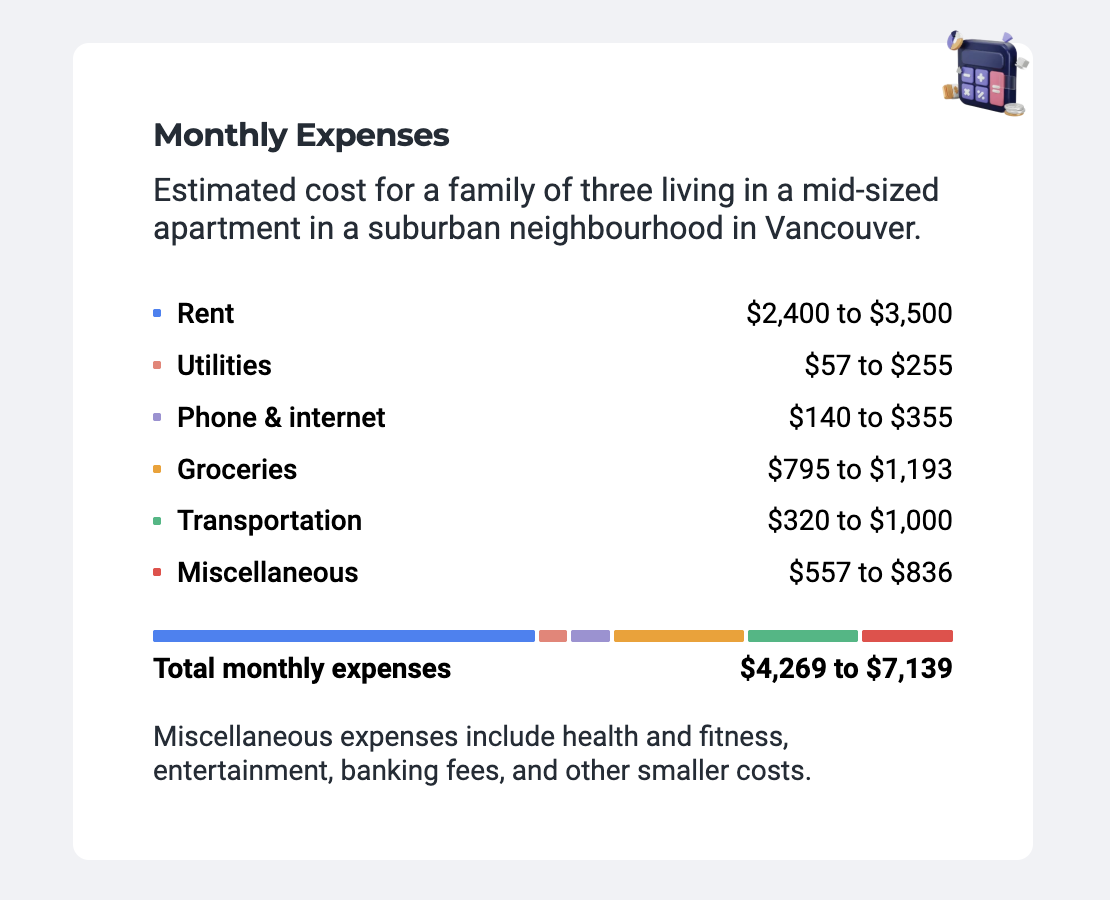
Estimated monthly costs for a family of three living in a mid-sized apartment in a suburban Vancouver neighbourhood, including rent, utilities, phone and internet, groceries, transportation, and miscellaneous expenses. Total: $4,269 to $7,139 per month.
Can you live in Vancouver without a car?
Yes — and many people do.
Vancouver has one of the best public transportation systems in Canada. TransLink operates buses, the SkyTrain, and the SeaBus, connecting downtown Vancouver with surrounding municipalities including Burnaby, Richmond, Surrey, and North Vancouver.
If you live near a SkyTrain station or a major bus route, you can comfortably commute without a car. Many neighbourhoods are also highly walkable and bike-friendly.
Owning a car in Vancouver adds high costs:
- Insurance (which is publicly managed in BC)
- Gas
- Maintenance
- Parking (often $100–$200+ per month if not included in rent).
For many residents, especially newcomers, relying on transit, biking, and occasional car-sharing services (like Evo or Modo) is far more economical.
Your Move to Vancouver Starts Here
About the author