
Updated on May 1, 2026


Your complete guide to Toronto's best areas — from family-friendly suburbs to vibrant downtown neighbourhoods
This guide is for newcomers, families, professionals, and anyone relocating to Toronto who is trying to find the best neighbourhoods where they actually want to live, whether you’re relocating for work, family, or a fresh start.
Choosing the right neighbourhood in Toronto is especially important due to the city’s diversity and size. The difference between landing in the right area and the wrong one can shape your daily commute, your children’s schooling, your social life, and how quickly you feel at home.
This guide walks you through Toronto’s major neighbourhoods — from the buzzing West End to the quieter suburbs of Etobicoke and Scarborough — so you can make a confident, informed decision about where to put down roots.
Key Takeaways
- Toronto is divided into distinct areas — West End, Downtown, Midtown, East End, and suburbs — each offering a different lifestyle, price range, and commute experience
- Family-friendly neighbourhoods like East York, Bedford Park, and Lawrence Park offer strong schools, green space, and community amenities
- Transit access varies significantly: neighbourhoods along subway Lines 1 and 2 offer the fastest downtown connections
- Renting before buying is strongly recommended — exploring the city firsthand will help you find the neighbourhood that truly fits your life
How is the City of Toronto Divided?
Toronto City layout
Before diving into the details, it helps to see the full picture. The map below shows how Toronto is laid out across its major areas: from Etobicoke in the west to Scarborough in the east, and everything in between.
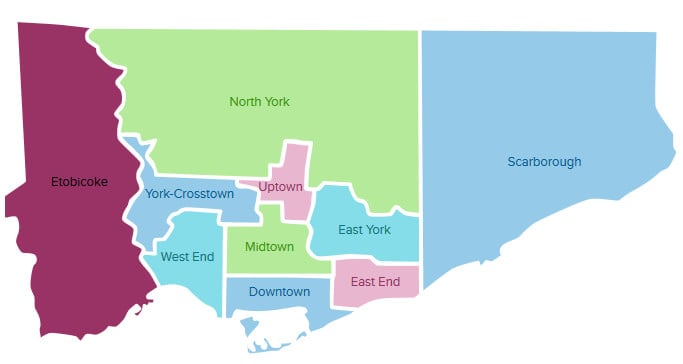
Knowing where each neighbourhood sits in relation to the others — and to downtown — is the first step in figuring out where you actually want to live.
Now let’s dive into each area and its neighbourhoods.
1. Neighbourhoods in the West End Area
The Annex
The Annex and its historic charm are a hub for young professionals and creative young adults. Historically home to students and staff of the University of Toronto, this neighbourhood begins at the north-west boundary of what would be considered downtown. The Annex is renowned for its preserved architecture and a unique character that reflects its rich heritage. The main U of T campus is at the southeast end of the neighbourhood, while The Annex itself is a mix of leafy streets with old houses and pubs and eateries friendly to the student budget.
It’s by no means a students-only area, though — the Bloor West Village is a famous shopping strip. It has seen a host of new businesses move in over the last few years to make this an attractive area for residents of any age group or background.
Famous Toronto landmarks Honest Ed’s and the Brunswick House bar have both closed their doors in recent years, but with Christie Pits Park just to the west and Casa Loma to the north, The Annex still possesses plenty beyond its bars, restaurants, and book stores. It also has the benefit of being close to three subway stations on Line 2: Bathurst, Spadina, and St George.
Roncesvalles
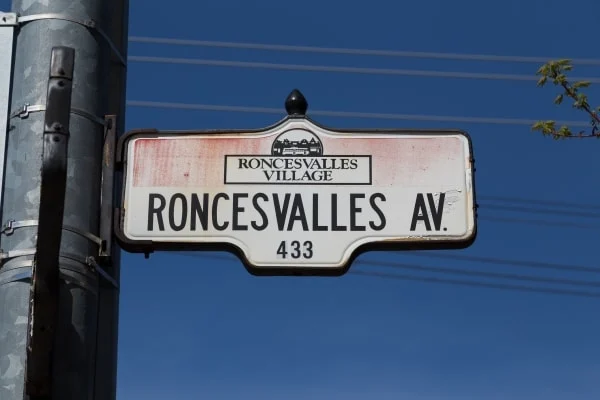
Historically, this is the Polish neighbourhood of Toronto, but within the last decade, Roncesvalles has become something of a haven for creative and hipster types. “Roncy,” as the locals call it, refers to the areas surrounding Roncesvalles Avenue running south from Bloor to King Street West in the west end of Toronto. Roncesvalles is one of the prettier Toronto neighbourhoods, with various independent shops, vintage shops, bars, restaurants, and coffee shops offering plenty of character. As one might imagine, rents have risen in line with Roncy’s popularity, but remains cheaper than Toronto neighbourhoods closer to downtown. One drawback is that it requires a bit of a commute to downtown. Unless you are at the north end of the neighbourhood and can easily get to the Dundas West subway station, you are most likely going to have to trundle downtown on a streetcar, which can be somewhat frustrating as streetcars tend to be very busy, very quickly at peak times.
Kensington
There’s a fiercely independent spirit to Kensington, which sets it apart as one of Toronto’s most unique and iconic neighbourhoods. The web of streets that make up Kensington Market is home to all manner of thrift stores, book shops, cafes, quirky bars, fresh food outlets, and specialty food stores.
Its status as a sanctuary for bohemians makes it attractive for some, but it may be a reason to avoid it as a living destination for others.
Located on the western side of Chinatown between College Street to the north and Dundas Street to the south, Kensington is easily accessible to the downtown core as well as to two frequent streetcar routes: the 505 Dundas to the south, and the 506 College to the north. College Street is also home to an impressive selection of record stores and indie bars for cheap eats, cheap drinks, and late nights out.
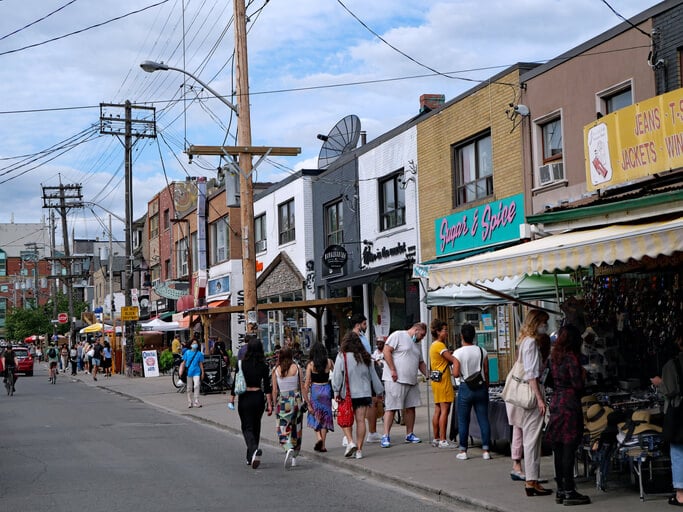
Kensington Market
Little Italy
Little Italy is just past Kensington Market along College Street. Known as a vibrant community with a lively social scene, it has much of the charm of its neighbour but feels a little less rough around the edges.
As you might expect in a traditionally Italian neighbourhood, there are lots of great places to eat, but it’s also one of the best areas in Toronto for a night out as well. The Taste of Little Italy festival, considered one of the best of the city’s many summer street carnivals, takes over the area for a weekend every June.
Little Italy is also a great location to go watch the football (soccer) World Cup or European Championships when they come around every other year. All this combines to make it one of the most exciting Toronto neighbourhoods to call home.
To move around, the 506 College/Carlton streetcar runs east to west through Little Italy, while Line 2 of the subway is about a 15-minute walk north. Only a block north of College is Dundas West, where you will find Little Portugal. Vegetarians will love this strip as there are so many restaurants catering for their needs — even non-vegetarians love the food.
Dovercourt
Dovercourt is especially known for its charming residential streets, which feature a mix of traditional and modern homes, adding to the area’s family-friendly appeal.
The south end of the ‘village’ along Bloor between Ossington and Dufferin is home to indie bars, record stores, and the famous Long & McQuade guitar store. Dufferin Mall will satisfy most of your shopping needs, and for a night out you can jump in a taxi or take the 63 Ossington bus south to the area around Ossington & Dundas to Ossington & Queen, which has one of the best concentrations of nightlife in the city.
Two subway stops service the area; both Ossington Station and Dufferin Station are on Line 2.
Bloordale Village
This neighbourhood features a diverse housing stock, with homes ranging from early 20th-century detached houses to modern condos and renovated townhomes, reflecting a mix of architectural styles and eras. Dufferin Mall has a large Walmart, as well as a number of other clothing stores, and will satisfy most of your weekly shopping needs without having to go too far.
There are subway stations at both Dufferin and Lansdowne, so travelling to other parts of the city can be done quickly and conveniently. There’s also a church right next door to a strip club — a quirky symbol of Toronto’s easy-going and tolerant nature.


West Queen West
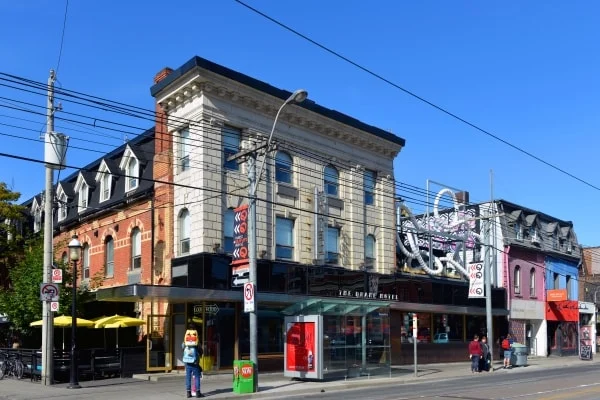
Vogue magazine placed West Queen West second in its list of the coolest neighbourhoods in the world just a few years ago, and it’s got enough boutiques, vintage clothes shops, record stores, and art galleries to back that up. Stretching along Queen Street from Bathurst Street to Gladstone Avenue, the area is also home to Trinity Bellwoods Park, one of Toronto’s most popular hangout spots in the summer months. The area is served by the 501 Queen streetcar, which runs east to west every few minutes during rush hour.
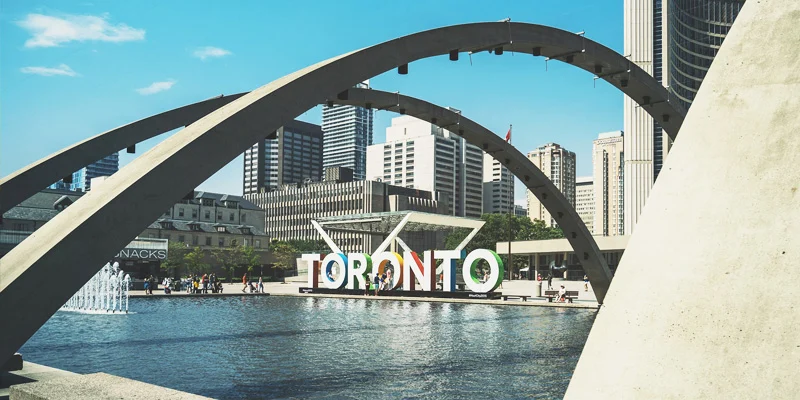
Take on Toronto with confidence!
King West
One of Toronto’s busiest and most energetic areas, King West is for those who truly want to embrace city life. If you want to live here, expect it to be in a condo, and expect to pay upwards of $2,300 for a one-bedroom place.
The area is lined with high-rise apartment blocks, most of which are quite new and impressive, and generally come with a gym and parking available. What you get for your money is a prime location downtown.
Just about everything is convenient, and you will be spoiled for choice in terms of nightlife, restaurants, yoga studios, and gyms, with easy access to events at the Rogers Centre, where the Toronto Blue Jays baseball team play, the Air Canada Centre, and Echo Beach concert venue.
In terms of transit on King Street, the 504 King route has traditionally been one of the city’s most problematic, but a recent decision by the city to restrict traffic has greatly improved journey times. With the TTC adding extra streetcars in 2018, that trend should continue to improve.
Liberty Village
For those seeking the best of city living, Liberty Village offers modern amenities, urban convenience, and a vibrant community atmosphere.
This areas has really emerged as a popular location in recent years, but is somewhat lacking in independent character as franchises move in to the demand for amenities by the growing population. It’s very convenient to the BMO Field where Toronto FC and the Toronto Argonauts play, so expect crowds on game days. It is also well located for a quick commute to the downtown core on the 514 Cherry streetcar, which starts from Dufferin Gate Loop.
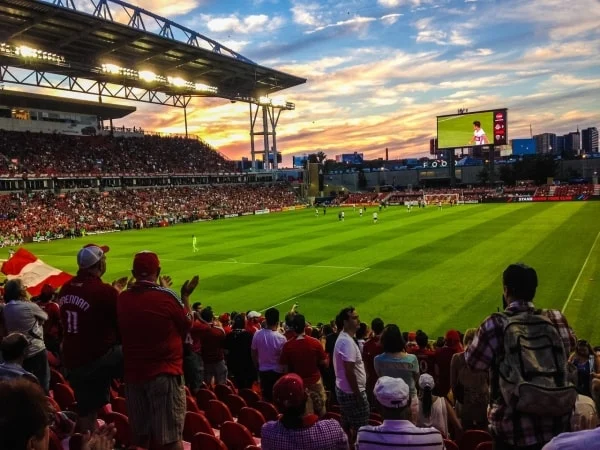
Major League Soccer’s Toronto FC play at BMO Field near Liberty Village.
High Park North
High Park North is a village-type neighbourhood. Locals recognize the region as being a welcome haven away from the hustle and bustle of downtown. This spot is principally residential, made up of high-rise apartments and houses. High Park itself, to the south of the neighbourhood, is one of the biggest parks in North America at 400 acres. Toronto calls itself ‘a city within a park’; its more than 1,600 public parks make up about 13 percent of the city’s land area, a total of 8,000 hectares, and High Park is the largest of them all.
Many have found themselves lost in the expanses of the park, which is home to countless ducks, birds, chipmunks, swans, and squirrels. Tennis courts, baseball diamonds, soccer fields, monuments, Chinese gardens, a labyrinth, a zoo, a cafe, and a pool can all be found here, too.
High Park North is served by the Dundas West, Keele, and High Park stations of the Bloor-Danforth TTC subway line, and it won’t take you longer than 20 minutes to reach downtown Toronto. The TTC also operates local buses out of each station. A downside is that you would have to pay around $30 to get a cab from the downtown core to High Park. Night owls may be doing this more often than planned, as the TTC stops at 2 a.m.
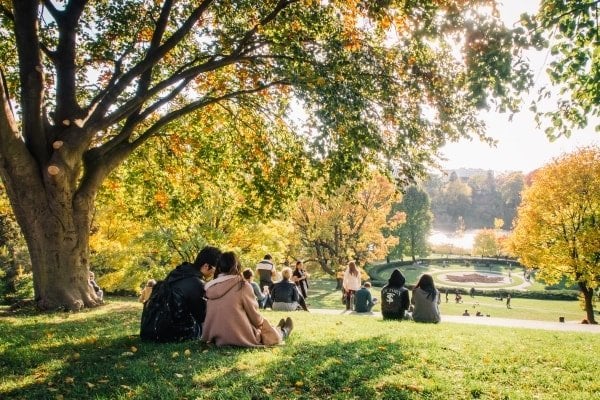
High Park is Toronto's largest park.
Parkdale
Now considered one of the west end’s trendy spots, Parkdale has developed into a desirable neighbourhood having shaken off a bad reputation, which it had until relatively recently. With a diverse population that contributes to its vibrant culture, this community is home to Tibetan, North African, and West Indian enclaves mixed in with some great bars, vintage fashion, and comic book stores. Parkdale is just west of Liberty Village and south of Roncesvalles, and you can get downtown and to the subway lines using the frequent 501 and 504 streetcar lines.
The Junction
Another fashionable part of the west end, The Junction is a historic neighbourhood with a unique character, fighting the tide of gentrification in recent years as its reputation grows.
Home to an excellent bar scene (especially if you like craft beers), but not too lively as to be off-putting, The Junction is popular as both a neighbourhood to call home and as a place to visit and hang out for outsiders.
The Junction is similar in vibe to many of its neighbourhoods, such as Queen West and Roncesvalles, which it borders to the south. Trendy independent food stores and galleries are its calling card, while transit options are another selling point; Keele Station and Dundas West Station to the south will have you downtown in 20 minutes.
Bloor West Village
Bloor West Village is a stretch of road with colourful shops and the ambiance of a local village. There’s a tangible sense of community in Bloor West Village, which is relatively quiet at night compared to some of the surrounding areas. You will find everything you might need and more here. It has schools, bars (both sophisticated and casual), cafes, supermarkets, and restaurants.
Chinatown
Home to Toronto’s thriving and extensive Chinese community, Chinatown is also a more affordable location to find a house close to downtown.
An excellent place to buy your fresh fruit and vegetables, your dollar will stretch further in Chinatown than in most other places. Spadina Avenue is the main thoroughfare through Chinatown, which is serviced by the 510 Spadina streetcar running north/south, while the 505 and 506 streetcars run east/west.
If you’re working downtown, you may even choose to walk from Chinatown and make some savings on transit, while enjoying the sights and scents of the neighbourhood along the way.
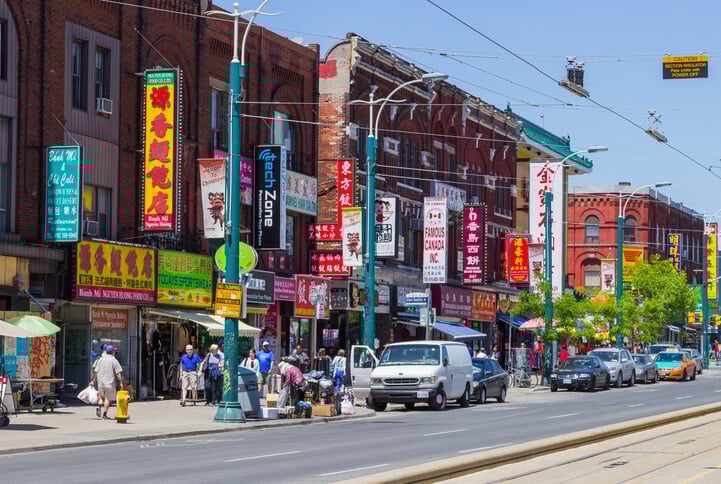
Spadina Avenue in Toronto
2. Neighbourhoods in Downtown Toronto
Yorkville
Yorkville is one of the wealthiest parts of Toronto, known for its luxury real estate that comes with a premium price tag, though there are still some condo buildings in and around Yorkville which may prove to be affordable.
This is where the rich and famous come to shop at the high-end fashion stores such as Gucci, Prada and Louis Vuitton, or sip cocktails at the many high-end hotel bars. Yorkville is also a prime location for celebrity spotting during the Toronto International Film Festival, which takes place every September.
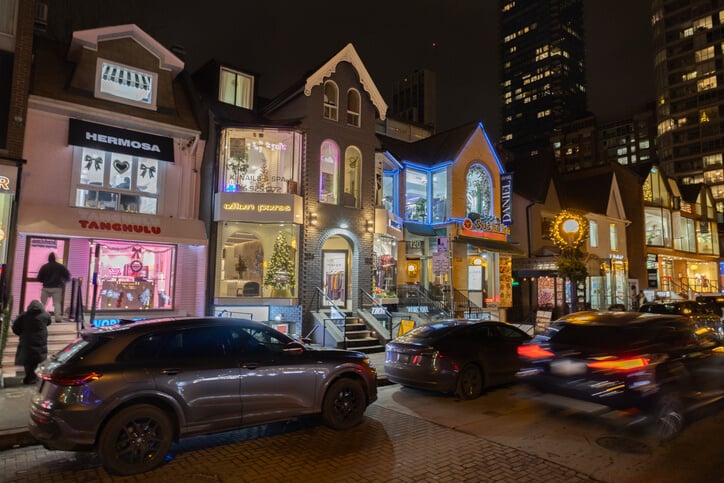
Lights on a street at Toronto Yorkville Village at night.
Downtown Core
More known for banks, office blocks, and shopping outlets than living quarters, the downtown core is also home to Toronto’s Financial District, the city’s central business hub and a key area for commercial activity.
Living right in the very centre of downtown will leave you with convenient access to just about everything you could want, but the living expenses are likely to leave a sizable hole in your wallet.
The downtown core hosts an array of flash restaurants and cocktail bars, the Eaton Centre shopping mall, the Air Canada Centre, St Lawrence Market, Yonge & Dundas Square, the Art Gallery of Ontario, and a wealth of transit options.
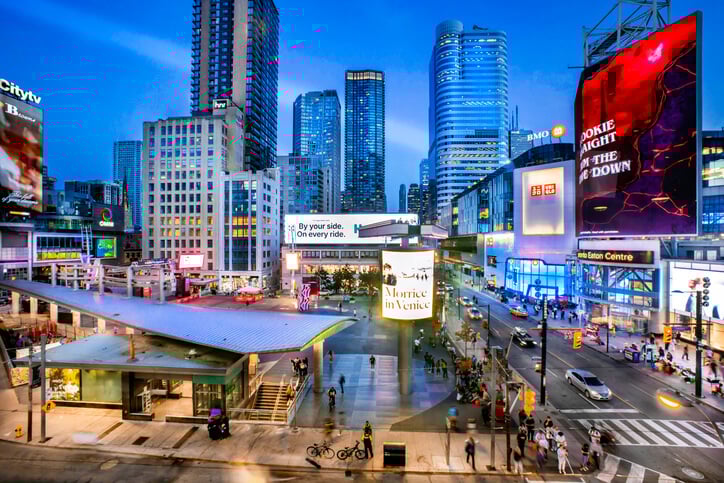
Sankofa Square in downtown Toronto
Fashion District/Entertainment District
This neighbourhood can be very busy, day and night. Renowned for its urban convenience, the area offers easy access to city amenities, transit, shopping, and recreational options, making it highly accessible for residents and visitors alike.
Workers in many of Toronto’s creative industries, agencies, and media companies pack the cafes and streets by day, while after dark, the nightclubs, bars, and restaurants make sure this part of Toronto never sleeps.
Queens Quay & Spadina/Cityplace
Overlooking Lake Ontario, this is quite a picturesque area, ideal for joggers or walking the dog. There are many condo buildings along Queen’s Quay, so it is densely populated.
Many attractions and essential services, such as parks, grocery stores, and cafes, are within walking distance for residents, making daily errands and leisure activities highly convenient.
The 509 and 510 streetcars both run frequently and connect to the subway system and the GO Trains just a few stops east at Union Station.
3. Neighbourhoods in Midtown
Yonge & Eglinton
This midtown Toronto neighbourhood, based around the intersection of Yonge Street and Eglinton Avenue, is well located to quickly travel downtown — you can jump on Line 1 of the subway and be there in 20 minutes. You may not even need to travel too far too often, however, as Yonge & Eglinton has plenty to offer in its own right. While much of the surrounding areas are home to the affluent, there is still affordable accommodation to be found, and the neighbourhood has become quite popular among young Irish and British workers in particular. There are lots of amenities, including the Eglinton Mall and Cineplex, while the area also boasts a wide selection of boutiques and restaurants. It’s possible to have a good night out in this neighbourhood without having to go downtown, which makes it one of the most popular parts of midtown for those in their twenties and thirties.
In terms of transit, the Line 1 subway is convenient for getting downtown or further uptown. The Eglinton Avenue buses (the 32 and the 34) going east and west run very regularly, and the Crosstown LRT — provides exceptional transit access, connecting residents efficiently to other parts of Toronto and making commutes even easier.
Davisville Village/St Clair & Yonge/Mount Pleasant
This relaxed area of midtown is popular among both downtown professionals and families. It’s less pricey than Rosedale and Summerhill to the south, and less busy than Yonge & Eglinton to the north.
Mount Pleasant Road serves as a key corridor and boundary marker, connecting various parts of the neighbourhood and providing easy access to transit and local amenities. The sprawling Mount Pleasant Cemetery divides Davisville and St Clair to the south.
The streets of Davisville are filled with residents walking their dogs or relaxing in the small parks dotted around the area. The Kay Gardner Beltline, a disused railway line, is now transformed into a popular recreational route and green corridor for walking, cycling, and running, connecting parks and defining neighbourhood boundaries. Locals flock to the path in the summer evenings to exercise.
Mount Pleasant East is a peaceful, well-connected neighbourhood in midtown Toronto, appealing to families and professionals who value green spaces and convenient transit options like the nearby Eglinton Crosstown LRT. Housing options in this area include detached houses, condos, and a notable selection of semi-detached homes, offering a blend of privacy and community charm.
Line 1 of the subway will also take you uptown or downtown, with stops in both Davisville and St Clair, while the 512 St Clair street runs westbound from St Clair Station.
Rosedale/Summerhill
These areas are considered among the most affluent in the city, renowned for their historic charm, preserved heritage, and timeless architecture. Beautiful large houses fill the streets intersecting Yonge Street and beyond. Rosedale-Moore Park is recognized for its prestigious homes and abundant green spaces, making it one of Toronto’s most desirable neighbourhoods.
One of the biggest liquor stores in Toronto is situated beside the Summerhill station. Rosedale and Summerhill are Toronto neighbourhoods with plenty of quiet bars, boutique shops, and restaurants interspersed with thriving tennis clubs and parks. One of the best sandwiches in the city is served at Black Camel, next to Rosedale station.
Eglinton West
Also known as Little Jamaica, Eglinton West is a mainly residential neighbourhood, but the businesses that line the Eglinton West thoroughfare have a strong Caribbean character, though locals believe this is fading. The area is well-served by major north-south arteries, which enhance connectivity and provide residents with convenient commuting options throughout Toronto. Like Yonge & Eglinton, the Crosstown LRT construction work along the avenue is the cause of much frustration, but will be a big asset when completed.
Lawrence Park, Lawrence Park North & Bedford Park
These parks are at the quieter, greener end of midtown — and represent some of the most desirable family real estate in Toronto. Lawrence Park proper is one of Toronto’s oldest and most established neighbourhoods, known for its winding streets, mature trees, and large detached homes. Lawrence Park North is recognized for its quiet, tree-lined streets and proximity to the urban core, attracting families and professionals seeking a peaceful yet connected lifestyle. The area also features Alexander Muir Memorial Gardens, a beloved community gathering spot that highlights the neighbourhood’s natural beauty and accessibility. Lawrence Park North shares much of the same character as Lawrence Park but tends to be slightly more accessible in price, attracting families who want the same environment with a bit more breathing room in the budget.
Bedford Park, nestled between the two, earns its reputation as one of Toronto’s most desirable family neighbourhoods. It’s home to several well-regarded public and private schools — including proximity to some of Toronto’s most sought-after institutions — making it a draw for families prioritizing education. Community amenities are strong: local parks, recreational facilities, and a walkable village strip along Avenue Road give the area an unhurried, neighbourly feel. Green space is generous throughout, with easy access to the ravine system that winds through this part of the city.
For newcomer families looking to put down roots in a stable, well-serviced part of Toronto, this northern stretch of midtown is worth serious consideration.
4. Neighbourhoods in East End
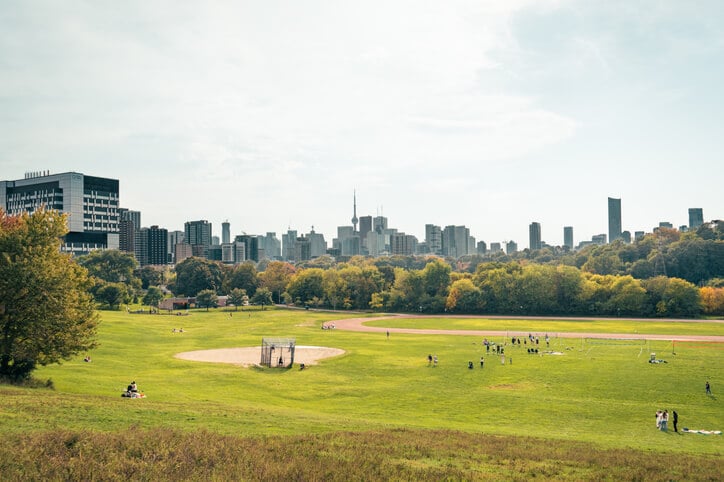
Toronto from the east end, looking over Riverdale Park.
Danforth-Greektown
Again, like many other neighbourhoods in the East End, Danforth-Greektown is one of the safest and most family-friendly neighbourhoods in Toronto. Starting from the east side of the Don Valley Parkway, most of the Danforth as far as Victoria Park is often considered Greektown. The neighbourhood is best known for the annual Taste of Danforth festival, Canada’s largest street festival, which takes over Danforth Avenue from Broadview to Pape for a weekend every August. The area is home to plenty of restaurants, while the bar scene is somewhat more low-key than the west end or downtown, with lots of locals rather than a destination for party-goers.
One big advantage is that Line 2 of the TTC’s subway system runs right through the neighbourhood underneath Danforth Avenue, so transit couldn’t be more convenient. That convenience has made it more popular with young professionals and newcomers to Toronto, but the area retains its Greektown identity nonetheless. The fact that Greektown borders the Don Valley River Park is a huge plus for nature lovers and those who want some respite from the concrete jungle. A short walk south to Riverdale Park will also give you arguably the best vista of Toronto’s skyline.
Leslieville
The ‘cool’ part of the east end. Leslieville, like West Queen West, is a haven for creative types and is filled with independent shops, bars, and restaurants to cater to all manner of niche interests. Centred around Queen Street East, its main transit line is the 501 Queen streetcar. If you’re driving or taking a cab, then you can get downtown quickly on the Lake Shore Boulevard and the Gardiner Expressway. Leslieville is also a very family-friendly neighbourhood.
Little India
Located at the east end of Leslieville, Little India has held on to its authenticity better than most of Toronto’s ethnic neighbourhoods. Naturally, Little India offers top quality Indian food, and the area is renowned for its specialty food shops, which contribute to a vibrant and diverse culinary scene. The Gerrard India Bazaar is worth a visit. Accessible by the 506 Carlton/College streetcar to go east or west, the area is also just a short walk away from Woodbine Park and Woodbine Beach.
Moss Park
Located close to the downtown core, the area surrounding Queen and Sherbourne includes Moss Park, which is officially designated as a Neighbourhood Improvement Area (NIA). This reflects ongoing community development efforts and targeted initiatives to enhance local infrastructure and socio-economic conditions. While the neighbourhood has traditionally had a bad reputation, notorious for drug use and street prostitution, things are getting better, and Moss Park’s profile has noticeably improved over recent years. Rents tend to be lower than many other Toronto neighbourhoods, so don’t rule it out completely (it’s probably not one for young families, though). The 501 Queen Street and 505 Dundas Street streetcar routes operate east-west through Moss Park.
The Village
Based around the Church & Wellesley junction, The Village is the heart of Toronto’s LGBT community and is renowned for being a welcoming community for all residents. Lots of bars and nightclubs line the streets, so it is a lively place to live, particularly for the annual Pride festival in June. The TTC doesn’t have a bus route down Church Street, but it’s just a quick walk over to Yonge Street where you can get on the subway at either Wellesley or College station.
East Chinatown
East Chinatown offers a variety of authentic cuisines and community events. Rents will be cheaper than nearby Leslieville, but you will still be close enough to take in its charms. The 506 streetcar will be your best bet for travelling downtown from East Chinatown.
Cabbagetown
The name dates to the 19th century when struggling Irish immigrants would grow vegetables in the patches in front of the homes that fill this area. Today, Cabbagetown is part of the larger Cabbagetown–South St. James Town neighbourhood, known for its rich history, vibrant community features, and architectural charm. Some of the tree-lined streets of Cabbagetown are among the prettiest in the city, and the area’s cultural vitality and accessibility make it especially appealing. The area around Parliament & Carlton has the feel of a small village, and there are some good restaurant choices as well. The 506 streetcar takes you east and west, while the 65 Parliament bus goes northbound to Castle Frank subway station.
Riverdale
Riverdale is a relaxed residential part of the east end that overlaps somewhat with the western boundaries of Danforth-Greektown. It also borders East Chinatown and Leslieville, so you get easy access to all that Toronto neighbourhoods have to offer as well.
Riverdale is lined with Victorian and Edwardian-style homes, and Riverdale Park is a hive of activity in the summer months. The park hosts softball games, with running clubs also making use of the area. For those with relaxation in mind, Riverdale Park is a great spot to sit on the grassy banks and take in the amazing views.
Riverdale is especially popular with families seeking a relaxed, community-oriented environment, thanks to its green spaces, family-friendly amenities, and welcoming atmosphere. The 504 and 505 streetcars go north and south through Broadview Avenue to Broadview Station, where you can connect to the subway.
Corktown
A quiet residential area to the east of the downtown core, Corktown is a historic neighbourhood with a unique character. Like Cabbagetown, it was an Irish enclave in years gone by.
The frequent 504 King streetcar will have you downtown in less than 10 minutes, while the picturesque Distillery District with its many craft shops is just a few minutes’ walk away.
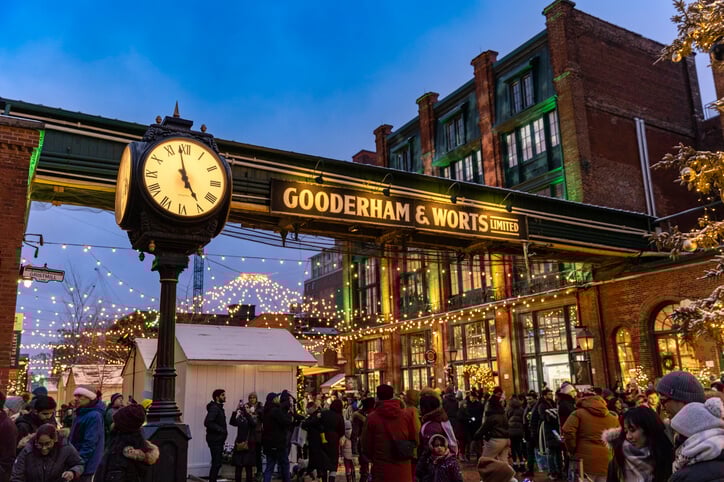
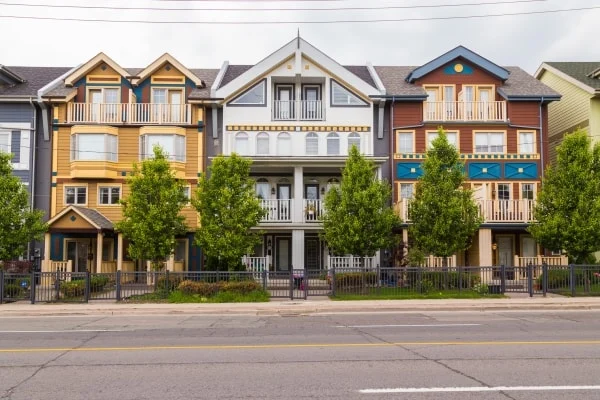
The Beaches
A chilled-out neighbourhood home to many middle-class families, The Beaches is renowned for its relaxed beach-town vibe and unique lifestyle that feels like a vacation year-round.
The area features sandy shores and is especially popular among families and professionals seeking a balance between tranquillity and urban amenities. Woodbine Beach Park, a key recreational space along the lakefront, offers natural beauty, extensive facilities, and hosts community events that contribute to the neighbourhood’s appeal.
The beachfront boasts 3 kilometres of boardwalk, and many parks, schools, and local attractions are within walking distance, enhancing convenience for residents. Public transit is by way of the 501 Queen streetcar.
Houses in The Beaches
5. East York & Danforth Village
East York is one of Toronto’s most welcoming areas for families and newcomers alike. It offers a quieter pace than downtown, with affordable housing options and a strong sense of community that makes settling in feel a little easier.
East York stands out for providing quality homes without the high price tag found in many surrounding neighbourhoods, making it especially attractive for budget-conscious buyers.
The area is well-served by schools, community centres, and local amenities — giving families everything they need within reach. Whether you’re looking for green space, good transit, or a neighbourhood where people actually know their neighbours, East York delivers.
Danforth Village
Danforth Village runs along the iconic Danforth Avenue and is best known for its vibrant food and retail scene, shaped largely by its Greek heritage. Independent restaurants, bakeries, and specialty grocery stores line the street, making it a destination for both locals and visitors. Families will find solid public schools nearby, and the Danforth/Coxwell area has easy TTC access. The neighbourhood also hosts the annual Taste of the Danforth festival, one of Toronto’s most popular street food events.
Woodbine Heights
Woodbine Heights is a quiet, residential pocket sitting just east of Danforth Village. It’s a favourite among young families and is especially popular with families seeking a peaceful, community-oriented environment. The area is known for its detached homes, friendly streets, and proximity to Dentonia Park — a large green space with sports fields and walking trails. Local schools like Woodbine Junior Public School serve the community well, and the nearby East York Community Centre offers fitness programs, youth activities, and newcomer settlement
6. Suburban Neighbourhoods
Some of the surrounding cities lie outside Toronto’s official city limits, but are still considered part of the Greater Toronto Area (GTA). These areas, while beyond the city limits, function as Toronto suburbs or large commuter towns rather than Toronto neighbourhoods per se.
That said, many of these communities are easily commutable from Toronto and, as a result, are extremely popular for families in Toronto and those working in the city.
Vaughan
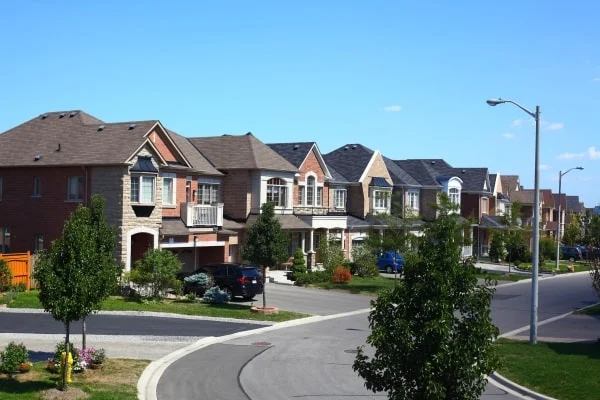
Vaughan is a relatively low-key suburb located just north of Toronto’s city limits. Its population is quickly growing, especially since the extension of the Toronto subway line into Vaughan Metropolitan Center as of December 2017. This growth is expected to continue. The new subway extension makes commuting to downtown Toronto much more convenient, and is one of the main attractions to living in the area compared to other Toronto suburbs in this list. Other attractions in Vaughan include the Canada’s Wonderland Theme Park, Vaughan Mills Shopping Centre, and an IKEA store.
Vaughan is classic North American suburbia.
Scarborough
With some of the cheapest rents among Toronto suburbs, Scarborough tends to be a popular location for new immigrants to settle. As a result, it has tonnes of character and is one of the most diverse and colourful places in the GTA.
It is sometimes known as “Scar-beria” by locals (a reference to Siberia) as it feels somewhat disconnected from Toronto and forgotten about by City Hall; however, there is still plenty of public transit in the area to enable a commute to other parts of Toronto for work, should you choose to settle here.
The TTC’s Line 3 train operates as far as Kennedy Station, where you can switch onto the subway system to travel downtown or to the west end. Some popular attractions in Scarborough include the Toronto Zoo and the beautiful Scarborough Bluffs, which offer stunning views of Lake Ontario and picturesque hiking trails, making it a favourite spot for outdoor enthusiasts.
North York
Encompassing most of uptown Toronto, North York is largely residential and has many micro-neighbourhoods of its own. Access to downtown is convenient via Line 1 of the subway system on either the Yonge side or the University side.
A standout amenity in the area is the North York Central Library, which serves as a major community and cultural hub. The library offers extensive educational resources, community programs, and is a prominent landmark close to other local amenities, making it a focal point for residents.
Etobicoke & Etobicoke West Mall
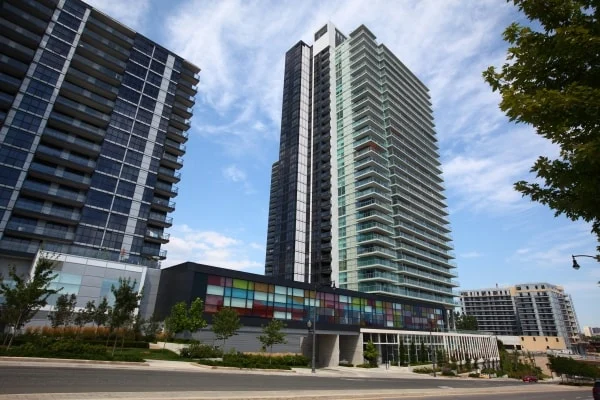
Located on the western edge of Toronto — right before the city gives way to Mississauga — Etobicoke (the “ke” is silent) has a distinctly suburban feel without losing its connection to the city. Tree-lined streets, detached homes, and a quieter pace make it a favourite for families and professionals looking for space. The waterfront along Lake Ontario adds a bonus: parks, trails, and waterfront access that you won’t find in most other Toronto neighbourhoods. The scenic Humber River also runs through parts of Etobicoke, providing beautiful natural spaces and recreational trails that enhance the area’s outdoor appeal.
Getting downtown is easier than the location might suggest. Subway Line 2 runs directly through Etobicoke, with Royal York, Islington, and Kipling stations all within the neighbourhood — making the commute straightforward. It’s also one of the most convenient areas for frequent flyers, sitting just minutes from Toronto Pearson International Airport.
Generally considered a middle-class to affluent area, Etobicoke reflects that in its retail and amenities. The Etobicoke West Mall area anchors everyday shopping needs, with a solid mix of grocery stores, pharmacies, big-box retailers, and local services. It’s practical and well-stocked — the kind of neighbourhood where errands don’t require a long drive.
For newcomers, Etobicoke offers a welcoming balance: accessible transit, a calm residential atmosphere, and proximity to both the city and the airport.
How Do I Choose The Best Neighbourhood?
The right neighbourhood isn’t just about price — it’s about how well it fits your daily life. Here are four things to work through before you decide.
- Match your commute to your work location. Toronto is larger than it looks on a map, and commute times vary significantly by neighbourhood. If you’re working downtown, areas like Midtown, the West End, or East York give you quick subway access. If your workplace is in the suburbs or near the airport, Etobicoke or North York may make more sense. Map out the actual commute — not just the distance — before committing.
- Compare school rankings if you have children. School quality varies across the city, and Toronto has both strong public schools and well-regarded private options. The Fraser Institute publishes annual school rankings for Ontario that are worth reviewing. Lawrence Park, Bedford Park, and parts of North York consistently score well. If schools are a priority, narrow your neighbourhood list around them, especially focusing on sought-after neighbourhoods known for high demand, excellent amenities, and top educational institutions.
- Set a clear budget range before you start looking. Rental and purchase prices shift significantly from one neighbourhood to the next. Knowing your hard limit upfront will save you time and prevent you from falling in love with an area that doesn’t work financially. Factor in transit costs too — a cheaper rent in Scarborough may be offset by a longer, costlier commute.
- Visit at different times of day. A neighbourhood can feel completely different on a Tuesday morning versus a Friday night. Walk the streets, check out the nearest grocery store, and get a feel for the noise level and foot traffic. What reads as “lively” online may feel overwhelming in person — or the reverse.
Further Moving2Canada Resources for Newcomers to Toronto
Getting settled in Toronto is easier with the right information. Here are some Moving2Canada guides to help you take the next step:
- Toronto Neighbourhoods Guide — a deeper look at where to live across the city
- Housing and Mortgage Guide for Newcomers — everything you need to know about renting and buying in Canada
- Newcomer Checklist — a step-by-step guide to getting settled after you arrive
- Moving2Canada Newsletter — sign up for the latest immigration news, housing tips, and newcomer resources delivered to your inbox
Frequently Asked Questions
Which Toronto neighbourhoods are best for families?
Some top Toronto neighborhoods for families include Beaches, Danforth, and High Park, which offer excellent schools and parks.
These areas offer good schools, green space, community centres, and a quieter pace compared to the downtown core. Scarborough is also worth considering for families looking for more space at a lower price point.
How much does housing cost by neighbourhood?
Costs vary widely. As of September 2025, the average home price in Toronto is approximately $1.09 million, reflecting a year-over-year decline of about 5.5%. Renting a one-bedroom in the downtown core or Midtown will generally cost more than the same unit in Scarborough or Etobicoke. Detached homes in areas like Rosedale or Lawrence Park are among the most expensive in the city, while North York and the East End offer more accessible price points. For current figures, check Rentals.ca for rental listings and TRREB for purchase market data.
Which areas have the best transit access to downtown?
Neighbourhoods along subway Line 1 and Line 2 have the strongest downtown connections and offer exceptional transit access. Midtown (Yonge & Eglinton, Davisville, St Clair), the West End, and parts of North York all provide reliable subway access, making commutes efficient and connecting residents to broader Toronto areas. Etobicoke is well served by Line 2, while East York connects via the Bloor-Danforth line. Scarborough has transit access but commutes tend to be longer.
Where should newcomers rent before buying?
Renting first is almost always the right move when you’re new to Toronto. It gives you time to learn the city, understand neighbourhood differences, and make a more informed decision about where to buy. Areas like North York, East York, and parts of Etobicoke offer good rental availability and feature a diverse home types, including apartments, condos, and detached homes from various eras. This variety allows renters to choose from different architectural styles and price points, making these neighbourhoods practical bases to explore the city from.
Use Rentals.ca to browse current listings across all Toronto neighbourhoods.
Related articles
How Much Is Rent in Toronto? Updated for October 2026
Read more

How Much Is Rent in Toronto in July 2026?
Read more
5 Canadian cities ranked among the best in the world
Read more
How to Find a Job in Toronto
Read more
About the author