Updated on September 16, 2026


Multiple Canada's immigration programs use the NOC system to evaluate work experience, job offers, and employment criteria.
This article explains everything about NOC codes and how they are relevant to Canadian immigration.
Starting November 16, 2022, Canada uses the NOC 2021 version of the Occupation Classification System.
Check this article on how the 2021 version compares to the previous 2016 version: Immigration Canada switches to NOC 2021
Overview: The National Occupational Classification System
The National Occupational Classification system is a database developed by the Canadian government. NOC codes categorize every possible occupation a person could have in Canada.
The NOC system categorises jobs and provides information about each job. This includes the job title, duties, responsibilities, and required training.
The NOC system categorizes an occupation and assigns it a five-digit code called the NOC code. Examples of NOC codes include 21231 for software engineers, or 41220 for secondary teachers.
Many different Canadian industries and organisations use NOC codes. Some of the use cases include developing recruitment strategies, conducting research and analysis, and—of course—Canadian immigration. For example, when you create an Express Entry profile, your work experience will only count for points if it is categorised as a skilled occupation.
NOC codes and TEER categories
Certain Canadian immigration programs target prospective immigrants with work experience in certain Training, Education, Experience, and Responsibilities (TEER) categories. For example, all three Express Entry-aligned programs—Federal Skilled Worker (FSW), Federal Skilled Trades (FST), and Canadian Experience Class (CEC)—only accept candidates with “skilled work experience”. But what qualifies as skilled work experience?
What are the TEER categories?
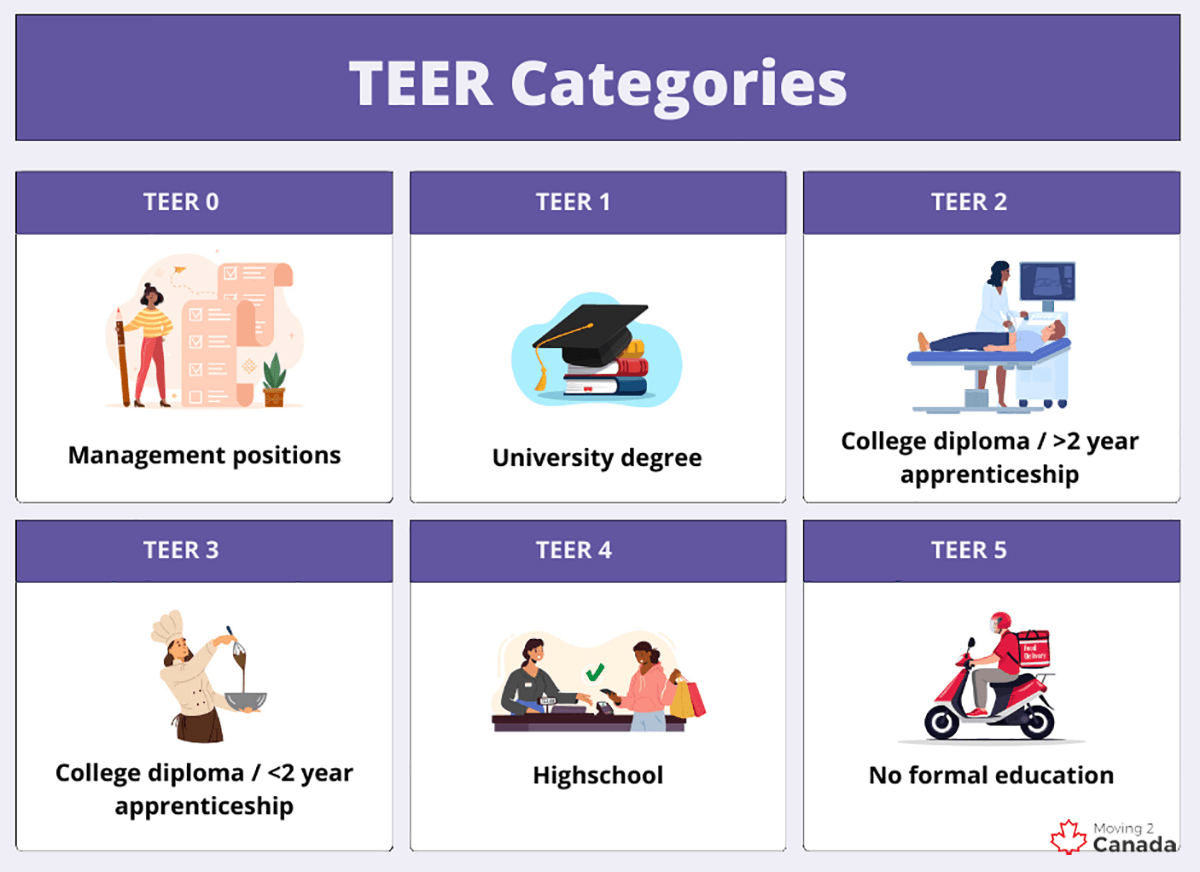
There are a total of six TEER categories:
TEER 0 (zero):
- Management positions across all industries and sectors.
- Examples include: Advertising, marketing and public relations managers, Financial managers.
TEER 1:
- Occupations that usually require a university degree.
- Examples include: Financial advisors, Software engineers.
TEER 2:
- Occupations that usually require a college diploma, apprenticeship training of two or more years, or supervisory occupations.
- Examples include: Computer network and web technicians, Medical laboratory technologists.
TEER 3:
- Jobs that need a college degree, short apprenticeship, or long on-the-job training.
- Examples include: Bakers, Dental assistants and dental laboratory assistants.
TEER 4:
- Occupations that usually require a high school diploma, or several weeks of on-the-job training.
- Examples include: Home child care providers, Retail salespersons and visual merchandisers
TEER 5:
- Occupations that usually need short-term work demonstration and no formal education.
- Examples include: Landscaping and grounds maintenance labourers, Delivery service drivers and door-to-door distributors.
In Canadian immigration, skilled work experience is work experience obtained in TEER categories 0, 1, 2, and 3. Meanwhile, Canada considers work experience obtained in TEER categories 4 and 5 as intermediate- or low-skilled work experience.
NOC Codes and Express Entry
This table shows how the TEER categories are related to the criteria for each Express Entry-managed program.
| Eligibility criteria | Canadian Experience Class | Federal Skilled Worker Program | Federal Skilled Trades Program |
|---|---|---|---|
| Language skills | English or French skills •CLB 7 for TEER 0 or TEER 1 occupations •CLB 5 for TEER 2 or TEER 3 occupations | English or French skills CLB 7 | English or French skills •CLB 5 for speaking and listening •CLB 4 for reading and writing |
| Type/Level of work experience | Canadian work experience in an occupation listed in 1 or more of these NOC TEER Categories: •TEER 0 •TEER 1 •TEER 2 •TEER 3 | Work experience in an occupation listed in 1 or more of these NOC TEER Categories: •TEER 0 •TEER 1 •TEER 2 •TEER 3 | Work experience in a skilled trade under key groups of TEER 2 or TEER 3: •Major Group 72, technical trades and transportation officers and controllers, excluding Sub-Major Group 726, transportation officers and controllers •Major Group 73, general trades •Major Group 82, supervisors in natural resources, agriculture and related production •Major Group 83, occupations in natural resources and related production •Major Group 92, processing, manufacturing and utilities supervisors, and utilities operators and controllers •Major Group 93, central control and process operators and aircraft assembly assemblers and inspectors, excluding Sub-Major Group 932, aircraft assemblers and aircraft assembly inspectors •Minor Group 6320, cooks, butchers and bakers •Unit Group 62200, chefs |
| Amount of work experience | One year in Canada in the last 3 years (either combination of full-time or part-time work) | One year continuous within the last 10 years (combination of part-time, full-time or more than 1 job in your primary occupation) | Two years within last 5 years (either combination of full-time or part-time work) |
| Job offer | Not required. | Not required. But you can get selection criteria (FSW) points for having a valid job offer. | Required: •a valid job offer of full-time employment for a total period of at least 1 year or •a certificate of qualification in that skilled trade issued by a Canadian provincial, territorial or federal authority |
| Education | Not required. | Secondary education required. You can get more selection criteria (FSW) points for your post-secondary education. | Not required. |
How do You Find your NOC Code and Skill Level?
Immigration, Refugees and Citizenship Canada (IRCC) has designed a tool that makes finding your NOC code quick and easy. Just head over to IRCC’s find your NOC code search tool.
You can use the IRCC tool to search for a job match by using words from your job title and related duties. When choosing an NOC code, make sure that the duties and responsibilities listed on the NOC database match the duties and responsibilities that you performed when you held the position.
If you apply for Canadian permanent residence through a skilled worker program (i.e. Express Entry-aligned programs) you will need to submit letters of reference from your current and previous employers. IRCC officers will check the letters to ensure that the duties and responsibilities match those of the NOC code you’ve claimed. Officers will also consider your job title, related education, and salary, to check if your NOC code selection is valid.
If you are worried about choosing the right NOC codes for your current and previous jobs, we recommend talking to an immigration expert. Book a consultation with one of our recommended registered Canadian immigration consultants to get all of your questions answered.

Related Content

Will High-Wage Occupation Points Impact Category-Based Express Entry Draws?
Read more

Could the October 16 CRS Update Push Express Entry Draw Scores Above 530?
Read more
How International Candidates Should Explain Their Immigration Status
Read more

Working Holiday Canada News, IEC Pools and Invitations
Read more
About the author