
Updated on June 12, 2026


The CRS score determines your rank in the Express Entry pool and directly impacts your chances of receiving an Invitation to Apply (ITA) for permanent residence. This guide will help you understand how the CRS works, what a competitive score looks like in 2026, and how to improve your chances of success.

Not sure which immigration program to choose? Take this quiz.
Express Entry and CRS Reforms Are Coming
In April-June 2026, IRCC conducted stakeholder consultations on its proposed plans to unify the three immigration programs under Express Entry into one federal high skilled immigration program. IRCC has also proposed changes to CRS factors and points, some of which could be implemented as early as Fall 2026. Learn more about the proposed Express Entry reforms and how you can prepare your profile for them.
What Is the CRS Score?
The CRS score is derived from the Comprehensive Ranking System (CRS) — a merit-based points system developed by Immigration, Refugees and Citizenship Canada (IRCC). It is used to assess and score Express Entry profiles and to rank candidates in the pool based on their potential to succeed economically in Canada. Points are awarded based on factors such as:
- Age
- Level of education
- Language proficiency in English and/or French
- Work experience (Canadian and foreign)
- Spouse or common-law partner factors (if applicable)
- Additional factors, such as a provincial nomination, Canadian education, or having a sibling in Canada.
Each factor contributes to your total CRS score, which determines you ranking in the Express Entry pool. Candidates with the highest scores are invited to apply for permanent residence during regular draws conducted by IRCC.
Note: IRCC has proposed changes to the CRS point system, which may be implemented as early as Fall 2026. Among proposed changes are the removal of spouse or common-law partner points and points for having a sibling in Canada. Changes may also be made to provincial nomination points.
You Can No Longer Get CRS Points For a Job Offer
Effective March 25th, 2025, and until further notice, Express Entry candidates will no longer receive additional points for having a valid Canadian job offer. Valid job offers are still important in the context of the Federal Skilled Worker Program.
That said, IRCC is currently planning extensive CRS reforms. One proposed change is to bring back points for job offers in high-wage occupations. These reforms will likely be implemented between late 2026 and 2027.
How to Calculate Your CRS Score?
While the Canadian government provides a detailed breakdown of how scores are calculated, there are also free online tools that can help you do it faster—and with more personalized insights.
Below, we explore three methods for calculating your CRS score: using the Moving2Canada CRS Calculator, the official IRCC tool, and a manual calculation for advanced users.
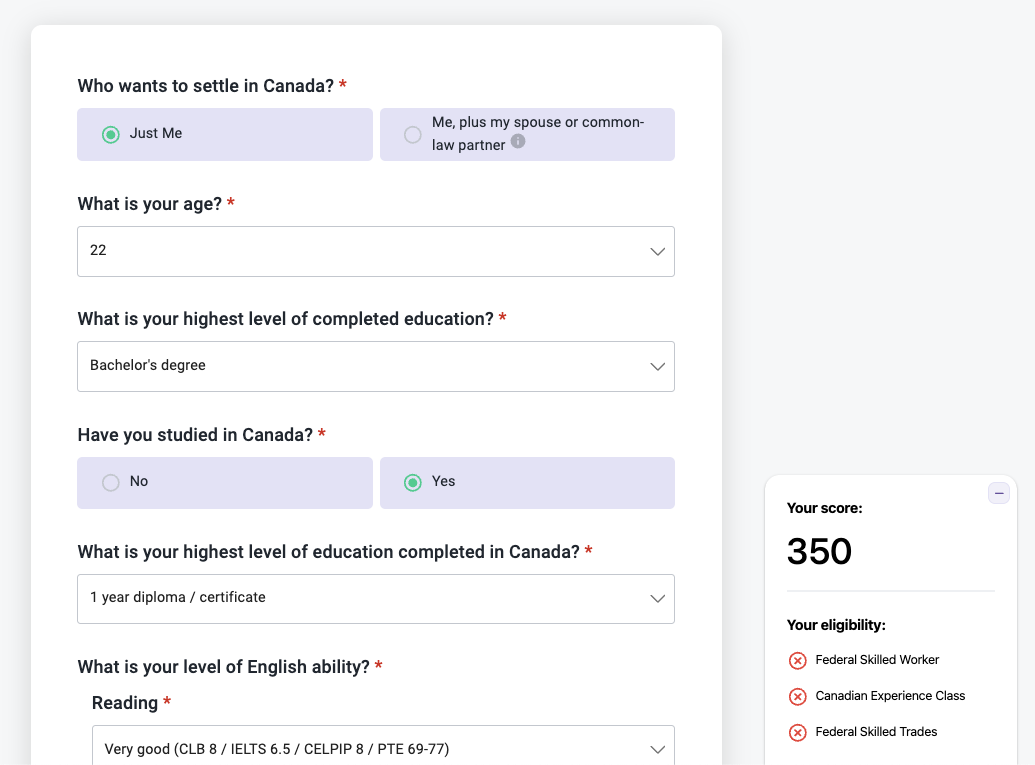
1. Use Moving2Canada Express Entry Score Calculator (Recommended)
Our Express Entry Points Calculator does more than just calculate your score, it helps you understand your immigration options. In addition to your CRS result, this tool goes the extra mile to provide personalized insights, compare your score against past draws, and guide you with confidence through your immigration journey. And the best is that all of this is completely free!
2. Try the Official IRCC CRS Tool
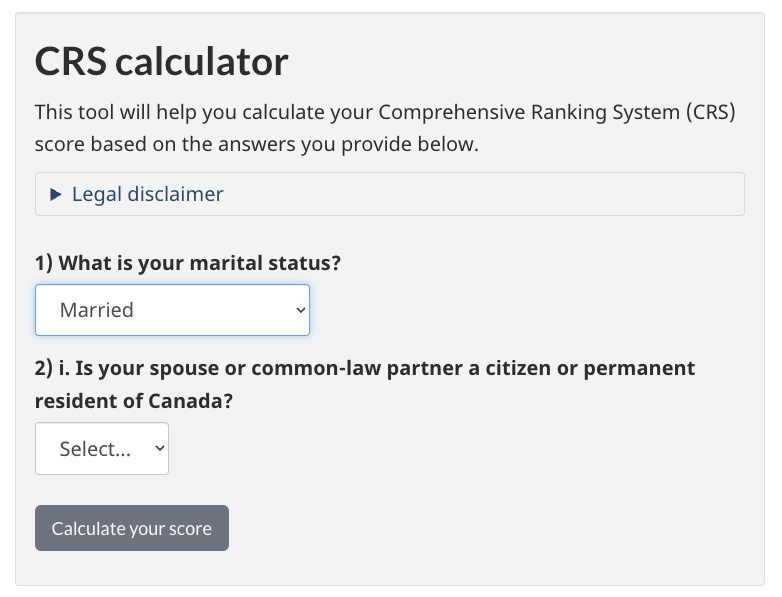
The IRCC CRS calculator is the official government tool for calculating your CRS score. It’s accurate and up to date with current criteria. However, it does not tell you which Express Entry programs you may qualify for, nor does it offer guidance or context. It’s best used alongside more comprehensive tools like Moving2Canada’s.
3. Manual Calculation (For Advanced Users)
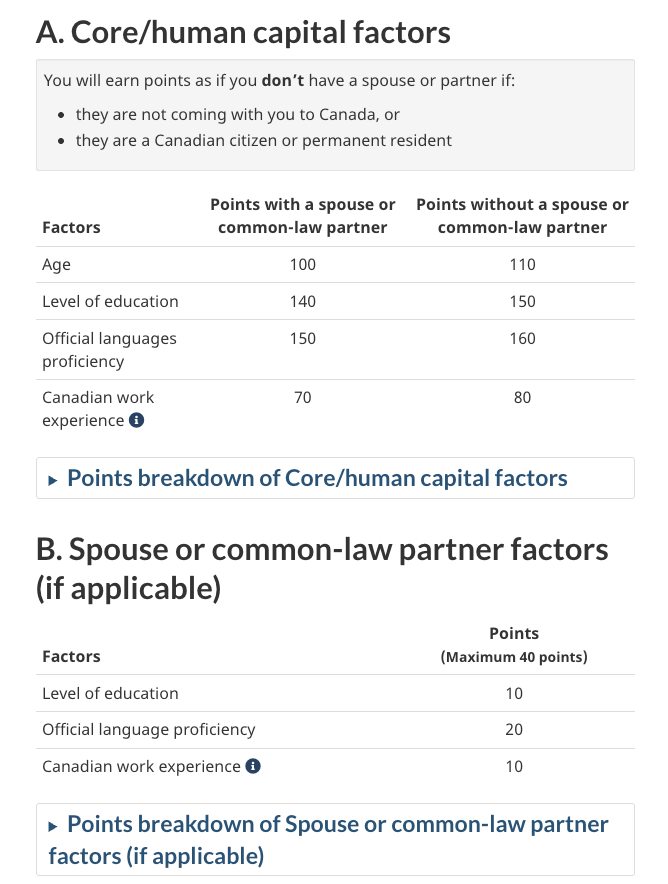
You can also calculate your CRS score manually using the official CRS criteria. This method gives you a deeper understanding of how each factor affects your score. However, it can be time-consuming, complex, and prone to error—especially with changing rules and overlapping categories.
What Is a Good CRS Score in 2026?
A “good” CRS score in 2026 depends on the type of Express Entry Category you’re targeting. For Canadian Experience Class draws, scores above 550 are considered highly competitive. However, category-based draws—such as those for healthcare, trades, or French-speaking candidates—often have lower cut-offs, sometimes starting around 400 or even lower.
If your score is between 400–499, you may still have strong chances, especially with improvements in language test results or through a Provincial Nominee Program (PNP). Scores below 400 might require exploring alternative pathways or boosting your profile with additional credentials or experience.
Not sure where you stand? Use our CRS Score Calculator, to estimate your score instantly. Then, check out our full guide to see what scores were competitive in 2025—and discover actionable tips to increase your chances of receiving an invitation to apply.
How to Increase Your CRS Score?
Your CRS score isn’t fixed, it can be improved with the right strategies. Whether you need a small boost or a major jump, there are both short- and long-term ways to raise your score.
Short-term improvements include retaking your language tests (aiming for CLB 9 or higher) or updating your profile with new work experience.
Long-term strategies might involve pursuing further education, gaining Canadian work experience, or learning French, especially since French proficiency can now unlock additional points and eligibility for targeted draws.
Even though job offer points were removed in 2025, there are still many ways to strengthen your profile. Want a full breakdown of all your options? Read our complete guide on how to improve your CRS score and take control of your Express Entry journey with confidence.
Improve your English and French scores with our partners
Improve Your English
Improve Your French (parlez-vous français?)
Does a PNP Nomination Increase your CRS score?
Yes, a Provincial Nominee Program nomination from an Express Entry-aligned PNP stream will increase your CRS score by 600 points. If an applicant has received a PNP nomination from a non- Express Entry aligned program, they will not get 600 points for their Express Entry profile however, they can apply for Canadian permanent residence a different way, not using the Express Entry system. Either way, a PNP nomination is great!
Note: IRCC’s reforms proposal hints at changes to provincial nomination points. However, as the reforms are only a proposal at present, this is not confirmed and there’s no clarity on what these changes may be.
CRS Score Resources
CRS Score Calculator
Calculate an estimate of your CRS score and determine if you’re competitive for Express Entry.
CRS Score Overview
Get a breakdown of the different CRS score factors here.
How to improve your CRS score
If your CRS score isn’t competitive, you can follow these options to increase it.
Express Entry Draw Results
Find out the CRS score cut-off from the most recent Express Entry draws.
Express Entry Roadmap
Not sure how Express Entry works? We’ll help you out.
Video: CRS score explained

Your FAQs about the CRS score answered
Is CRS expected to drop in 2026?
There is no official CRS score prediction for 2026. Comprehensive Ranking System (CRS) cut-off scores depend on factors such as the number of candidates in the Express Entry pool, immigration targets, and the number of invitations issued in each draw. Category-based draws, including those for transport occupations, can sometimes have different CRS cut-offs than general draws.
Is there a minimum CRS score required to be eligible for Express Entry?
While there’s no fixed minimum CRS score to enter the Express Entry pool, higher scores increase your chances of receiving an Invitation to Apply (ITA) for permanent residence. Scores needed can vary between draws, depending on the targeted categories and the profiles of candidates in the pool.
Can I get PR with a low CRS score?
Yes, it’s possible to get permanent residence with a low CRS score, but it often requires alternative strategies. Candidates with scores below 400 may still qualify through Provincial Nominee Programs (PNPs), which can add 600 points to your profile, or through category-based Express Entry draws that target specific occupations or language skills. Additionally, improving your language test results, gaining more work experience, or studying in Canada can help increase your score over time. If your CRS is low, it’s important to explore all available immigration pathways.
Why is the CRS score so high in 2026?
What CRS score is needed for PR in 2026?
Do I get more CRS points if I apply with a spouse?
Why did some Express Entry profiles see scores drop in 2025?
Latest Updates

About the author