You can tap your phone to pay for groceries, send your share of dinner by e-transfer, meanwhile your subscriptions renew each month like clockwork. It's easy, convenient, and frictionless.
But when paying takes so little effort, it’s easy to lose track of what you’ve spent and what’s left. That’s what I mean by invisible money.
This post explores how invisible money could be hurting your progress towards your goals as a newcomer to Canada, and what you can do about it.
Key takeaways
- Canada’s digital money system can make it hard to understand your spending. This doesn’t mean you’re bad at money.
- You can set up your accounts to help you visualize your spending. Advisors can help with this too.
- Spending just 20 minutes on your money this month could help you feel more in control.
- We’re sharing money tips more often now. Get these insights in your inbox by joining our community – it’s free.
Invisible Money and the Stories we Tell Ourselves
It’s only $12 a month. I can afford it, right?
Probably – but the issue comes when there are five subscriptions at that price, plus your other recurring costs like utilities and rent or your mortgage. Next thing you know, that $12 a month withdrawal is the straw that broke the camel’s back.
Or maybe it’s I’ve got $500 in my account, so I can afford it. That $500 feels different once you remember the bills due before your next payday.
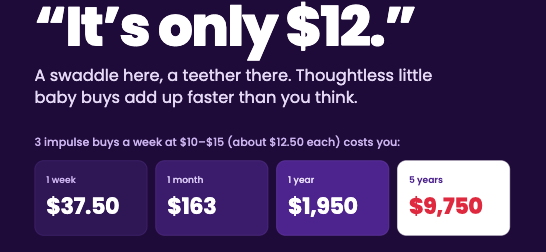
I ran into my own version of this with second-hand baby clothes and toys. I found myself doomscrolling Facebook Marketplace on maternity leave. There was always another listing to look at, and when something was only $10 or $15, sending an e-transfer barely registered. If anything, I was a little smug about it because buying second-hand felt like a smart way to save. And each time I sent a little money, it didn’t feel like it was hurting my progress towards my money goals.
But I was judging each purchase on its own. A $10 box of toys might be a good deal. So might a $15 bundle of baby clothes. The question I kept skipping was how much I was spending on baby stuff altogether.
When the Story Starts to Hurt
The story you tell yourself can change as soon as you see the total. You finally look at your statement, see how much you spent and think, I’m just bad with money. That’s a big leap from a few lines on a screen (we’re often our own worst critics).
The trouble with I’m bad with money is that it can make opening your banking app feel like bracing for bad news. It leaves you feeling powerless, and can often lead to inaction — it’s easier to put it off until payday or until the next bill comes in. In the meantime, you’re making choices with even less information.
What if you thought about it like this instead:
Maybe you spent more than you meant to because you didn’t have visibility into your spending.
Maybe your budget didn’t leave enough room for things your family actually needed.
Those are two different problems with two different solutions.
A more useful story is specific enough to act on. I know what each Marketplace purchase costs. I’m losing track of what I spend on baby stuff over the month. That’s a problem you can do something about.
How to Make Money More Visible
Luckily, there are a few strategies you can use to make your invisible money visible again. Here are some of the strategies I use:
Use cash for some purchases. I honestly find cash a little bit cumbersome (especially since I do my grocery shopping online) – with one exception: Marketplace. I built myself a marketplace budget for baby stuff, got that much cash, and now – if I want to spend more, I need to sell some baby stuff to finance my new purchases. I find it works with marketplace buying because I usually need to go pick up the item anyway, so cash doesn’t add extra friction. But, if you like paying with cash to help you keep track of things, envelope budgeting might be the system for you. Check out our guide to envelope budgeting for more details.
Digital envelopes. With some setup, you can use digital envelopes to keep track of money for certain purposes. I do this for larger ‘optional’ expenses, like trips back home and a renovation fund so I know when we can afford to make certain upgrades to the house. I transfer money to those ‘envelopes’ each month, then decide if I can afford certain things based on the balances of those accounts. I also have dedicated accounts that I contribute to over time for mandatory expenses, like insurance and property taxes.
Separate accounts for wants and needs. For me personally, tracking every single coffee or baked treat doesn’t feel good. When I buy those things, or other ‘feel good’ purchases – or ‘wants’ — (like art at a market), I want to know it won’t hurt my progress towards my goals, that’s it. So, I created a separate ‘wants’ account. I transfer money over there once all my needs and savings/investing goals are taken care of, and then I know I can spend that money (all of it, if I want to) without feeling guilty or tracking every dollar.
You can use online calculators (like this one) or budgeting apps to help you work out the difference between your income and your expenses each month.
Unsure how to set up the accounts you need? Our community gets free access to Scotiabank’s banking advisors. You can book your free appointment here, or learn more about what financial advisors do and how they can help.
20 Minutes Today = Money Progress Tomorrow
That’s how I do it. I’d love to hear how you’re making your money visible. Email me at [email protected] if you’ve got a better tip for our readers.
Otherwise, consider choosing one of the tips from the list above and spend 20 minutes getting it all set up. Then, check in with yourself next month and see how things are going. Do you feel more in control of your money? Are you starting to see how your money decisions go past “can I afford this right now” to “how will this impact my money progress”?
If you’d like tips like this in your inbox, join our community. It’s free, and you can unsubscribe at any time. We’d love to see you there!
🇨🇦
Unlock Your Canadian Future!
Whether it’s finding the best immigration program for you, landing your dream job, or making the most of life in Canada, it all starts with your free Moving2Canada account!
About the author

Stephanie Ford
She/Her
Finance, Law and Immigration Writer
Stephanie is a content creator who writes on legal and personal finance topics, specializing in immigration and legal topics. She earned a Bachelor of Laws and a Diploma in Financial Planning in Australia. Stephanie is now a permanent resident of Canada and a full-time writer at Moving2Canada.
Read more about Stephanie Ford
Citation
Ford, Stephanie.
"The Issue with Invisible Money and How to Make it Visible Again."
Moving2Canada.
Last modified November 18, 2026.
https://moving2canada.com/2026/11/invisible-money-in-canada/.
Copy for Citation




Featured Stories

Immigration • Nov 17, 2026
International Student Arrivals Drop 52 Percent in September 2026
Read more

Immigration • Nov 17, 2026
Canada’s PR Admissions Jump 28% in September, but 2026 Target Remains a Challenge
Read more

Living • Nov 17, 2026
Most Self-Employed Newcomers Don’t Have Private Health Cover
Read more

Finances • Nov 17, 2026
$12.50 for Lettuce? What Canada’s Latest Inflation Numbers Really Mean for Your Wallet
Read more