When you’re in a new (or newish) place, it takes time to learn what groceries, heating and transport usually cost. That can make it hard to tell whether you’re overspending or prices are simply rising.
That’s where Canada’s monthly inflation data can help. It gives you a starting point for checking your bills, spotting costs that need more room in your budget, and finding expenses worth shopping around for.
The latest figures published by StatsCan cover October 2026. Here’s what they mean for your money, and what you can do next.
Key takeaways
- Gas and groceries are getting more expensive in 2026.
- Want an easy win to reduce your costs? Phone plans are getting cheaper, and our partner PhoneBox is offering our community $30 off their first bill and affordable monthly plans.
- Use your own bills to set your budget. A national average won’t match every household.
- We’re sharing more money content for newcomers. Join our community to get these tips and tricks in your inbox.
How we researched this article, and why we wrote it:
We reviewed the data from the StatsCan Consumer Price Index October 2026 Report. We also read other media articles covering the inflation data by industry leaders and banks. Then, we reflected on how the key points from the report apply to our readers, newcomers to Canada, and what value our team’s experience brings.

Save on your phone plan
Exclusive deal on phone plans in Canada
Our partner, PhoneBox, offers Moving2Canada users exclusive deals including $30 off the first payment for your new phone plan.
Check out our deals
What does Canada’s latest inflation report say?
Canada’s Consumer Price Index (CPI) tracks the price of a ‘basket’ of goods and services, including food, housing, and transport. Over time, the CPI captures the changes in prices for common goods and services paid for by Canadian consumers and tells us how quickly life is becoming more expensive.
In October, overall prices were 3.1% higher than a year earlier, matching September’s annual inflation rate. Prices rose 0.2% from September to October.
Here’s what that looks like across some of the common goods and services Canadian consumers buy:
| Expense | Change from October 2025 | Dollar example: yearly change |
| Groceries | +2.0% | A $180 weekly shop → $183.60 |
| Gasoline | +30.9% | $90 gas bill → $117.81 |
| Clothing | +1.8% | A $100 clothing purchase → $101.80 |
| Cell phone services | −6.2% | A $50 monthly plan → $46.90 |
| Accommodation | +1.4% | $2,000 in monthly housing costs → $2,028 |
Examples assume the same quantities of goods or equivalent services, and they’re averages and illustrations, not a direct reflection of your costs. Dashes mean a monthly figure isn’t shown in the StatsCan data.
Grocery Prices: Growing Faster in October 2026
The data tells us that grocery prices jumped in October, after increases slowed in the months prior. Fresh vegetables, sugar and confectionary, and condiments prices rose particularly quickly in October.
Honestly, I was a little surprised to see grocery prices ‘only’ up 2% year-over-year. I noticed just this week while I was shopping that a bulk pack of romaine lettuce had hit $12.50. I vividly recalled it being $9 just a few months ago (and the glory days of it being $5-6 just a few years ago). If you feel the same way, remember that the inflation rate covers a broad range of goods. One item can rise much faster than the headline rate, but others offset this by rising more slowly or even falling.
I order my groceries online so I went ahead and ran a comparison of my grocery totals for 2025 compared to 2026, and it seems my total grocery spending has gone up by around 4.8% year-over-year (though, we have a baby now that we didn’t have last year, so that added increase makes sense).
I looked at some individual items too and that stung a little – for me personally, coffee creamer is up 30% (.90 cents higher), crushed tomatoes are 20% more expensive, and spaghetti squash cost 20% (or $1.14) more too. Avocados were 10 cents cheaper per bag. (These are prices at my local store, and may be different for you.)
So, despite my feelings about lettuce, it seems the 2% year-over-year increase could reflect reality. That said, these figures describe broad price changes. They don’t predict next month’s bills or mean your landlord, supermarket or phone provider will change prices by the same amount.
Gas Prices Jump Year-Over-Year
If filling your tank has become a painful part of your budget, October’s figures help explain why. Gasoline prices were 30.9% higher than a year earlier, even though they fell 2.5% from September.
As an illustration, the same amount of gasoline that cost $90 in October last year would cost $117.81 with that annual increase. That’s almost $28 extra each time you fill up – though this will vary depending on your car size and type and where you live.
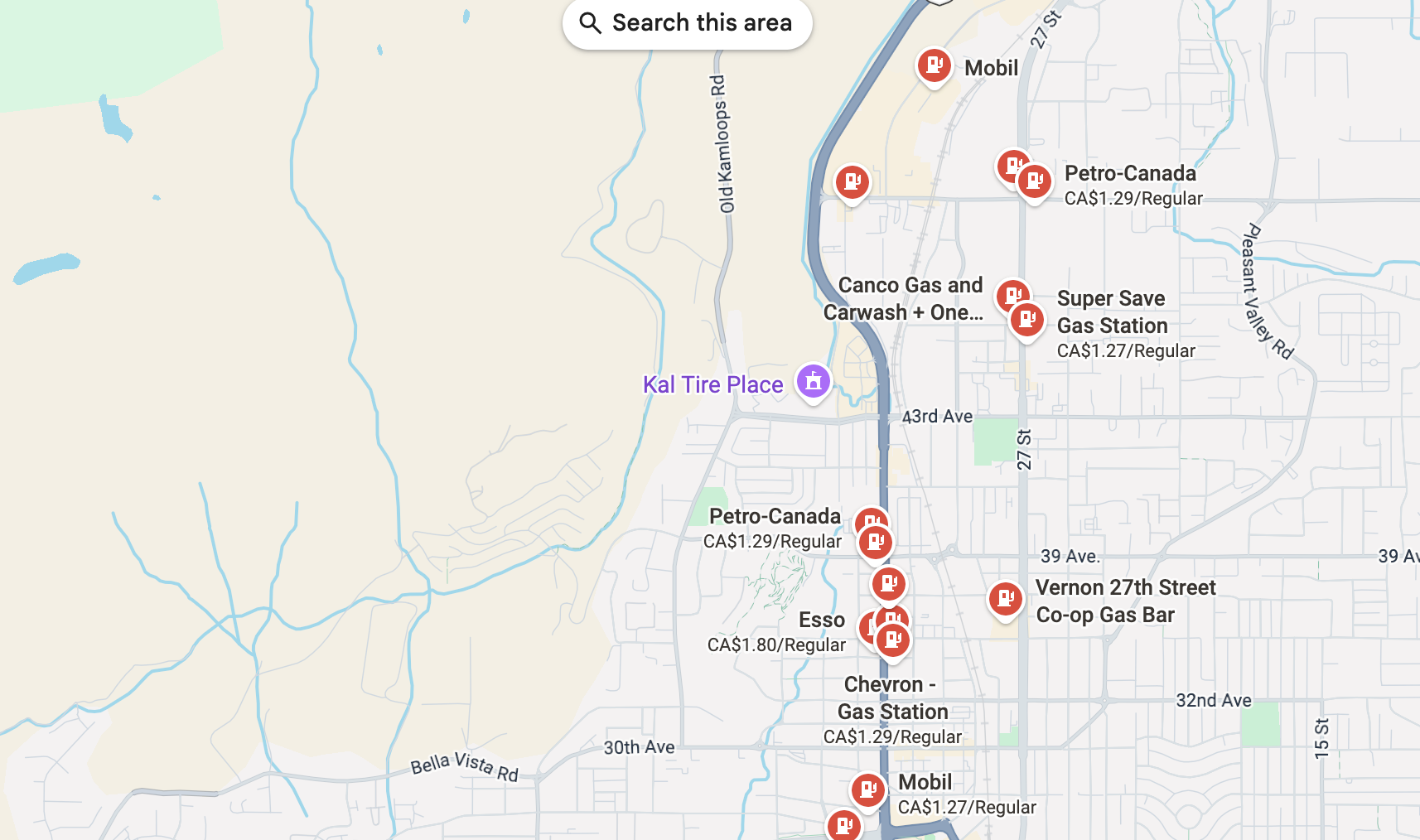
One thing I’ve learned is that gas prices can vary significantly between communities – or even gas stations within the same town. We have a Costco membership in Kelowna and we find that gas costs about 8 cents less per litre at our local Costco gas bar compared to many other gas stations. Today, it’s around $1.49 / litre.
If we look at a nearby town – Vernon – gas is around $1.29 / litre today. Vernon is a 45 minute drive from Kelowna, so I’m not about to start filling the car there regularly. But whenever we happen to drive through, you bet we’re filling the car in Vernon instead.
Oh – and in case you didn’t know, you can check gas prices nearby in Google Maps.
Managing Your Monthly Budget: Your Personal Inflation Rate
A reality is that your experience of inflation depends on how you spend your money.
A household that drives a gas guzzler daily will feel price changes differently from someone who walks to work or works from home or drives an EV.
Statistics Canada has a helpful calculator that can help you understand how your spending impacts your overall costs (with inflation in mind). Here’s what mine looks like, roughly:
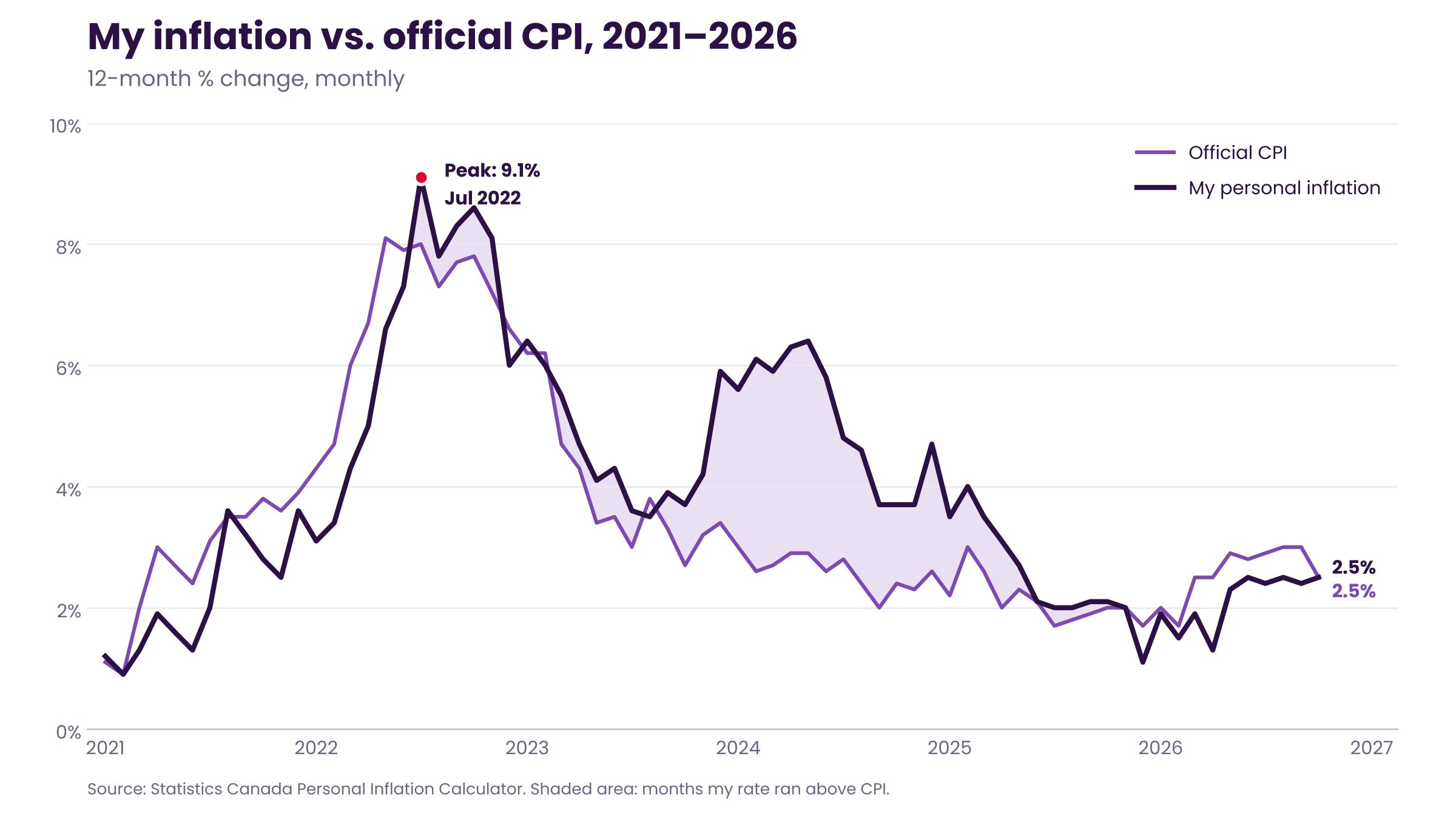
My personal inflation rates are impacted more strongly by housing costs, and less by gas (since we don’t drive as much as a typical household). Travel also hit my inflation rate a little harder than ‘average’ – and I’d guess this is the case for many newcomers. I visit family in Australia when I can (every other year if possible), so rising travel costs weigh more heavily on my inflation rate than it would for someone who travels internationally less frequently.
You can calculate yours at https://www150.statcan.gc.ca/n1/pub/71-607-x/71-607-x2020cal-eng.htm
Our free Budget Calculator for Newcomers is another good resource at this point. It builds an estimate from your city, family size and housing type. You can compare your results to your own bank statements so you can see where your real spending is different.
Quick Win: Check your phone plan
The latest data shows that phone plan prices have dropped recently. So, now is a great time to compare plan pricing, especially if you’re on a month-to-month plan or out-of-contract so there’s no nasty cancellation fees.
If you’re already in Canada, check how much data you use to work out what type of phone plan you need. Then search for plans that meet your needs.
Moving2Canada’s partner, PhoneBox, has 75GB plans for $35 a month (as of November 17, 2026) — and you get $30 off your first month. They’re a trusted partner and they provide multilingual customer support, free Canada-wide calling and international texting, international minutes to 34 countries, and high-speed internet.
Check out our PhoneBox partner offer for an affordable phone plan.
Deeper Dive: Give your grocery budget a reality check
We’ve learned that many people are happy to ‘cut’ their grocery budgets without actually looking under the hood to see what’s going on. It seems easy enough to say, sure I’ll cut $100 off my grocery bill. But, if you keep budgeting $800 for household groceries but regularly spend $900, it’s worthwhile spending some time on what’s driving that gap before saying you’ll make that cut.
Step 1 is to work out what you actually spend, and what you’re buying. If you’re not sure what you spend, keep your receipts for a few weeks, or check your online order history like I did. AI was so helpful for this – it ran the analysis for me in just a few seconds and had plenty of helpful observations.
Then, for your next shop, plan three or four meals around food you already have. Add the missing ingredients to your list, then compare prices for the items you buy most often.
I asked an online AI to compare the costs of the items I buy most often at local grocery stores, and it told me very clearly to avoid the supermarket closest to my home “except for single emergency items”. That was an eye-opening discovery for me!
You can also try flexible swaps where they suit your meals, like frozen vegetables, a different brand, or beans in place of some meat. We do meatless meals multiple times each week and bulk out meaty dishes with beans too, so the meals stretch further.
Finally, be selective about bulk buying. A lower unit price only helps if you can afford the upfront cost, store the food, and use it before it spoils. If you love the bulk price but not the bulk size, see whether a friend or neighbour wants to split it with you. In some cities, newcomer Facebook groups and neighbourhood associations even organize shared Costco runs.
It’s also worth checking whether you qualify for the Canada Groceries and Essentials Benefit (CGEB). Eligible households can get up to $679 a year for a single person or $890 for a couple, plus $234 for each eligible child. The next payment lands on January 5, 2027, and most people who file their taxes don’t need to apply separately.
For more ideas, our guide on how to save money on groceries in Canada goes into a lot more detail.
Budget for the commute you actually make
Run the numbers and see what you’re actually spending on transport each month (by checking your bank statements). If you drive, I’d suggest including parking and the occasional extra trip, as well as your insurance, loan payments, and maintenance costs, rather than only counting gas for the drive to work.
Then, consider whether the money you’re spending on transport fits into your budget.
As a general rule, try to keep your total transport costs under 15% of your monthly income, and treat 20% as an absolute upper limit.
At or around 15%, I would move to other parts of the budget to see where to cut costs. But, higher than that, it might be worth seeing what changes are possible.
Some easy places to start are combining errands, sharing a regular trip, or taking transit for the journeys where it makes sense. If those changes won’t bring your transportation costs down, it might be time to consider some harder changes – like downgrading to a cheaper vehicle or seeing if you can make do without owning one.
Make one change this week
You don’t need to rebuild your whole budget every time new inflation figures come out. Just choose one task, like comparing phone plans or reviewing your grocery receipts, and make a change this week.
Got a money tip you’d like to share with our team? Reach out to [email protected] to share yours. We would love to feature it!
Need more information like this?
Our email community gets helpful money tips each week. Join 180,000 other newcomers that get all the latest information from us to settle successfully in Canada.

Latest Updates

About the author

Stephanie Ford
She/Her
Finance, Law and Immigration Writer
Stephanie is a content creator who writes on legal and personal finance topics, specializing in immigration and legal topics. She earned a Bachelor of Laws and a Diploma in Financial Planning in Australia. Stephanie is now a permanent resident of Canada and a full-time writer at Moving2Canada.
Read more about Stephanie Ford
Citation
Ford, Stephanie.
"$12.50 for Lettuce? What Canada’s Latest Inflation Numbers Really Mean for Your Wallet."
Moving2Canada.
Last modified November 17, 2026.
https://moving2canada.com/2026/11/latest-inflation-numbers-meaning/.
Copy for Citation

Featured Stories

Work • Nov 13, 2026
What International Candidates Get Wrong About Salary Expectations
Read more

IEC • Nov 13, 2026
When does the IEC 2027 Season Open?
Read more

Express Entry • Nov 12, 2026
Tips from an Outland French Speaker on Succeeding in Express Entry
Read more

Immigration • Nov 12, 2026
2027–2029 Francophone Immigration Targets: How Many French-Language Express Entry ITAs Will Canada Issue?
Read more