Canada's permanent residence (PR) admissions jumped nearly 28 percent in September 2026, reaching their highest monthly level of the year.
According to the latest Immigration, Refugees and Citizenship Canada (IRCC) data, Canada admitted 35,480 new permanent residents in September, up from 27,800 in August.
This brings total admissions under the Immigration Levels Plan to approximately 252,200 during the first nine months of 2026, or 66.4 percent of the 2026 target of 380,000.
With just three months remaining, Canada will need to admit another 127,800 permanent residents to meet its target.
Separately, two one-time initiatives have granted permanent residence to another 57,900 people already living in Canada. These admissions are additional to the regular Immigration Levels Plan targets.
Key Takeaways
- September PR admissions jumped 28 percent to 35,480, the highest monthly figure of 2026.
- Canada has reached 66.4 percent of its 2026 PR target, with 252,200 admissions.
- Economic immigration is lagging, while family sponsorship is slightly ahead of schedule.
- Another 57,900 people received PR through two one-time initiatives, counted separately from the Immigration Levels Plan.

Live Webinar - Ask Us Anything
Ask Us Anything Live on November 20
Join RCIC Rebecca Major and the Moving2Canada team to discuss all things immigration and life in Canada, live. We'll be answering your questions live too, so don't miss out.
Get Notified When We're Live
September PR Admissions Reach Highest Level of 2026
Canada admitted 35,480 permanent residents in September, an increase of 7,680, or 27.6 percent, compared with August.
This reversed the 15 percent decline seen in August and made September the strongest month for PR admissions so far this year.
Admissions were also 5.4 percent higher than in September 2025. However, they were still 4.5 percent below September 2024, when 37,145 people became permanent residents.
Here’s how monthly admissions compare over the past three years.
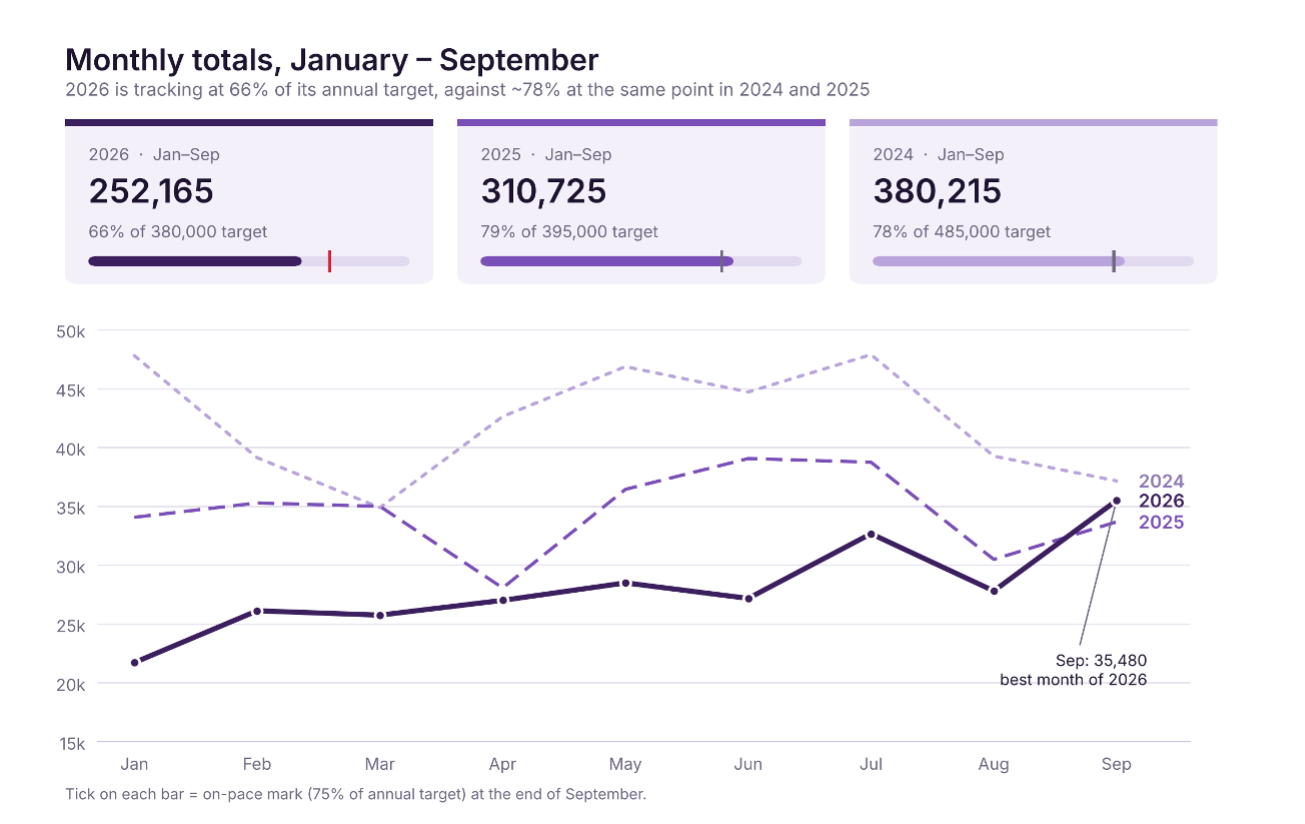
Source: IRCC. Figures exclude admissions through the two one-time initiatives.
While September’s increase is encouraging, the broader trend shows that Canada is admitting fewer permanent residents than it did during the peak immigration years of 2023 and 2024.
This reflects the federal government’s decision to reduce immigration levels and stabilize annual admissions.
Canada Has Reached 66 Percent of Its 2026 PR Target
Canada’s 2026–2028 Immigration Levels Plan sets a target of 380,000 new permanent residents in 2026.
By September 30, approximately 252,200 people had received permanent residence under the plan. That’s 66.4 percent of the annual target, even though 75 percent of the year has passed.
Here’s how each immigration category is performing.
| Immigration category | 2026 target | Jan–Sept admissions | Percent of target | On Track? |
|---|---|---|---|---|
| Economic | 239,800 | 149,800 | 62.5 percent | No |
| Family | 84,000 | 66,600 | 79.3 percent | Yes |
| Refugees and protected persons | 49,300 | 30,200 | 61.3 percent | No |
| Humanitarian & Compassionate and Other | 6,900 | 5,600 | 81.2 percent | Yes |
| French | 30,150 | 19,800 | 65.7 percent | No |
| Total | 380,000 | 252,200 | 66.4 percent | No |
Source: IRCC. Figures are rounded. French-speaking admissions outside Quebec are included within the other immigration categories and are not additional to the total.
Economic Immigration Is Picking Up, But Still Behind Target
Economic immigration accounts for approximately 63 percent of Canada’s PR target in 2026.
This category includes Express Entry, Provincial Nominee Programs (PNPs), the Atlantic Immigration Program, and other economic immigration pilots.
By September 30, Canada had admitted approximately 149,800 economic permanent residents, reaching 62.5 percent of its annual target of 239,800.
The good news is that admissions are picking up. Canada admitted approximately 22,700 economic permanent residents in September, up from 17,500 in August and 20,400 in July.
However, there’s still a considerable gap to close.
To meet its target, IRCC would need to admit another 90,000 economic permanent residents in the final three months. That’s an average of 30,000 per month, considerably higher than September’s figure.
While the recent increase is encouraging, economic immigration admissions will need to accelerate further for Canada to meet its 2026 target.
French-Speaking PR Admissions Reach 66 Percent of Target
Canada is also slightly behind schedule on its Francophone immigration target.
Between January and September 2026, approximately 19,800 French-speaking newcomers received permanent residence outside Quebec. This brings admissions to 65.7 percent of the annual target of 30,150.
To meet its goal, IRCC would need to admit another 10,350 French-speaking permanent residents in the final three months of the year. We expect that IRCC will hit this particular target, given that 30,500 ITAs were issued to Francophone candidates in the first half of 2026.
Looking ahead, Canada is increasing its Francophone immigration targets outside Quebec to 9.5 percent in 2027, 10.5 percent in 2028 and 12 percent in 2029.
French-language proficiency is likely to remain an important advantage for prospective immigrants in the coming years. Most of these admissions are expected to come through French-language category-based Express Entry draws.
Family Sponsorship Is Ahead of Schedule
Canada admitted approximately 66,600 permanent residents through family sponsorship programs between January and September. This brings admissions to 79.3 percent of the annual target of 84,000.
This puts family sponsorship slightly ahead of schedule.
Family sponsorship admissions increased to approximately 7,500 in September, up from 6,200 in both July and August.
IRCC would need to admit another 17,400 family class permanent residents in the final three months, or an average of 5,800 per month, to meet its target.
Looking ahead, Canada’s 2027–2029 Immigration Levels Plan reduces the annual family sponsorship target to 81,000 for 2027. However, a time-limited initiative will allow up to 45,000 additional spouses, common-law partners and dependent children to transition from temporary to permanent residence in 2027. Overall, we may see an increase in PR admissions under this category next year.
Refugee and Humanitarian Admissions Show Mixed Progress
Canada admitted approximately 30,200 permanent residents through the refugees and protected persons category during the first nine months of 2026.
That’s 61.3 percent of the annual target of 49,300. Another 19,100 admissions are needed by year-end to achieve the 2026 target.
Meanwhile, the Humanitarian & Compassionate and Other category has reached 81.2 percent of its target, with 5,600 admissions against an annual goal of 6,900.
For 2027, the government plans to maintain the refugee and protected persons target at 49,300, while reducing the Humanitarian & Compassionate and Other target to 5,000.
57,900 People Received PR Through One-Time Initiatives So Far This Year
Canada also granted permanent residence to another 57,900 people through two one-time initiatives between January and September 2026.
These admissions are separate from the annual PR target of 380,000.
In-Canada Workers Initiative: 17,400 Admissions from January to September 2026
This initiative aims to transition 33,000 eligible workers to PR over 2026 and 2027, including at least 20,000 in 2026.
By September 30, approximately 17,400 workers had received PR, reaching 87 percent of the 2026 target. This includes 2,300 admissions in September.
With only 2,600 admissions remaining, the initiative appears on track to meet its target.
Protected Persons Initiative: 40,500 Admissions from January to September 2026
This initiative aims to grant PR to up to 115,000 eligible protected persons and their in-Canada dependants over two years, including 46,000 in 2026.
By September 30, approximately 40,500 people had received PR, reaching 88 percent of the annual target. September alone accounted for 9,280 admissions.
Combined with the regular Immigration Levels Plan, these initiatives bring Canada’s total PR admissions to approximately 310,100 in the first nine months of 2026.
Note: These two initiatives are separate from the time-limited PR measure announced in Budget 2026, which aims to grant permanent residence to up to 200,000 additional people in 2027.
Can Canada Still Meet Its 2026 PR Target?
September’s increase is encouraging, but Canada still has considerable ground to make up.
To reach 380,000 admissions, IRCC needs another 127,800 permanent resident admissions between October and December.
That’s an average of 42,600 per month, roughly 20 percent higher than September’s figure, which was already the strongest month of 2026.
If Canada maintains September’s pace for the rest of the year, it would finish with approximately 358,600 admissions, more than 21,000 short of its target.
However, the 2026 Immigration Levels Plan includes a lower admissions range of 350,000. This means Canada could still finish within its planned range without reaching the central target.
A stronger finish is also possible, particularly as IRCC processes applications from the record-breaking number of candidates invited through Express Entry earlier in the year.
What Lies Ahead for Permanent Residence in 2027?
Canada’s new 2027–2029 Immigration Levels Plan maintains the annual PR target at 380,000, but changes how those spaces are distributed.
Economic immigration will account for a larger share of admissions. However, the plan puts growing emphasis on regional immigration programs (PNP, Atlantic Immigration Program, and the Rural Community Immigration Program) rather than federal high-skilled immigration through Express Entry.
This shift reflects the government’s focus on addressing labour shortages in specific provinces and communities. It will also help temporary residents already working in Canada transition to permanent residence.
Beyond the regular PR target, existing one-time initiatives will continue in 2027, alongside a new time-limited measure offering up to 200,000 additional PR spaces, primarily to process existing applications.
If you’re hoping to become a permanent resident in 2027, this means where you live and work could become increasingly important. Provincial nominee programs and regional immigration pathways may offer more opportunities, particularly if your skills match local labour market needs.
However, with fewer spaces allocated to federal high-skilled immigration, competition through those pathways could remain intense.

About the author

Sugandha Mahajan
She/Her
Content Marketer
Born and raised in New Delhi, India, Sugandha moved to Canada as a permanent resident in early 2020, just weeks before the pandemic shut everything down. She has first-hand experience with many common newcomer challenges, including navigating the Express Entry system, finding a job without Canadian experience, and figuring out small talk. To deepen her understanding of the field, she is currently pursuing a Graduate Diploma in Immigration & Citizenship Law at Queen’s University.
Read more about Sugandha Mahajan
Citation
Mahajan, Sugandha.
"Canada’s PR Admissions Jump 28% in September, but 2026 Target Remains a Challenge."
Moving2Canada.
Last modified November 17, 2026.
https://moving2canada.com/2026/11/canada-pr-admissions-jump-28-percent-in-september-2026-target-remains-challenge/.
Copy for Citation




Featured Stories

Immigration • Nov 17, 2026
International Student Arrivals Drop 52 Percent in September 2026
Read more

Living • Nov 17, 2026
Most Self-Employed Newcomers Don’t Have Private Health Cover
Read more

Finances • Nov 17, 2026
$12.50 for Lettuce? What Canada’s Latest Inflation Numbers Really Mean for Your Wallet
Read more

Work • Nov 13, 2026
What International Candidates Get Wrong About Salary Expectations
Read more