Receive emails from Scotiabank to provide you with tools, resources, and advice to guide you through your banking journey as you settle into your new life.
Receive emails from Scotiabank to provide you with tools, resources, and advice to guide you through your banking journey as you settle into your new life.
Receive emails from Scotiabank to provide you with tools, resources, and advice to guide you through your banking journey as you settle into your new life.
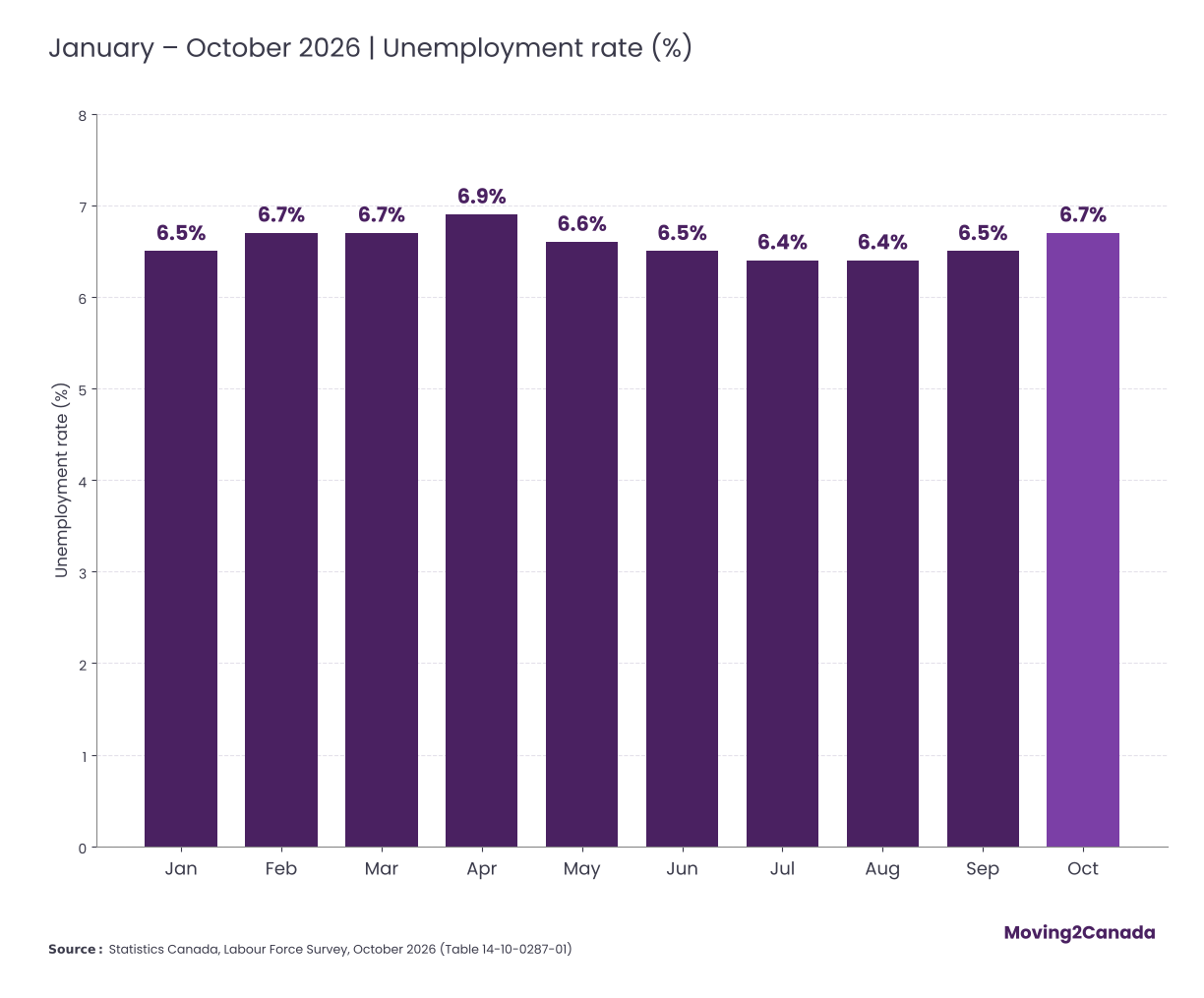
Canada's unemployment rate rose to 6.7% in October, up from 6.5% in September. That's the second monthly increase in a row, and the highest rate since April. Here's what's going on in Canada's job market.
Statistics Canada’s latest Labour Force Survey shows that the jump in unemployment wasn’t driven by job losses this time. Instead, more people started looking for work (33,000 more job seekers) and didn’t find it. Economists had been expecting a modest rebound of around 13,600 jobs, so this month’s result is another disappointment. Canada has now lost around 46,000 jobs since the start of 2026.
That said, 6.7% is still below the 2026 high of 6.9% we saw in April, and down slightly from October 2025 (6.9%).
Key Takeaways
Unemployment rate: 6.7 percent, up 0.2 percentage points from September 2026.
Employment: Little changed in October (-4,700), following losses of 68,000 in September and 42,000 in August.
Wages: Average hourly wages up 2.2 percent year-over-year to $37.89.
Industries seeing gains: Construction (+16,000) and educational services (+15,000).
Industries seeing losses: Wholesale and retail trade (-29,000) and transportation and warehousing.
Provincial employment changes: Employment increased in British Columbia and Newfoundland and Labrador. It fell in Alberta and Prince Edward Island.
Next release: The November 2026 labour market report is likely to be released on December 4, 2026. We’ll update this page following that release. If you want to get that update in your inbox, join our email community.
One glimmer of good news in Canada’s job market is that, on the whole, most people are very satisfied (rating it 8 or higher out of 10) with their jobs.
Dissatisfaction seems to be driven (or at least correlated with) lower wages, which makes sense given Canada’s relatively high cost of living. It was concentrated among sales and service workers, who have the lowest average hourly wage of any broad category of workers in Canada.
The Job Market in Canada’s Provinces in October 2026
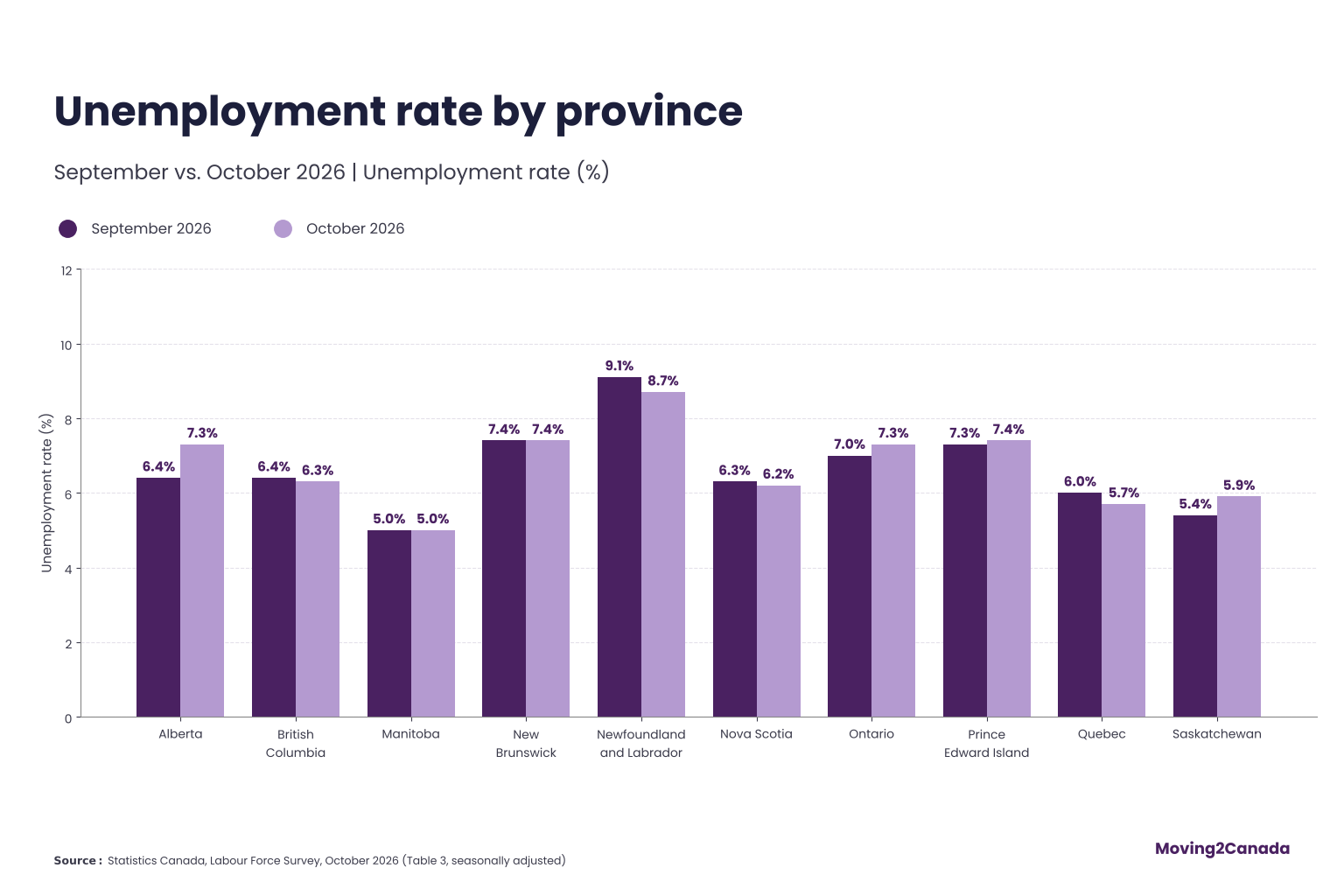
Alberta, which has been Canada’s job creation engine for most of 2026, lost 24,000 jobs in October, almost exactly reversing its September gain. Its unemployment rate jumped 0.9 percentage points to 7.3%, the biggest increase of any province. Even so, employment in Alberta is still up by 41,000 compared with a year ago, and one bad month doesn’t make a trend – so watch this space for future updates on the market in Alberta.
British Columbia went the other way, adding 12,000 jobs after losing 20,000 in September. Newfoundland and Labrador added 2,900 jobs, and its unemployment rate dropped from 9.1% to 8.7%. Prince Edward Island lost 1,300 jobs.
Ontario’s unemployment rate rose to 7.3%, up 0.3 percentage points, as more people searched for work. Employment there has now been flat for three months in a row. Saskatchewan’s rate also rose, from 5.4% to 5.9%.
Quebec is a good reminder that unemployment rates alone don’t tell the whole story. Quebec’s unemployment rate fell from 6.0% to 5.7% — but that’s because fewer people were looking for work, not because of an increase in jobs. Employment in Quebec held steady in October after losing 68,000 jobs across August and September, and it’s down 106,000 jobs compared with a year ago.
Provincial Unemployment Rates Across Canada in September 2026
Here are the provincial unemployment rates from Statistics Canada’s October 2026 Labour Force Survey:
Alberta: 7.3 percent
British Columbia: 6.3 percent
Manitoba: 5.0 percent
New Brunswick: 7.4 percent
Newfoundland and Labrador: 8.7 percent
Nova Scotia: 6.2 percent
Ontario: 7.3 percent
Prince Edward Island: 7.4 percent
Quebec: 5.7 percent
Saskatchewan: 5.9 percent
Changes in Provincial Unemployment from September to October 2026
A Snapshot of Job Gains and Losses
After four months of public sector job losses, the trend reversed this month. Public sector employment rose by 50,000 in October, while the private sector lost 53,000 jobs — its first decline since February. Compared with a year ago, public sector employment is still down 70,000, while the private sector is up slightly.
The biggest losses were in wholesale and retail trade, which shed 29,000 jobs in October. This industry has been trending down for a while, with 113,000 fewer jobs than a year ago, mostly in Ontario, Quebec and BC. This is worth knowing if you’re a newcomer counting on a retail job as a first step into the Canadian job market — competition for these roles is likely to be tougher.
There was better news in construction, which added 16,000 jobs in October and is up 47,000 jobs over the past year. That’s consistent with what we’re hearing from our sister company, Outpost Recruitment.
Educational services recovered 15,000 jobs in October, after losing 35,000 in September. But the sector is still down 48,000 jobs compared with a year ago, which likely reflects the significant decline in international students studying in Canada.
Young workers aged 15 to 24 had a tough month, with the youth unemployment rate rising to 13.7% (up 0.7 percentage points). For students in this age group, the unemployment rate was 13.5%. Newcomers in this age bracket — including international students looking for part-time work — should expect a competitive market. As we’ve noted before, IEC participants targeting seasonal roles, like those at ski resorts heading into winter, tend to face less competition in our experience.
For core-aged workers (25 to 54), unemployment held steady at 5.8% for men and 5.3% for women. Unemployment for people aged 55 and older edged up to 5.5%.
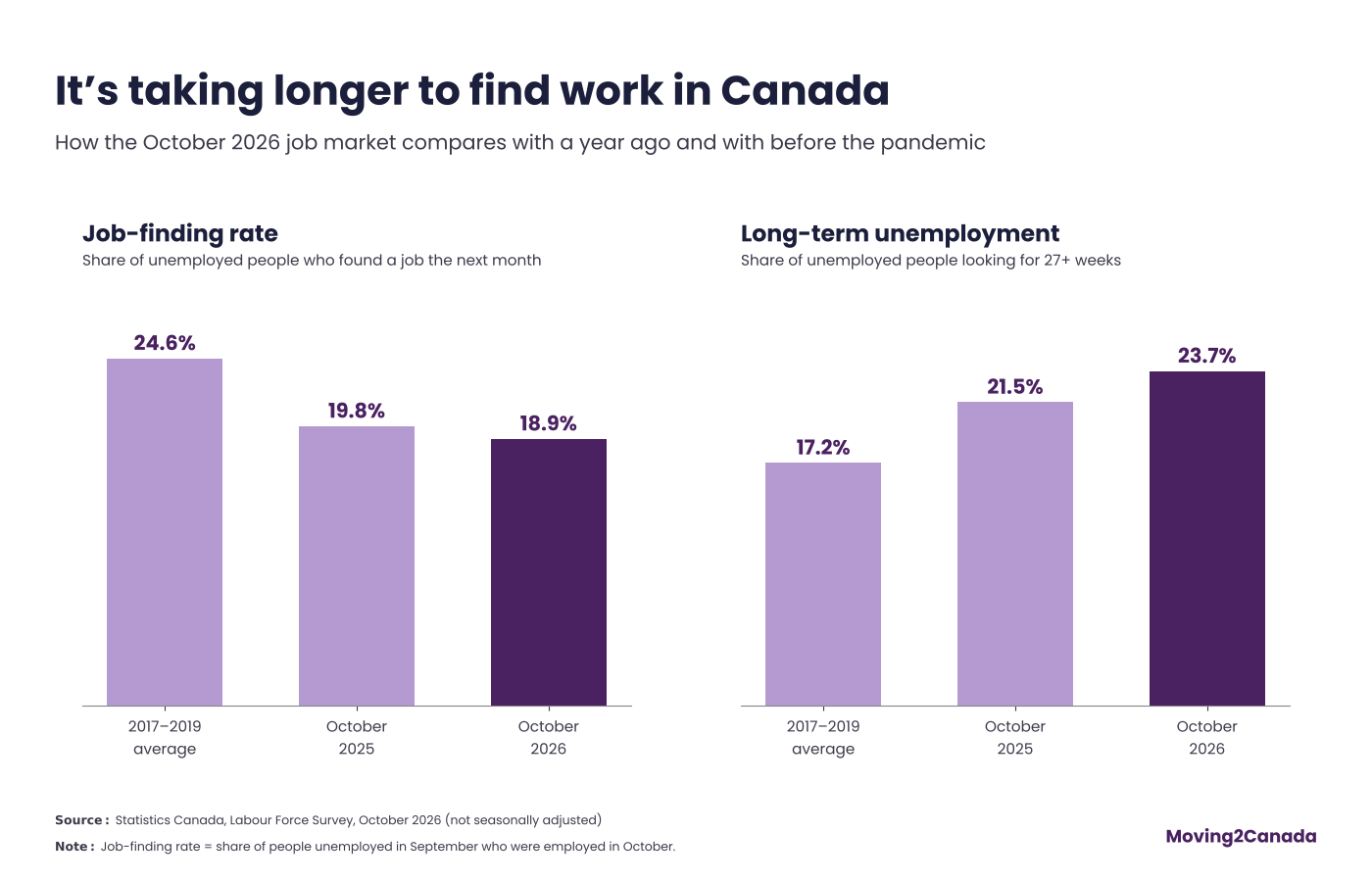
One more figure stands out this month: nearly one in four unemployed people (23.7%) have now been looking for work for six months or longer. That’s up from 21.5% a year ago and well above pre-pandemic levels. And fewer than one in five unemployed people in September (18.9%) had found work by October. In other words, once someone is out of work in Canada right now, it’s taking longer to get back in.
The Job Market in Canada’s Major Cities
Montreal’s unemployment rate improved this month, falling from 7.4% to 6.9%. That’s still noticeably higher than a year ago, though (up 1.1 percentage points from October 2025). Newcomers hoping to move to Montreal may still want to weigh options outside the province, depending on your industry and circumstances. Recent political changes in Quebec might also be of interest to you if you’re considering a move to Montreal or Quebec.
Toronto’s unemployment rate rose again, from 7.2% to 7.4%, making it the highest of Canada’s three largest cities this month. The good news is that Toronto is still in better shape than it was a year ago, when unemployment was above 8%, and employment in the city is up 60,000 year over year.
Vancouver saw an improvement, with unemployment dropping from 7.1% to 6.6%.
The Impact of Canada’s Aging Population
Canada’s immigration system has prioritized economic immigration in recent years, in part to bring in younger workers as older workers retire. Canadians aren’t having as many children as they used to, and the birth rate is quite low. This means that younger workers from outside countries have been brought in to replace the workers who leave the workforce in Canada.
An interesting impact of the recent changes to Canada’s immigration policy is that it seems the slowing inflows of younger workers are impacting the unemployment rate in Canada. Since some workers are aging and leaving the workforce, and no younger newcomers are replacing them, there are fewer overall workers and, therefore, fewer people looking for work.
While this can have the cosmetic impact of decreasing Canada’s unemployment rate, which is a good thing, it may also worsen job shortages in critical sectors.
Moving2Canada's Sister Company
Looking for a construction role in Canada?
Outpost Recruitment matches local and international construction professionals with Canada's leading construction and engineering firms.
Expert resources to help immigrants get jobs in Canada
Canada’s job market provides a wealth of opportunity for newcomers, but it is only that — an opportunity.
To take full advantage, recent and prospective immigrants can leverage free government-funded resources and programs. We recently partnered with Canada InfoNet, a government-funded pre-arrival employment support program, to bring you two expert guides on transitioning to a career in Canada:
The outlook on Canadian construction and infrastructure
Ruairi Spillaine, Outpost Recruitment and Moving2Canada founder, analyzes what’s happening in the construction sector in Canada.
“Canada’s construction sector continues to provide opportunities to experienced candidates who can differentiate themselves in a tighter employment market. While commercial and residential sectors are slower, institutional buildings and a buoyant infrastructure sector continue to drive employment opportunities from coast to coast. Meanwhile, Canada’s industrial sector including nuclear, mining and renewables has had a strong 2026.“
Moving2Canada and Outpost Recruitment Founder, Ruairi Spillane
If you are interested in working in Canada’s construction sector, Outpost helps motivated candidates find suitable jobs in Canada.
The agency works with general contractors, subcontractors, developers, and consultants who are hiring across senior management, operations, project management, site, design, quality, and commercial personnel.
Outpost Recruitment is actively looking for candidates for projects across Canada. View the latest job postings here.
How to get a job in Canada
If you’re looking for a job in Canada here are some steps you can take to land that sweet, sweet Canadian job offer.
Get your resume in good shape. This crucial step is often left down the list of job seekers’ priorities, despite being arguably the most important step of all. Read our Canadian resume guide to get going.
Build your network. You can assemble a team to help you in your job search. With ongoing physical distancing and travel restrictions, technology is your friend here. Read our networking guide, written by award-winning entrepreneur Ruairi Spillane, for expert advice.
Here’s a popular webinar from recruitment expert and Moving2Canada founder, Ruairi Spillane, about how to create the best resume for the Canadian jobs market:
New and improved Jobs Board
We have worked hard over recent weeks to ramp up the number and range of job postings on our Jobs Board.
We also have a number of other resources for helping you find your career in Canada. You’ll find broad-stroke information that will arm you with the knowledge you need to succeed, as well as industry-specific insights into finding jobs by industry, such as teaching.
We have helped thousands of workers worldwide navigate the job search, immigration and settlement process in Canada.
Get job hunting resources, application checklists, exclusive offers from our partners, and much more just by joining the Moving2Canada community.
Free Resources!
Let your job search soar with Moving2Canada's help
Join our community to get the latest job opportunities, career tips, job search resources, and all the immigration, and money content you need to succeed in Canada.
Stephanie is a content creator who writes on legal and personal finance topics, specializing in immigration and legal topics. She earned a Bachelor of Laws and a Diploma in Financial Planning in Australia. Stephanie is now a permanent resident of Canada and a full-time writer at Moving2Canada.
Citation
Ford, Stephanie. "Canada’s Unemployment Rate Rises to 6.7% in October 2026 as Job Market Stalls."Moving2Canada.Last modified November 6, 2026.https://moving2canada.com/work/finding-jobs/labour-market-report/.
Copy for Citation
Ready to Take Charge of Your Immigration to Canada?
Join 180,000+ newcomers and discover the best immigration programs, access exclusive jobs, and use our resources & tools to succeed in Canada