Receive emails from Scotiabank to provide you with tools, resources, and advice to guide you through your banking journey as you settle into your new life.
Receive emails from Scotiabank to provide you with tools, resources, and advice to guide you through your banking journey as you settle into your new life.
Receive emails from Scotiabank to provide you with tools, resources, and advice to guide you through your banking journey as you settle into your new life.
Canada's unemployment rate held steady at 6.4 percent in August 2026, ending three consecutive months of declines.
According to Statistics Canada’s latest Labour Force Survey, employment fell by 42,000 jobs, or 0.2 percent, in August. The decline follows a relatively strong period from April to July, when Canada added a combined 181,000 jobs. Despite the monthly decline, employment remains up 217,000 jobs compared with August 2025.
The employment rate, which measures the share of the population aged 15 and older who are employed, fell 0.1 percentage points to 60.8 percent.
Key Takeaways
Unemployment rate: 6.4 percent, unchanged from July 2026
Employment: Down 42,000 (-0.2 percent) in August, but up 217,000 (+1.0 percent) year-over-year
Wages: Average hourly wages up 2.0 percent year-over-year to $37.02
Industries seeing gains: Manufacturing
Industries seeing losses: Business, building and other support services, public administration, natural resources, and utilities
Provincial employment changes: Employment fell in Quebec and Ontario and increased in New Brunswick
Regional Insights from the August 2026 Labour Force Survey
Quebec saw the largest employment decline among the provinces in August, losing 19,000 jobs, or 0.4 percent. Most of the decline came from Montreal, where employment fell by 21,000. Quebec’s unemployment rate remained unchanged at 5.6 percent.
Quebec was also the only province where employment was lower than a year earlier. The province had 54,000 fewer people employed in August compared with the same month in 2025.
Ontario employment fell by 18,000 jobs, or 0.2 percent. However, this follows a net gain of 119,000 jobs between March and July. The province’s unemployment rate was little changed at 6.9 percent and is down 0.8 percentage points compared with August last year.
New Brunswick was the only province to record a meaningful employment increase in August, adding 2,400 jobs, or 0.6 percent. Its unemployment rate remained stable at 7.3 percent.
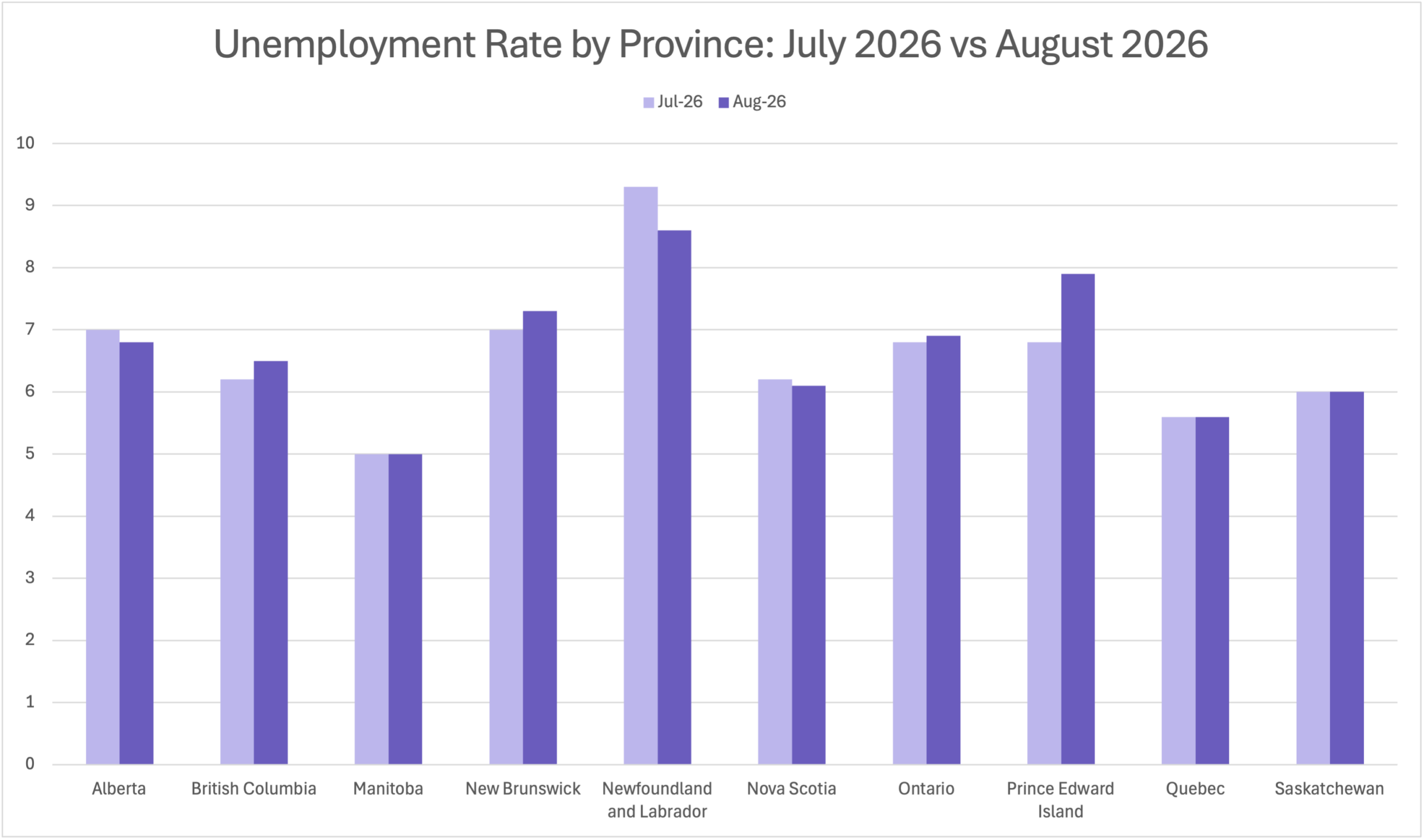
Employment was little changed in the remaining provinces. Alberta’s unemployment rate fell 0.2 percentage points to 6.8 percent, while British Columbia’s increased 0.3 percentage points to 6.5 percent.
Provincial Unemployment Rates Across Canada in August 2026
Here are the provincial unemployment rates from Statistics Canada’s August 2026 Labour Force Survey:
Alberta: 6.8 percent
British Columbia: 6.5 percent
Manitoba: 5.0 percent
New Brunswick: 7.3 percent
Newfoundland and Labrador: 8.6 percent
Nova Scotia: 6.1 percent
Ontario: 6.9 percent
Prince Edward Island: 7.9 percent
Quebec: 5.6 percent
Saskatchewan: 6.0 percent
Changes in Provincial Unemployment from July to August 2026
Employment Changes by Demographic Group
Youth employment declined by 19,000, or 0.7 percent, in August. The unemployment rate among Canadians aged 15 to 24 edged up 0.3 percentage points to 12.9 percent.
Despite the increase, youth unemployment is down considerably year-on-year. The rate has fallen by a net 1.4 percentage points compared with August 2025, when it stood at 14.3 percent. However, it remains above the pre-pandemic average of 10.8 percent.
Among core-aged workers between 25 and 54, the picture was different for men and women. The unemployment rate for core-aged men rose 0.2 percentage points to 6.0 percent as more men entered the labour market and looked for work.
For core-aged women, the unemployment rate fell 0.2 percentage points to 5.0 percent. However, this was partly because fewer women participated in the labour market. Employment among core-aged women fell by 17,000.
For workers aged 55 and older, employment was little changed and the unemployment rate held at 5.1 percent.
Summer Job Market Improved for Students in 2026
Students returning to school this fall had a somewhat better summer job market than they did last year.
Among students aged 15 to 24, the unemployment rate averaged 15.9 percent from May to August 2026. That’s down from 17.9 percent over the same four months in 2025.
The improvement was strongest among students aged 20 to 24. Their unemployment rate fell from 12.3 percent in summer 2025 to 9.2 percent this summer.
Students aged 17 to 19 also saw some improvement, with their unemployment rate falling from 18.5 percent to 16.7 percent.
However, finding summer work remained much more difficult for the youngest students. The unemployment rate among returning students aged 15 and 16 was 29.9 percent, little changed from 29.6 percent last summer.
CMA Insights
Where you plan to settle in Canada can have a real effect on your job search.
Toronto’s unemployment rate remained at 6.7 percent in August. While that is still slightly above the national rate, conditions have improved considerably over the past year. Toronto’s unemployment rate had reached a high of 9.0 percent in July 2025.
Montreal’s unemployment rate was 6.5 percent in August, little changed both from July and from a year earlier. Employment in the city fell by 21,000 during the month, accounting for more than the overall employment decline recorded in Quebec.
Manufacturing Adds Jobs as Several Industries See Declines
Manufacturing stood out as the only industry to record a meaningful employment increase in August.
The sector added 22,000 jobs, or 1.2 percent, with most of the increase coming from Ontario. Manufacturing employment in Ontario rose by 14,000.
Several other industries moved in the opposite direction. Employment fell by 20,000 in business, building and other support services, 8,800 in public administration, 7,700 in natural resources, and 5,600 in utilities.
Looking over the past year gives a different picture. Health care and social assistance has added 129,000 jobs since August 2025, while information, culture and recreation has added 49,000. Transportation and warehousing employment is up 47,000.
Wholesale and retail trade recorded the largest year-over-year decline, with employment down 55,000.
Wage Growth Slows to 2.0 Percent
Average hourly wages reached $37.02 in August, up 2.0 percent compared with a year earlier.
However, the pace of wage growth has slowed for two consecutive months. Average wages were growing at 3.3 percent year-over-year in June and 2.8 percent in July.
August’s 2.0 percent increase was the slowest year-over-year wage growth recorded since November 2017, excluding 2021 during the COVID-19 pandemic.
Canada’s Job Market Gives Back Some of Its Recent Gains
August interrupted a run of stronger labour market results. Canada’s unemployment rate had fallen for three consecutive months from May through July, while the economy added 181,000 jobs between April and July.
The loss of 42,000 jobs in August gives back part of those gains, although employment remains 217,000 higher than it was a year ago.
There are also signs that finding work can remain difficult for people who have been unemployed for an extended period. Of the roughly 1.5 million unemployed people in August, 24.0 percent had been searching for work continuously for at least 27 weeks. Before the pandemic, the average was 17.1 percent.
At the same time, the layoff rate was 0.8 percent in August, close to the pre-pandemic average of 0.9 percent. This suggests the August employment decline was not driven by an unusually high number of layoffs.
For newcomers looking for work in Canada, the August numbers show why it is useful to look beyond the national unemployment rate. Job market conditions continue to differ considerably depending on your province, city, industry, and age group.
Moving2Canada's Sister Company
Looking for a construction role in Canada?
Outpost Recruitment matches local and international construction professionals with Canada's leading construction and engineering firms.
Expert resources to help immigrants get jobs in Canada
Canada’s job market provides a wealth of opportunity for newcomers, but it is only that — an opportunity.
To take full advantage, recent and prospective immigrants can leverage free government-funded resources and programs. We recently partnered with Canada InfoNet, a government-funded pre-arrival employment support program, to bring you two expert guides on transitioning to a career in Canada:
The outlook on Canadian construction and infrastructure
Ruairi Spillaine, Outpost Recruitment and Moving2Canada founder, analyzes what’s happening in the construction sector in Canada.
“Canada’s construction sector continues to provide opportunities to experienced candidates who can differentiate themselves in a tighter employment market. While commercial and residential sectors are slower, institutional buildings and a buoyant infrastructure sector continue to drive employment opportunities from coast to coast. Meanwhile, Canada’s industrial sector including nuclear, mining and renewables is set for a strong 2026.“
Moving2Canada and Outpost Recruitment Founder, Ruairi Spillane
If you are interested in working in Canada’s construction sector, Outpost helps motivated candidates find suitable jobs in Canada.
The agency works with general contractors, subcontractors, developers, and consultants who are hiring across senior management, operations, project management, site, design, quality, and commercial personnel.
Outpost Recruitment is actively looking for candidates for projects across Canada. View the latest job postings here.
How to get a job in Canada
If you’re looking for a job in Canada here are some steps you can take to land that sweet, sweet Canadian job offer.
Get your resume in good shape. This crucial step is often left down the list of job seekers’ priorities, despite being arguably the most important step of all. Read our Canadian resume guide to get going.
Build your network. You can assemble a team to help you in your job search. With ongoing physical distancing and travel restrictions, technology is your friend here. Read our networking guide, written by award-winning entrepreneur Ruairi Spillane, for expert advice.
Here’s a popular webinar from recruitment expert and Moving2Canada founder, Ruairi Spillane, about how to create the best resume for the Canadian jobs market:
New and improved Jobs Board
We have worked hard over recent weeks to ramp up the number and range of job postings on our Jobs Board.
We also have a number of other resources for helping you find your career in Canada. You’ll find broad-stroke information that will arm you with the knowledge you need to succeed, as well as industry-specific insights into finding jobs by industry, such as teaching.
We have helped thousands of workers worldwide navigate the job search, immigration and settlement process in Canada.
Get job hunting resources, application checklists, exclusive offers from our partners, and much more just by joining the Moving2Canada community.
Free Resources!
Let your job search soar with Moving2Canada's help
Join our community to get the latest job opportunities, career tips, job search resources, and all the immigration, and money content you need to succeed in Canada.
Stephanie is a content creator who writes on legal and personal finance topics, specializing in immigration and legal topics. She earned a Bachelor of Laws and a Diploma in Financial Planning in Australia. Stephanie is now a permanent resident of Canada and a full-time writer at Moving2Canada.
Citation
Ford, Stephanie. "Canada’s Economy Lost 42,000 Jobs in August; Unemployment Rate Holds at 6.4 Percent."Moving2Canada.Last modified September 4, 2026.https://moving2canada.com/work/finding-jobs/labour-market-report/.
Copy for Citation
Ready to Take Charge of Your Immigration to Canada?
Join 170,000 + newcomers and discover the best immigration programs, access exclusive jobs, and use our resources & tools to succeed in Canada