
This article was updated more than 6 months ago. Some information may be outdated.
The number of foreign-born workers in Canada’s healthcare system has soared since the early 2000s. Recent data from StatsCan shows that there were over 57,000 healthcare workers born abroad in 2022, compared to 3,200 in 2000.
With this massive increase has come a significant spike in the success of those workers transitioning from temporary resident status to permanent residence. Let’s take a look at how healthcare worker numbers have changed over time, and dig into why they have strong rates of attainment of permanent resident status.

Why Canada needs immigrant healthcare workers
Canada’s aging population and increasing healthcare demands have created an urgent need for doctors, nurses, personal support workers, and other medical professionals. At the same time, many Canadian-trained healthcare workers are retiring, and rural areas face chronic shortages. To close the gap, immigration has become one of the most important sources of healthcare talent.
Over the past decade, foreign-born workers have stepped into critical roles across hospitals and long-term care facilities. In fact, immigrants are overrepresented in some healthcare occupations, particularly nursing aides, orderlies, and patient service associates. Without their contributions, Canada’s healthcare system would be under even greater strain.
The number of Temporary Foreign Workers (TFWs) in Canada’s healthcare sector grew from just 3,200 in 2000 to 57,500 in 2022 — a nearly 17-fold increase. Growth accelerated sharply during the COVID-19 pandemic, with the number of healthcare TFWs rising by 50% between 2019 and 2020 alone.
By 2022, TFWs made up:
- 4.9% of the workforce in nursing and residential care facilities,
- 3.0% of the workforce in ambulatory health care services, and
- 1.2% of the workforce in hospitals.
In certain subsectors, like home health care services, their share was even higher at 7.9%.
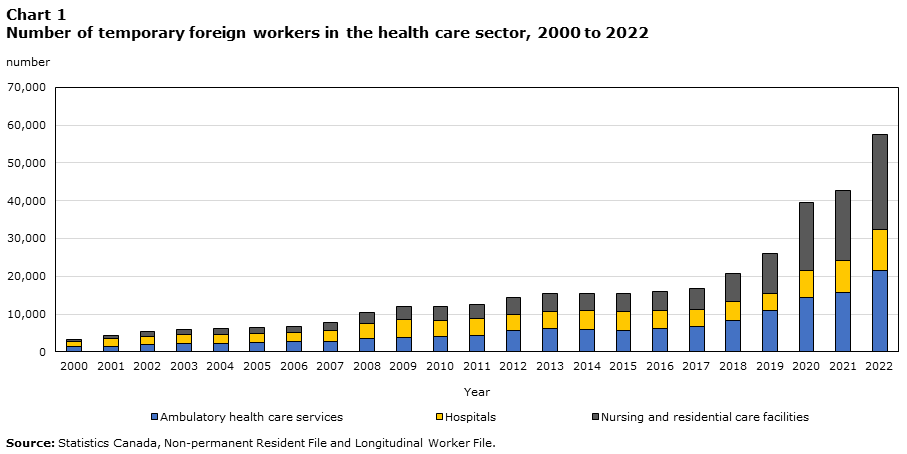
Chart from StatsCan
Shifting Source Countries and Provincial Concentration
The profile of foreign-born healthcare workers has changed dramatically since the early 2000s. The Philippines dominated in the early years, but since 2017, India has become the leading source country. By 2022, nearly 15,000 Indian healthcare workers were in Canada, making up one-third of all TFWs in ambulatory care.
Geographically, Ontario, Quebec, and British Columbia dominate. In 2022, 43% of healthcare TFWs were in Ontario, 26% in Quebec, and 13% in British Columbia, together accounting for more than four out of five healthcare TFWs.
Immigration Programs for Healthcare Workers
Broadly speaking, healthcare workers use six programs to come to Canada as a temporary resident:
- Temporary Foreign Worker Program, health occupations
- Temporary Foreign Worker Program, other
- International Mobility Program, health occupations
- International Mobility Program, other
- Study permit holders without a work permit
- Other temporary residents.
Recall that the TFWP includes LMIA-supported temporary workers, while the IMPs are LMIA-exempt temporary work permits. The IMP program includes PGWP holders, and the PGWP, other section (where PGWP holders lay), is the program that provides the most work permits to healthcare workers in Canada by a long margin. In 2022, this program saw 42,000 work permits, with the next closest being 10,400 from the study permit holders without a work permit program. The remaining programs each contributed 2,100 or fewer work permits in 2022.
Healthcare Worker Transition Rates to Permanent Residency
Perhaps the most striking finding is the success healthcare workers have had in transitioning to PR:
- By 2023, 58% of all TFWs in the healthcare sector from 2000 to 2022 had obtained PR.
- Filipino workers led the way, with 77% becoming permanent residents, followed by Indian workers at 57%, compared with just 43% of French workers.
- More recent cohorts are transitioning faster. For example, it took the 2000–2004 cohort 15 years for 63% to obtain PR, while the 2005-2009 and 2010–2014 cohorts reached the same rate within just seven years. After just 4 years, the 2015-2019 cohort reached 58.4%, showing the time it takes for healthcare workers to transition to permanent residence may be shortening even further in recent years.
Within the first five years of working in Canada’s healthcare system, more than half of TFWs secure permanent residency (54.5% for the 2000–2004 cohort; 59.6% for the 2010–2014 cohort).
Staying in the Sector After PR
The data also shows that healthcare workers are not just using Canada as a stopover — many remain in the sector long after getting PR. One year after gaining PR, nearly two-thirds of healthcare TFWs were still working in the sector. For those with occupation-specific healthcare work permits, retention was even higher: at least 80% remained in healthcare after one year, and more than three-quarters were still in the field five years later.
What led to the increase in foreign-born healthcare workers in Canada?
Several forces have contributed to the steady increase of internationally trained professionals in healthcare:
- Labour shortages: Canada’s healthcare worker shortages, made worse during the COVID-19 pandemic, prompted governments to expand recruitment abroad.
- Immigration policy shifts: Certain federal and provincial programs prioritize healthcare workers and caregivers, making it easier for temporary residents to transition to PR. We’re interested to see the impact of more recent programs, like healthcare category-based draws and targeted draws for healthcare workers across many of Canada’s PNPs over the past two years, including PEI, Ontario, Alberta, and BC.
- International student pathways: Many international students pursue healthcare-related programs in Canada, which open doors to work opportunities and later permanent residence.
More recently we’ve also seen improved credential recognition efforts. Although challenges remain, some provinces have simplified licensing processes for foreign-trained nurses and doctors, allowing them to enter the workforce more quickly. It will be interesting to see what impact this has on the number of immigrant healthcare workers in Canada – particularly nurses and doctors from the USA.
Key Takeaway For Newcomers to Canada
Coming to Canada as a temporary resident either to work in a healthcare role or study an in-demand healthcare-related field remains a strong strategy for gaining permanent residence in Canada.
Keen to stay in the loop about immigration and settlement in Canada? Subscribe to our newsletter to learn about Canadian immigration news as it happens.
About the author

Stephanie Ford
She/Her
Finance, Law and Immigration Writer
Stephanie is a content creator who writes on legal and personal finance topics, specializing in immigration and legal topics. She earned a Bachelor of Laws and a Diploma in Financial Planning in Australia. Stephanie is now a permanent resident of Canada and a full-time writer at Moving2Canada.
Read more about Stephanie Ford
Citation
Ford, Stephanie.
"Healthcare Workers Have Great Rates of Permanent Resident Status in Canada, Data Shows."
Moving2Canada.
Last modified August 29, 2025.
https://moving2canada.com/news-and-features/news/immigration/healthcare-workers-permanent-residence-in-canada/.
Copy for Citation
Featured Stories

Immigration • Oct 16, 2026
Will High-Wage Occupation Points Impact Category-Based Express Entry Draws?
Read more

Immigration • Oct 16, 2026
Could the October 16 CRS Update Push Express Entry Draw Scores Above 530?
Read more

IEC • Oct 16, 2026
Working Holiday Canada News, IEC Pools and Invitations
Read more

Immigration • Oct 16, 2026
How to Update Your Express Entry Profile for Canada’s New Job Offer Rules
Read more