
This article was updated more than 6 months ago. Some information may be outdated.
Steps and requirements needed to become a teacher in Ontario, including education, certification, costs and current job landscape.
If you’re considering a teaching career in Ontario, you’re entering a profession that is both needed and valued, but one that also requires planning, certification, and dedication. This article walks you step‑by‑step through what you need, how the process works, and what to watch out for, so you can move confidently toward your classroom career.
Landscape for Teachers in Ontario
Ontario is facing a growing need for certified teachers across all publicly funded school boards, with daily staff shortages reported in both elementary and secondary schools. A survey found that 24% of elementary schools and 35% of secondary schools in Ontario reported daily shortages of certified teachers during the 2023‑24 school year.
One of the reasons for the shortage is that the number of Educators in public elementary and secondary schools has decreased from 159,393 in 2018 to 155,487 by the end of 2023. This teacher shortage is expected to worsen due to retirements and rising student enrollment.
The good news for aspiring educators is that job prospects in Ontario are still strong, especially for new teachers, who have seen a steady decline in unemployment rates over the past decade. This is why, when compared to other careers, the job market for teachers is still rated as “Good” for the 2025–2027 period.
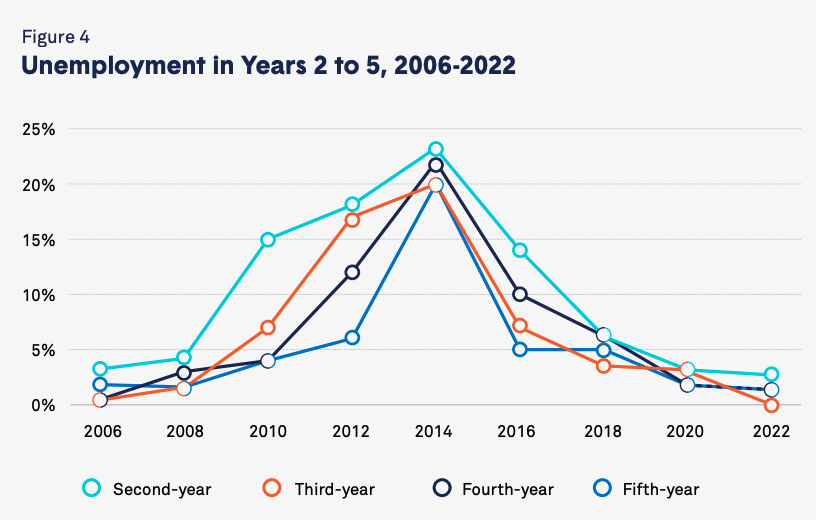
Source: Ontario College of Teachers
Also, to support this demand, the provincial government has committed $55.8 million to expand teacher-training capacity, creating space for up to 2,600 new teachers by 2027.
Who Regulates Teachers in Ontario?
In Ontario, the teaching profession is regulated by the Ontario College of Teachers (OCT). Established by the Ontario government, the OCT is the licensing and regulatory body that oversees who can legally teach in the province’s publicly funded schools. It sets the standards for professional qualifications, ethical conduct, and ongoing learning for all certified teachers. Anyone who wants to teach in Ontario must be certified and in good standing with the College, which means meeting academic requirements, passing background checks, and often demonstrating language proficiency.
The OCT also plays a vital role in maintaining public trust in the education system. It investigates complaints, enforces professional standards, and ensures transparency through a public register of certified teachers. Additionally, the College tracks trends in the teaching workforce through reports like Transition to Teaching, which offer data-driven insights into hiring, unemployment, and areas of teacher shortage.
Requirements to Become a Teacher in Ontario
Before you pursue a teaching career in Ontario, you must meet specific educational qualifications set by the OCT. These requirements exist to ensure every certified teacher has the academic foundation, professional preparation, and personal readiness needed for today’s classrooms:
- A minimum of three to four years of a bachelor’s degree from an acceptable institution.
- Completion of an initial teacher education program, typically delivered over four semesters, at a faculty of education approved by the OCT.
- For those teaching in the publicly‑funded school system: proficiency in English or French, depending on the language of instruction.
- If applying from outside Ontario (or from another country), submission of credential evaluations, proof of previous certification, and possibly fulfillment of additional requirements is required.
- For the “Technological Education” pathway (teaching tech/trades subjects), specific criteria apply: a secondary school diploma, five years’ experience in a trade, and a teacher education program.
- Successful completion of the OCT’s “Professional Suitability” requirement, which includes a criminal record check and demonstration of good character.
By fulfilling these requirements, you earn the academic and professional credentials necessary to apply to the OCT and become certified to teach in Ontario’s publicly funded schools.
Improve Your English
A strong English test score can boost your CRS, so choosing the right test and preparing well can make a difference. Moving2Canada partners with British Council IELTS, offering access to free preparation resources, including practice tests, interactive activities and tutorials to help you prepare with confidence.
Prepare for English Language Test →
Improve Your French (parlez-vous français?)
Level up your French language skills — sharpen your listening, speaking, reading, and writing to achieve the required niveau de français and stand out in your application. Use the PROMO Code M2C
Get French Training Quotes →
Step‑by‑Step Process to Obtain Certification
Once you’ve met the educational requirements, this is what you’ll need to do to apply and get your certificate.
- Gather all required documents: Some of the documents you will need:
- Your undergraduate transcript,
- Teacher‑education transcript,
- Proof of language proficiency (English/French) if applicable,
- and any previous teaching certification, if you were certified elsewhere.
- Complete the online application: Submit your application for the Certificate of Qualification and Registration (CQR) via the OCT’s portal. Be aware that the application is valid for a fixed period.
- Pay registration and membership fees: You’ll need to pay both the registration fee and the annual membership fee to become certified.
- Undergo professional suitability checks: This includes a criminal‑record check, declaration of good character, and possibly a statement of professional standing from any prior teaching roles.
- Application assessment by OCT: Once all documents and fees are in, OCT reviews your file and decides whether to grant certification.
- Receive your certificate and maintain membership: If approved, you receive your CQR and become a member in good standing. Remember, you will need to keep paying annual fees and meet ongoing professional standards.
Remember that all documents must be translated into English or French before submission. If you need professional translation services, click here to get a quote from one of our trusted affiliates.
Important info
The credential assessment report provided by Pathways to Teach Canada, usually accepted by other provinces like Manitoba, New Brunswick, Newfoundland and Labrador, Northwest Territories, Nova Scotia and Nunavut, is NOT accepted by the Ontario College of Teachers (OCT), and the OCT will conduct its own credential assessment.
Timeline to Become a Teacher in Ontario
Certification doesn’t happen overnight. From your degree, then the teacher education certificate to application and approval, each phase takes time, often many months, even years. It usually takes around five to six years of education to become a teacher in Ontario
| Stage | Duration | Details |
|---|---|---|
| Undergraduate Degree | 3–4 years (full-time) | A bachelor’s degree from an acceptable postsecondary institution is required. |
| Teacher-Education Program | 1–2 years (4 semesters) | Completed after your undergraduate degree; must be an OCT-approved initial teacher education program. |
| OCT Application & Processing | Up to 120 days (≈ 4 months) | Once all documents are submitted, the Ontario College of Teachers reviews your file and issues certification if approved. |
| Total Timeframe | 4–6 years | Varies based on your study pace, whether you complete a concurrent program, and if you have international credentials requiring extra steps. |
Costs to Become a Teacher in Ontario
At the same time, there are costs involved (tuition, program fees, application/registration fees) and strategic decisions (subject specializations, location of placement) that can affect how quickly you start teaching.
Here’s a table that outlines some key cost categories you’ll want to budget for.
| Cost Category | Estimated Amount (CAD) | Notes |
|---|---|---|
| Undergraduate degree tuition (Ontario, domestic) | ~ $7,000‑$10,000/year (≈$21,000‑$30,000 total over 3 years) | Based on average arts/humanities tuition in Ontario. |
| Initial Teacher Education Program tuition | ~ $20,000‑$30,000 (for 1‑2 years) | Example: teacher education tuition at Brock University in 2025 ~ $1,512.96 per credit for first two years. |
| OCT Annual Membership Fee | $200/year | This is the fee to remain certified once you become a member. |
| OCT Registration Fee (Ontario‑educated applicants) | $140 | Paid when you first apply to OCT. |
| OCT Registration Fee (Educated outside Ontario) | $362 ($140 + $222 evaluation fee) | For internationally educated teachers or those certified outside Ontario. |
| English/French Language Proficiency Test | ~ $250‑$350 | Approximate estimate for tests such as IELTS or CELPIP (variable by provider). |
| Transcript(s) processing fees | ~ $50‑$100 each | For your undergraduate transcript and teacher‑education program transcript; amounts vary. |
| Document translation (if not English/French) | ~ $100‑$300 | Depends on the number of pages and certified translator rates. |
Pro tips!
- Tuition varies significantly by institution and program; the amounts here are approximate based on available data.
- These costs add up, so it’s smart to budget not just the program tuition but also the “hidden” costs—testing, document translation, application fees, and maintaining membership. Planning early (for example doing volunteer work to strengthen your application) and selecting a program suited to in‑demand subjects/regions (e.g., rural Ontario, French immersion, STEM) can help speed your journey and enhance your employability.
Alternative or Special Pathways
Not everyone takes the traditional route through a university and teacher education program, and in Ontario, there are recognized alternative pathways into the profession. For example, individuals with significant skilled trades experience can become certified to teach technological education. This path typically requires a secondary school diploma, at least five years of trade experience, and completion of a teacher education program. It’s ideal for those coming from careers in construction, manufacturing, or similar industries.
Internationally educated teachers also follow a special route. If you earned your teaching credentials outside of Ontario or Canada, you can still apply for certification through the Ontario College of Teachers—but you’ll need to submit foreign credential evaluations, proof of language proficiency, and sometimes additional coursework. The College may require document translations, statements of professional standing from your previous jurisdiction, and a detailed breakdown of your teacher education program. Full guidance for internationally educated applicants is provided by the College here: Teachers educated outside Canada

Our Partner
Award Winning, 100% Canadian Resume Writing & Review Services from DocDoctor
DocDoctor is a professional writing service based in Canada. Since April 2015, DocDoctor has helped professionals looking to work in Canada by drafting or reviewing resumes and cover letters and optimizing LinkedIn profiles.
See Your Special Offer from DocDoctor
Answers to Your Top Questions About Teaching in Ontario
How to become a teacher in Ontario without a degree?
To teach in Ontario’s publicly funded schools, you must have a minimum three-year postsecondary degree and complete a teacher education program. Without a degree, you can’t be certified by the Ontario College of Teachers (OCT), except in limited cases like teaching trades. For more information, refer to section Minimum Educational Requirements and Alternative or Special Pathways.
How to become a kindergarten teacher in Ontario?
You need a postsecondary degree, a teacher education program with a primary division focus (JK–Grade 3), and certification from the OCT. Practicum placements in early years settings are often required. For more information, refer to section Minimum Educational Requirements
How to become a high school teacher in Ontario?
Complete a university degree and a teacher education program focused on the Intermediate/Senior divisions (Grades 7–12), then apply for certification with the OCT. You’ll also need to choose two teachable subjects. For more information, check the section Minimum Educational Requirements
How to become a substitute/supply teacher in Ontario?
Substitute teachers (also called occasional or supply teachers) must meet the same certification standards as full-time teachers: a degree, teacher education, and OCT membership. School boards hire supply teachers from the same applicant pool. For more information, refer to the section Minimum Educational Requirements .
How to become a trades teacher in Ontario?
You don’t need a university degree, but must have a secondary school diploma, at least five years of trade experience, and complete a tech-focused teacher education program. Certification through OCT is still required. For more info, refer to the section Alternative or Special Pathways to check your options.
How long to become a teacher in Ontario?
Typically, it takes 4 to 6 years. That includes 3–4 years for an undergraduate degree, 1–2 years for teacher education, and up to 4 months for OCT certification processing. International applicants may need more time. Check our section Detailed Timeline to become a teacher.

About the author

Indira Duarte
Indira specializes in creating clear, accessible, and culturally sensitive content for immigrant audiences. As an immigrant herself, she brings a personal understanding of the challenges newcomers face, crafting practical guides, informative articles, and inclusive resources that empower individuals at every stage of their immigration journey.
Read more about Indira Duarte
Citation
Duarte, Indira.
"How to Become a Teacher in Ontario: Step‑by‑Step Guide."
Moving2Canada.
Last modified October 24, 2025.
https://moving2canada.com/news-and-features/features/work/how-to-become-a-teacher-in-ontario/.
Copy for Citation
Featured Stories

Community Blog • May 18, 2022
Becoming Canadian
Moving2Canada Product Manager, Hugo O'Doherty, reflects on a journey to Canadian citizenship and what it means.
Read more
Community Blog • Feb 26, 2019
Moving2Canada wins Small Business BC award for contribution to immigrant community
Moving2Canada wins the award in the Best Immigrant Entrepreneur category of the Small Business BC Awards 2019.
Read more