





Updated on July 7, 2026



This content is sponsored by Scotiabank. The views, opinions, and information expressed in this piece are those of Moving2Canada and do not reflect those of Scotiabank. Scotiabank is not responsible for the content, accuracy, or any representations made herein.
Moving to a new country is never easy, especially when you’re doing it with a family. Immigration comes with paperwork, logistics, and perhaps most daunting of all: expenses.
At Scotiabank, we know planning is one of the most important steps in a successful move to Canada. We have compiled the collective wisdom of the Moving2Canada team to show you what the moving expenses for a fictional family might look like during a move to Vancouver, BC.


Meet the Li family*: Yan and Mei Li, originally from Shanghai, touched down in Vancouver, BC, in early March 2025 with their two kids—Luna (6) and Kai (3). Yan is a software engineer, and Mei taught preschool back home. They knew Canada wouldn’t be cheap, but they didn’t expect the sticker shock they’d face right away.
A quick note, dollar figures provided throughout this article are in CAD.
How much does it cost for a family to immigrate to Canada?
One of the most popular immigration pathways for overseas applicants is the Federal Skilled Worker Program, which operates through Express Entry. Here’s what a family of four might expect to pay when immigrating through Express Entry in 2025:
IMMIGRATION PROCESS COSTS
| Item | Cost (CAD) | Notes | Source |
|---|---|---|---|
| Educational Credential Assessment (ECA) | $256 per adult | Required for principal applicant and optional for spouse | WES |
| Language Testing (IELTS/CELPIP) | $446 per person (varies by location) | Usually required for both spouses | IELTS Website - Test Fee in London |
| Express Entry Biometrics | $85 per person (max $170 for family) | Collected at Visa Application Centre | IRCC |
| Medical Exams | $1,450 ($595 per adult, $130 per child) | Panel physicians only | Knightsbridge Doctors |
| PR Application Fees | $3,510 ($1,525 per adult, $230 per child) | Includes Right of Permanent Residence Fee | IRCC |
| Police Certificates (UK) | $252 ($126 per adult) | Required from every country where you’ve lived 6+ months | ACRO |
| Passport Photos | ~$10–$20 per person | Needed for PR application | |
| Optional: Representation (Immigration Consultant or Lawyer) | $750 | PR application review only | Canada Abroad |


Relocation costs for a family of four to move to Canada
Q: What were your biggest expenses in the first week after landing—and did any of them surprise you?
Our biggest cost was temporary housing—the Li family paid $2,800 for nine nights in a centrally located apartment, only to be hit with $200 in hidden cleaning and service fees. They also prepaid $111.60 per adult for a transit pass and bought 2 concession monthly passes too for the children. After arrival, they realized that the transit pass they needed to look at longer-term accommodation options was the more expensive zone 2 pass – and also that children under the age of 12 travel for free.
Q: What was your initial rent (or housing cost), and did you have to pay multiple months upfront?
Their two‑bedroom Surrey suite costs $2,200 per month. They paid first month’s rent up front and a 50% deposit—$3,300 total. It added up quickly, but those are standard terms in BC rentals.
Q: How much did you spend on furniture, appliances, or household essentials to get settled?
They budgeted $6,500 and furnished the small apartment with affordable basics and second‑hand finds, figuring they could upgrade furniture in the future once they’re more established in Canada. A higher‑quality mattress topped their priority list to ensure comfort and convenience, but they also bought bunk beds, a couch and loveseat, some small appliances, a television, some storage shelves, a dining table and some end tables. Shopping sales and second-hand kept them roughly 10% under budget.
Q: Were there any one‑time “setup” costs you didn’t expect—like insurance, deposits, or transit passes?
Unexpected setup fees included $200 annually for renter’s insurance, which almost all landlords required. They also paid $100 in utility connection charges for internet and electricity, and cell phone plans These one‑offs added about $300 to their move‑in bill.
Here’s a snapshot of the typical relocation expenses families face when moving to Canada:
RELOCATION COSTS
| Item | Cost (CAD) | Notes | Source |
|---|---|---|---|
| One-way Flights (4 people) | $2,400 London: Cheapest–$1,250 (London to Toronto, cheap seats, no checked bags), Reasonable–$3,500 (London to Winnipeg, checked bags included, flexible tickets) New Delhi: Cheap–$2,400, Reasonable–$4,000 | Varies by time of year and city | Google Flights |
| Shipping Household Goods | $500–$7,000 | Varies greatly depending on number of goods and type of shipping | The Relocator Sherpr |
| Luggage Overweight Fees | $600 (four extra bags) | Applies if you carry extra bags | Westjet Baggage Fees |
| Health Insurance (until provincial coverage kicks in) | ~$450–$1,500 | Recommended for first 3 months in some provinces (like BC or ON) Varies depending on coverage type and pre-existing conditions | Moving2Canada |
| Temporary Accommodation (first month) | $1,500–$3,700 | Major cities more expensive | RentSeeker Numbeo |
| Airport Transfers, Transport | $100–$300 | Transport to and from airport, possibly car rental | |
| Pet Relocation (if applicable) | $200–$800 per pet | Health certificates, border inspection fees, and airline costs Varies depending on type of pet | Government of Canada Air Canada |
Unexpected Costs During Your Move to Canada
Q: Looking back, what were the most unexpected expenses in the first 3 months?
The Li family faced a cleaning fee for their short‑term rental and lost $150 to currency conversion fees on money transfers4. Taxes were also a surprise, since Canadian stores don’t typically include taxes in the pricing on the shelves. Taxes are added at purchase and vary depending on whether both provincial and federal taxes apply.
Quick tip: It can be helpful to expect the unexpected and build a buffer into your budget when you’re moving your family to Canada. That said, you can avoid common surprises by researching exchange rates and bank transfer fees before you move.
Q: Were there any recurring costs that you underestimated?
Phone plans cost $80 per adult per month, not $50 as they’d assumed. Prescriptions and over‑the‑counter health items also added about $60 monthly. And while most chequing accounts charge monthly fees, they did some further research and discovered that with the Scotiabank StartRight® Program*, as an eligible newcomer they could avoid paying monthly account fees for the first twelve months on a Preferred Package 1, as well as unlimited no-fee international transfers2 and other perks.
How Much Does It Cost for a Family of Four to Live in Canada?
The biggest factor in your family’s cost of living? Location.
Costs for everyday staples, like food and winter clothing, vary across Canada. But where you live also impacts whether you need to buy a vehicle and how much winter clothing you’ll need.
Q: How much were you spending on groceries each week—and did food prices match your expectations?
They budgeted $300 per week but averaged $350, as local produce and dairy cost more than expected. Shopping weekend farmers’ stalls in summer and discount grocers helped them shave about $50 off weekly bills over time.
Q: Did you have to buy winter gear for the whole family—and how much did that add up to?
Winter jackets, boots, and accessories set them back $1,400 before the first winter. Waiting for end‑of‑season sales and visiting outlet stores and second-hand stores trimmed their total by about 20%. The Li family paid less than average in Canada for winter clothing, since the climate in Vancouver is mild compared to most other locations across the country.
Q: Did you buy a car or rely on public transit at first? What were the costs involved either way?
They stuck with public transit since Vancouver has good transit, bicycle infrastructure, and opted for short-term car rentals when needed.
Budgeting with a Family of Four in Canada
Once your family has arrived in Canada, the real financial journey begins. From setting up your home to building your credit history, the first few months can be financially intense, but they also offer your first taste of stability.
Q: If you could do it again, what would you spend less on—and what would you prioritize more?
They’d buy more second‑hand furniture to save around $1,000 and put that toward an emergency fund. Prioritizing a stronger safety net over immediate comforts would ease the transition.
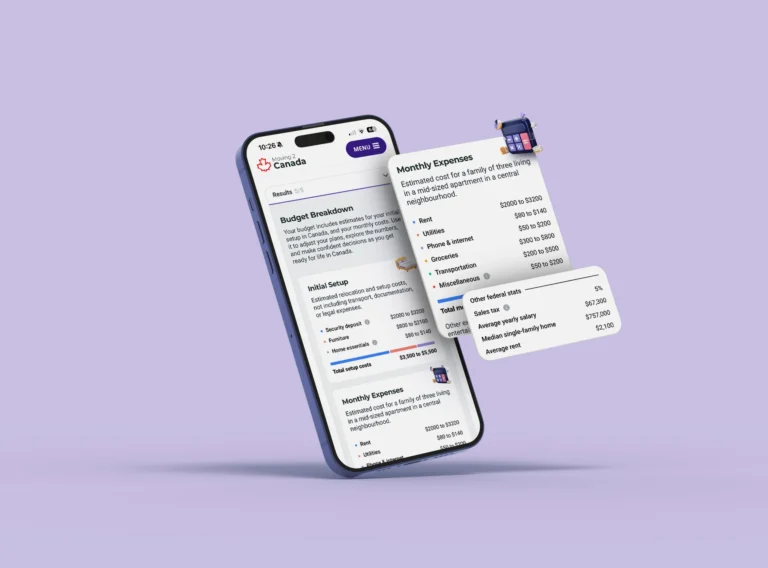
Here’s a general breakdown of ongoing monthly expenses for a family of four:
ONGOING MONTHLY COSTS IN CANADA
| Category | Monthly Cost (CAD) | Notes | Source |
|---|---|---|---|
| Rent (2–3 bed apartment) | $1,500–$3,700 | Major cities more expensive | Rentals.ca |
| Utilities (Gas, Hydro, Water) | $100–$400 | Can vary by season and province | Numbeo |
| Internet + Mobile (2 lines) | $95-$325 | For two adult phone plans | Numbeo |
| Groceries | $1,400 | Based on average family spend | Canada Food Price Report |
| Transportation (public transit or car) | $150–$2,800 | Monthly transit passes vs. car payments for two new vehicles, insurance, and fuel | Numbeo Globe & Mail |
| Childcare/Preschool (for 2-year-old) | $200–$1,850 | Subsidized in Quebec, very high in other provinces | Quebec Government Numbeo |
| Health-related costs (dental, prescriptions) | $100–$400 | Varies depending on insurance | Moving2Canada |
| Entertainment, Subscriptions, Clothing | $100-$500 | Discretionary and highly variable |
A good budget is one that adapts as your situation changes. Scotiabank’s money finder tool3 and mobile app can help track spending, set savings goals, and build the habits that lead to long-term financial success. And check out our budgeting guide for detailed tips.
Personalized Financial Advice from Scotiabank
At Scotiabank, we’re proud to support newcomers as they build their future in Canada. Our advisors are here to support you as you navigate your finances from choosing the right account to budgeting for your family and planning for retirement.
Legal Disclaimer
This article is provided for information purposes only. It is not to be relied upon as financial, tax or investment advice or guarantees about the future, nor should it be considered a recommendation to buy or sell. Information contained in this article, including information relating to interest rates, market conditions, tax rules, and other investment factors are subject to change without notice and The Bank of Nova Scotia is not responsible to update this information. All third party sources are believed to be accurate and reliable as of the date of publication and The Bank of Nova Scotia does not guarantee its accuracy or reliability. Readers should consult their own professional advisor for specific financial, investment and/or tax advice tailored to their needs to ensure that individual circumstances are considered properly and action is taken based on the latest available information.
* This is a fictional scenario intended for illustrative purposes only.
‡ Scotiabank StartRight® Program is available only for Canadian Permanent Residents from 0-5 years in Canada, International Students and Foreign Workers.
1 To qualify for the 1-Year No Monthly Account Fee Offer (the “Offer”), open a new Preferred Package account under the StartRight™ Program (the “Account”). During the first 12 months, your monthly Account fee will be waived and will not appear as a charge on your Account. The Account must be open and in good standing at the time of the waiver. All applicable service charges on the Account will continue to be applied monthly. After the first 12 months, you will begin to see the monthly Account fee charged to your Account unless you maintain a minimum daily closing balance of $4,000, in which case the monthly Account fee will be waived per the Account terms and conditions. Employees of Scotiabank and individuals who are currently or were previously holders/joint holders of a Scotiabank chequing account within the last 2 years are not eligible for this Offer. This Offer is non-transferable and cannot be combined with any other offers except as otherwise permitted. Maximum one Offer per client. All rates, fees, features and benefits are subject to change. Offer may be changed, cancelled, or extended at any time without notice.
2 For clients onboarded as a part of the Scotiabank StartRight® Program we do not charge a service fee for the transfer, however, foreign currency exchange rates apply. A transfer needs to be made from an eligible Scotiabank Chequing or Savings account. Subject to daily limits and additional terms and conditions as set out in the Scotiabank International Money Transfer Agreement found at https://www.scotiabank.com/international-money-transfer.
3 To access Scotia Smart Money by Advice+, you must have an active personal banking retail product, have transacted at least once on your account within the preceding 6 months and have logged into the Scotia Mobile Banking App.
4 For clients onboarded as a part of the Scotiabank StartRight® Program we do not charge a service fee for the transfer, however, foreign currency exchange rates apply. A transfer needs to be made from an eligible Scotiabank Chequing or Savings account. Subject to daily limits and additional terms and conditions as set out in the Scotiabank International Money Transfer Agreement found at https://www.scotiabank.com/international-money-transfer.
Related articles

Will High-Wage Occupation Points Impact Category-Based Express Entry Draws?
Read more

Could the October 16 CRS Update Push Express Entry Draw Scores Above 530?
Read more

Working Holiday Canada News, IEC Pools and Invitations
Read more
How to Update Your Express Entry Profile for Canada’s New Job Offer Rules
Read more
About the author