Your car needs new tires. The property tax bill lands. The dog eats something it shouldn't. None of these are surprises, exactly (well, maybe it is if it’s the first time your dog swallows a rock). You knew these costs were coming at some point. But when the bill arrives, it still knocks your budget sideways.
These are the gaps a sinking fund is designed to fill. It’s one of the simplest tools in personal finance, and it’s one that’s made a big difference to how I feel about money. Here’s what sinking funds are, how I decide when to use one, and the five I have running right now.
Key Takeaways
- A sinking fund is money you set aside, a little at a time, for an expense you know is coming.
- My rule about when to use sinking funds: if it’s expensive enough to sting when it comes out, I’d rather save for it.
- Take our quiz to see if you know which expenses go where (and subscribe to our YouTube channel while you’re there!):

What is a sinking fund?
A sinking fund is money you set aside, a little at a time, for a specific expense you know is coming. Instead of finding $1,800 for a car repair all at once, you put away $75 a month for two years. When the bill arrives, the money is already there – and many people find that it takes the sting out of paying for it (at least a little).
The name comes from corporate finance, where companies set aside money over time to pay off a bond. The household version is the same idea: spread a big cost into small, predictable pieces.
Sinking fund vs emergency fund
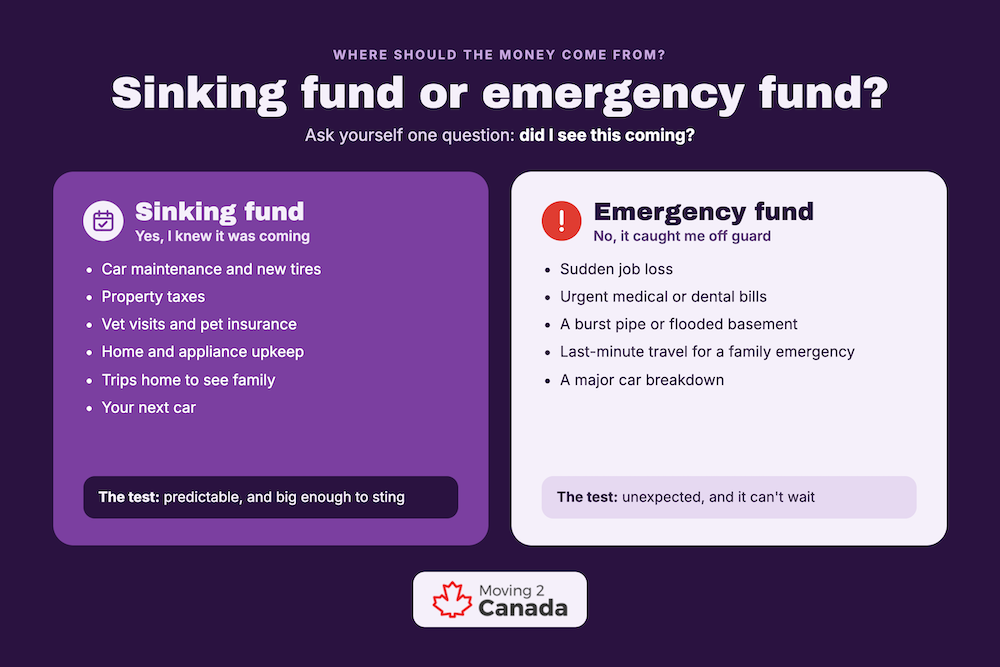
It’s a fairly common misconception that sinking funds and emergency funds are the same thing. But they’re not. They’re two separate funds, with two very different purposes. And knowing the difference can mean the difference between being prepared for an unexpected job loss or emergency dental visit (you know about gaps in Canada’s healthcare, right?) or ending up in debt.
Here’s a table showing the differences between a sinking fund and an emergency fund:
| Emergency fund | Sinking fund | |
|---|---|---|
| What it covers | The unexpected: job loss, a medical issue, a sudden move | The expected: costs you can see coming, even if the exact date or amount isn't fixed |
| How many | Usually one | As many as you have big, predictable expenses |
| Goal | A safety net you hope not to touch | Money you fully intend to spend |
| Example | Three to six months of essential expenses | $150 a month toward next year's property taxes |
The key difference: a sinking fund is meant to be spent. If you raid your emergency fund every time the car needs brakes, you don’t really have an emergency fund. Sinking funds protect it by catching the predictable stuff first.
How I work out how much money to put in:
For my ‘car’ sinking fund, I added up what we spent on the car in the last two years, then divided that total by 24. I then set up an automated payment for that monthly amount to go into a separate savings account at my bank.
I don’t assume this will always cover every expense – and sometimes if a more expensive maintenance item is flagged, I increase the amount of the automatic transfer for a little while – but it has served me well in the past few years.
When should you use a sinking fund?
My rule of thumb is simple: if it’s expensive enough to sting when it comes out, I’d rather save for it.
That line is different for everyone. On a tight budget, a $200 bill might sting. On a bigger income, it might be $1,000. The point isn’t the number. It’s the feeling of a payment throwing your month off, or the temptation to put it on a credit card and deal with it later.
An expense is a good fit for a sinking fund when it ticks most of these boxes:
- It’s predictable. You know it will happen, even if you don’t know exactly when.
- It’s irregular. It doesn’t come out of every paycheque, so it’s easy to forget about.
- It’s big enough to hurt. Paying it from one month’s cash flow would squeeze everything else.
- It’s worth planning for. You’d rather pay cash than carry a balance or dip into savings meant for something else.
If an expense is small and frequent (groceries, a streaming subscription), it belongs in your regular monthly budget. If it’s large and genuinely unpredictable, that’s what your emergency fund is for. Sinking funds sit in the middle.
The sinking funds I use
Here are five sinking funds I keep running, and why each one earns its place.
Vehicle repairs and maintenance
Cars always need something: oil changes, brakes, a new set of winter tires, the mystery noise that turns out to be expensive. I add to this fund every month, so a repair bill is annoying, not a crisis.
Tip: Look back at what you spent on your car over the last year or two. That’s a solid starting point for your monthly contribution.
Pet costs
Vet visits, vaccines, dental cleanings, pet insurance premiums and deductibles, and the occasional emergency trip to the vet. Pets are wonderful and also quietly expensive. Having this fund means I never have to weigh my pet’s care against my bank balance in the moment.
Tip: Even with pet insurance, you’ll usually pay a deductible or a share of the bill. Save for that gap.
Property taxes
Property tax is one of the biggest predictable bills a homeowner faces, and depending on your municipality it may arrive as one or two large payments a year. Divide last year’s bill by 12, round up a little for increases, and save that amount monthly.
Tip: Check whether your municipality offers a monthly instalment plan. If it does, you may not need a sinking fund for this at all. If it doesn’t, or you prefer to keep the cash earning interest until the due date, a sinking fund works well.
Trips back to Australia
Flights to Australia aren’t cheap, and they’re not optional for me. Treating these trips as a planned expense means I can book when fares are good instead of when I’ve finally scraped the money together.
Tip: If you’re a newcomer to Canada and you plan to return home regularly, a “trips home” fund is worth setting up early. Flights, travel insurance, and time off work add up quickly.
House maintenance
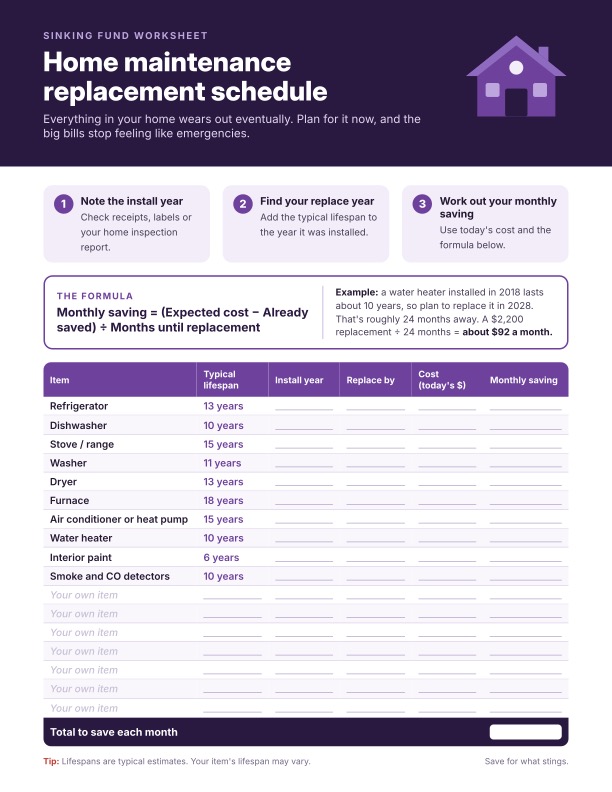
Homes always need something. The common rules of thumb are to save about 1% of your home’s purchase price each year, or about $1 per square foot annually. These can give very different figures, depending on the type of home and location.
Scotiabank’s guide to budgeting for home maintenance suggests a more personal approach. List the big parts of your home that you’re responsible for, estimate when each will need replacing and roughly what it will cost, then add your routine upkeep on top. The result is a monthly figure based on your actual home, not an average one.
Tip: The quick rules don’t account for an older home or local labour costs, so use them as a starting point and adjust for your house.
Free Budgeting Tool: Home Maintenance Sinking Fund Calculator Tool
How to set up a sinking fund
Setting one up takes about 20 minutes. Here’s the process I follow.
- List your expenses for sinking funds. Go through the last 12 to 24 months of bank and credit card statements. Flag anything big and irregular.
- Estimate the cost. Use what you actually spent last time, then round up. Prices rarely go down.
- Pick a deadline. When will you need the money? Property tax has a due date. A car purchase might be three or four years out.
- Do the math(s). Divide the target by the number of months until you need it.
- Automate it. Set up an automatic transfer for payday, so the money moves before you can spend it.
- Review once a year. Costs change. Adjust your contributions when they do.
The math(s) is simple:
What it costs / Number of months to save = Monthly amount
Here’s what that might look like. These figures are illustrative, so swap in your own.
| Sinking fund | Target | Timeline | Monthly contribution |
|---|---|---|---|
| Vehicle repairs and maintenance | $1,800 | 12 months (rolling) | $150 |
| Home maintenance costs | $1,500 | 12 months (rolling) | $125 |
| Pet costs | $1,200 | 12 months (rolling) | $100 |
| Property taxes | $4,200 | 12 months | $350 |
| Trip to Australia | $4,000 | 18 months | $222 |
Where to keep your sinking funds
Keep the money somewhere separate from your everyday chequing account, so it doesn’t quietly get spent. Some options you might consider:
- A high-interest savings account (HISA). Easy to access, and the money earns a little while it waits. Many Canadian banks and online banks let you open several savings accounts and nickname each one (“Car repairs”, “Australia 2027”).
- One savings account with folders or add a spreadsheet. If your bank doesn’t allow folders within each account, keep everything in one and track each fund’s balance in a simple sheet.
- A Guaranteed Investment Certificate (GIC). You might be able to buy a GIC with money you’ve saved. This is a slightly more advanced money move – so make sure you understand the important elements of GICs before making it. You’ll want to know about the term timelines, rollover, interest rate, and whether the GIC is redeemable or not at minimum before deciding if it’s right for you.
I usually avoid investing short-term sinking funds in the stock market. Generally, if you need the money in a year or two, a market dip could leave you short right when the bill arrives.
Common sinking fund mistakes
- Creating too many funds. A fund for every possible expense gets hard to manage. Start with the three to five that sting most.
- Borrowing between funds. Pulling from the Australia fund to cover a vet bill just moves the problem. If it happens, pay it back on a schedule.
- Feeling guilty spending it. This money has a job. When the car needs brakes, using the car fund is the plan working, not failing.
- Never revisiting the numbers. Insurance premiums, property taxes, and flights all go up. A yearly check-in keeps your contributions realistic.
- Skipping the emergency fund. Sinking funds work best alongside an emergency fund, not instead of one.
Action Item for Today
Sinking funds won’t make expenses cheaper, but they take the sting out. If you’re having a hard time working out where to start: start small.
Pick the one expense that stings most, work out the monthly amount, and automate it this week. Once you’ve watched a big bill get paid without the usual panic, you might find that you want a sinking fund for everything that stings.
If you want more tips like this, join our email community.
About the author

Stephanie Ford
She/Her
Finance, Law and Immigration Writer
Stephanie is a content creator who writes on legal and personal finance topics, specializing in immigration and legal topics. She earned a Bachelor of Laws and a Diploma in Financial Planning in Australia. Stephanie is now a permanent resident of Canada and a full-time writer at Moving2Canada.
Read more about Stephanie Ford
Citation
Ford, Stephanie.
"Big Bills Keep Wrecking Your Budget? You May Be Missing This One Thing."
Moving2Canada.
Last modified November 26, 2026.
https://moving2canada.com/2026/11/sinking-funds-explained/.
Copy for Citation




Featured Stories

Express Entry • Nov 26, 2026
600 ITAs in First STEM Category Express Entry Draw Since 2024, Cut-Off Jumps to 547
Read more

Finances • Nov 25, 2026
The $15,000 Pay Gap No One Warned Newcomer Women About (& How to Fight Back)
Read more

Immigration • Nov 25, 2026
What Canada’s 2027 Immigration Levels Plan Doesn’t Count
Read more

Immigration • Nov 25, 2026
The $5,000 Red Seal Completion Bonus: What Newcomers Need to Know (and Why Most Work Permit Holders Are Left Out)
Read more