
I read some truly heartbreaking data this week about the pay gap between female newcomers and their Canadian counterparts. I felt compelled to share this piece, which outlines the data, and shares some resources and tips to help close that gap.
Key Takeaways
- Recent newcomer women earned 31% less than Canadian-born men in 2025, and that gap grew by 4 points in a year.
- 77% of recent newcomer women aged 25–54 in BC hold a bachelor’s degree or higher, compared with 29% of Canadian-born men.
- The pay gap is roughly twice as large for women with a foreign degree as for those with a Canadian one, so getting credentials recognized early is one of the most effective steps you can take.
- Use local market rates and posted salary ranges, not your previous salary from abroad.
- Join the Moving2Canada newsletter to get the latest immigration news, job tips and resources for newcomers in your inbox.
🇨🇦
Unlock Your Canadian Future!
Whether it’s finding the best immigration program for you, landing your dream job, or making the most of life in Canada, it all starts with your free Moving2Canada account!
The Data on Women Newcomer’s Wages in Canada
Immigration, Refugees and Citizenship Data on Newcomer Wages
Source: — IRCC: 2026 Annual Report to Parliament on Immigration
The data:
Among full-time workers, women who immigrated as adults faced a 19.8% wage gap with Canadian-born men, compared with 8.1% for Canadian-born women.
What this means for women workers:
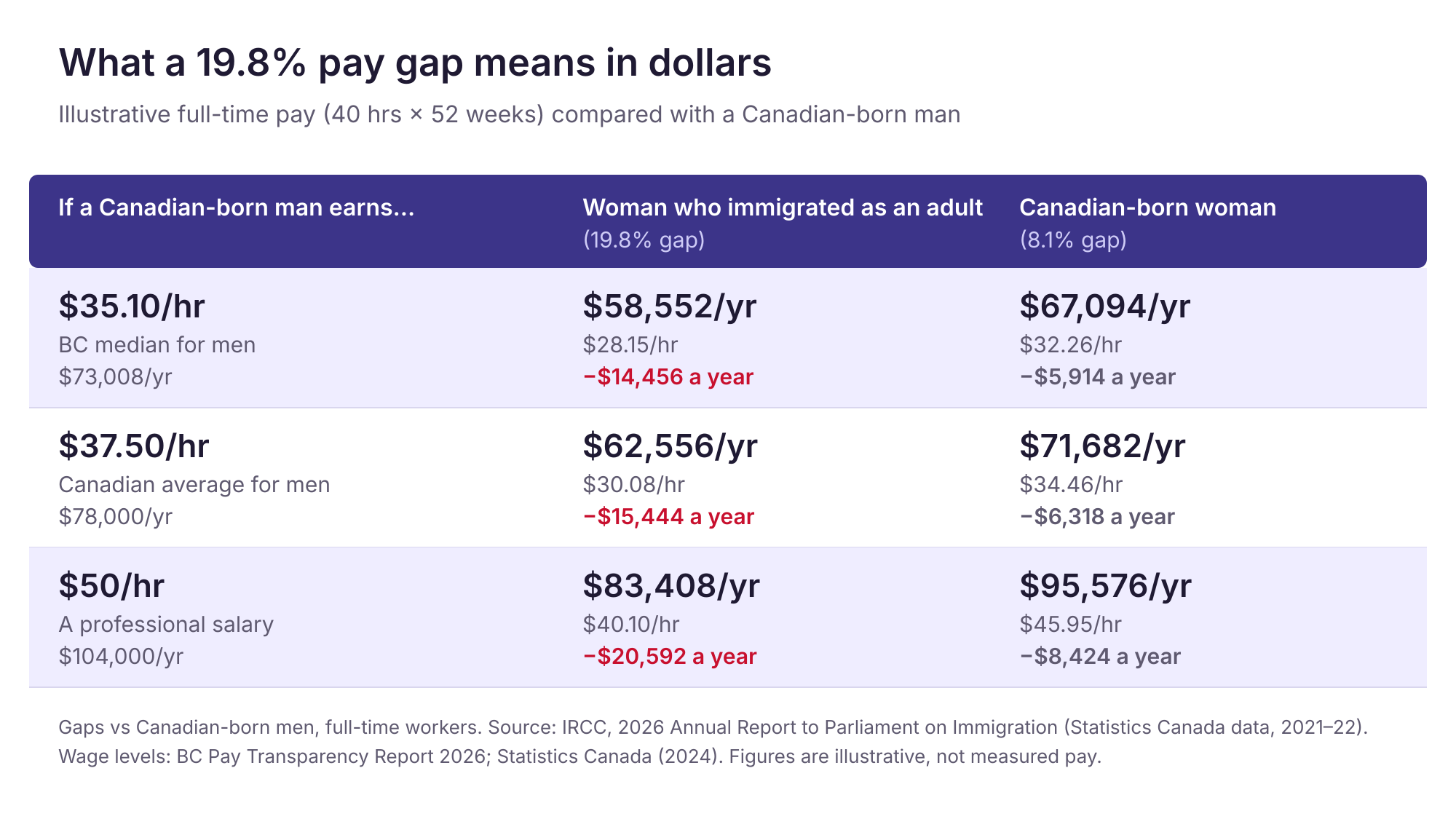
| If a Canadian-born man earns… | Immigrant woman (19.8% gap) | Canadian-born woman (8.1% gap) |
|---|---|---|
| $35.10/hr, BC median for men ($73,008/yr) | $28.15/hr, $58,552/yr, $14,456 less | $32.26/hr, $67,094/yr, $5,914 less |
| $37.50/hr, Canadian average for men ($78,000/yr) | $30.08/hr, $62,556/yr, $15,444 less | $34.46/hr, $71,682/yr, $6,318 less |
| $50/hr, a professional salary ($104,000/yr) | $40.10/hr, $83,408/yr, $20,592 less | $45.95/hr, $95,576/yr, $8,424 less |
Statistics Canada Data on Newcomer Wages
There are quite a few articles from Statistics Canada that refer to newcomer wages:
- Intersectional gender wage gap study (2023): In 2022, women who immigrated as adults earned 20.9% less per hour than Canadian-born men, down from 27.4% in 2007. For women who arrived as children, the gap was 10.5%.
- Longitudinal Immigration Database: Women admitted in 2022 earned a median $36,900 in their first year in Canada, compared with $48,800 for men, a 24.4% gap.
- The gender wage gap persists (March 2026): In 2025, racialized women earned 78 cents for every dollar earned by non-Indigenous, non-racialized men. Women overall earned 88 cents for every dollar men earned.
BC’s Pay Transparency Data on Newcomer Women
The source:– Government of BC: Pay Transparency Annual Report (June 2026)
- BC’s gender pay gap was 14.5% in 2025, down from 18.4% in 2022.
- Recent newcomer women, who landed in the last five years, earned 31% less than Canadian-born men, a gap 4 points wider than in 2024.
- 77% of recent newcomer women aged 25 to 54 hold a bachelor’s degree or higher, compared with 29% of Canadian-born men.
- Women temporary foreign workers earned 61% less than Canadian-born men (2023 data).
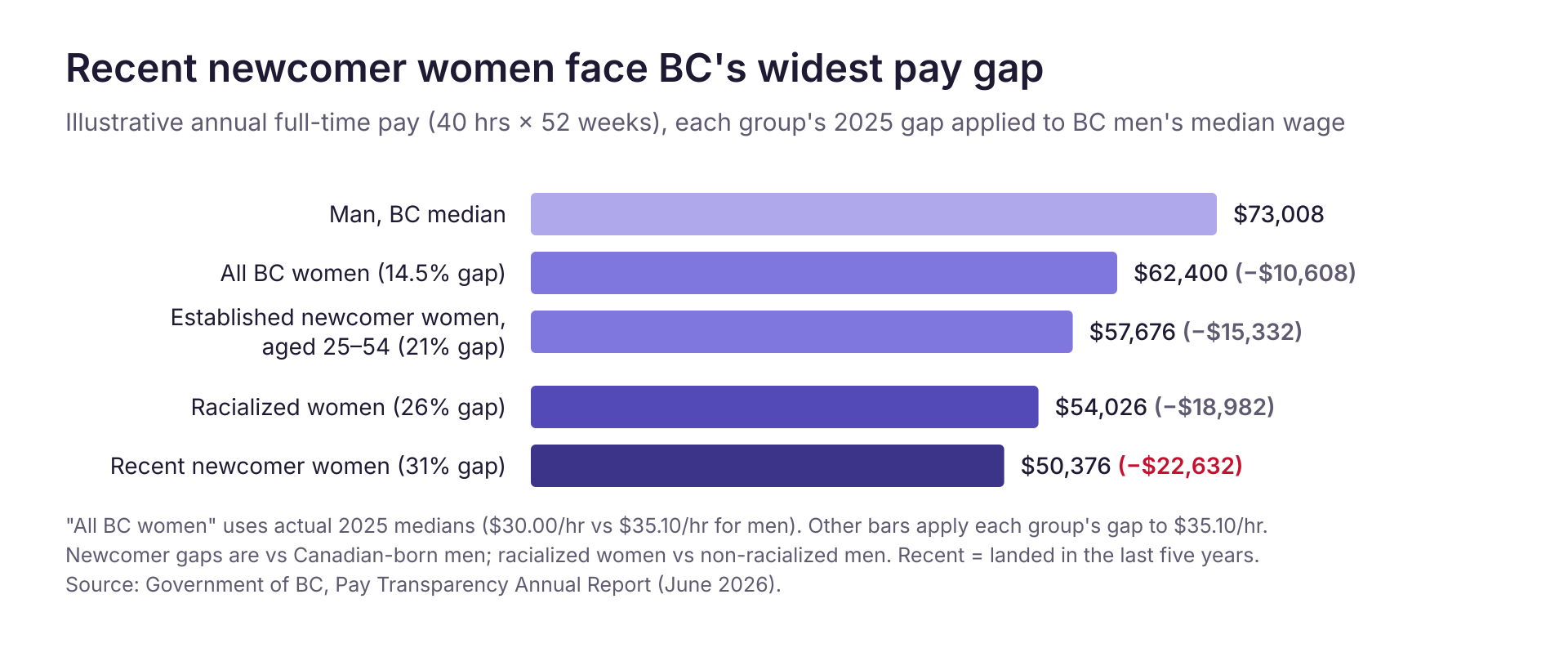
Caption: The chart is AI generated and takes the gap each BC group faces and applies it to a man earning BC’s median wage. The “All BC women” bar uses real 2025 median wages: Women’s median hourly wage in B.C. ($30.00) was the highest of any province, but men’s was $35.10. The other bars are illustrations, because the report compares each group with a different group of men.
- A woman who arrived in the past five years with a master’s degree typically earns about $69 for every $100 earned by a Canadian-born man, who is less likely to hold a degree at all.
- A woman who arrives later in her career gets less than 55 cents on the dollar at first.
WES Data on Immigrant Wages
Source: World Education Services: The Immigrant Integration Paradox (2026)
The data:
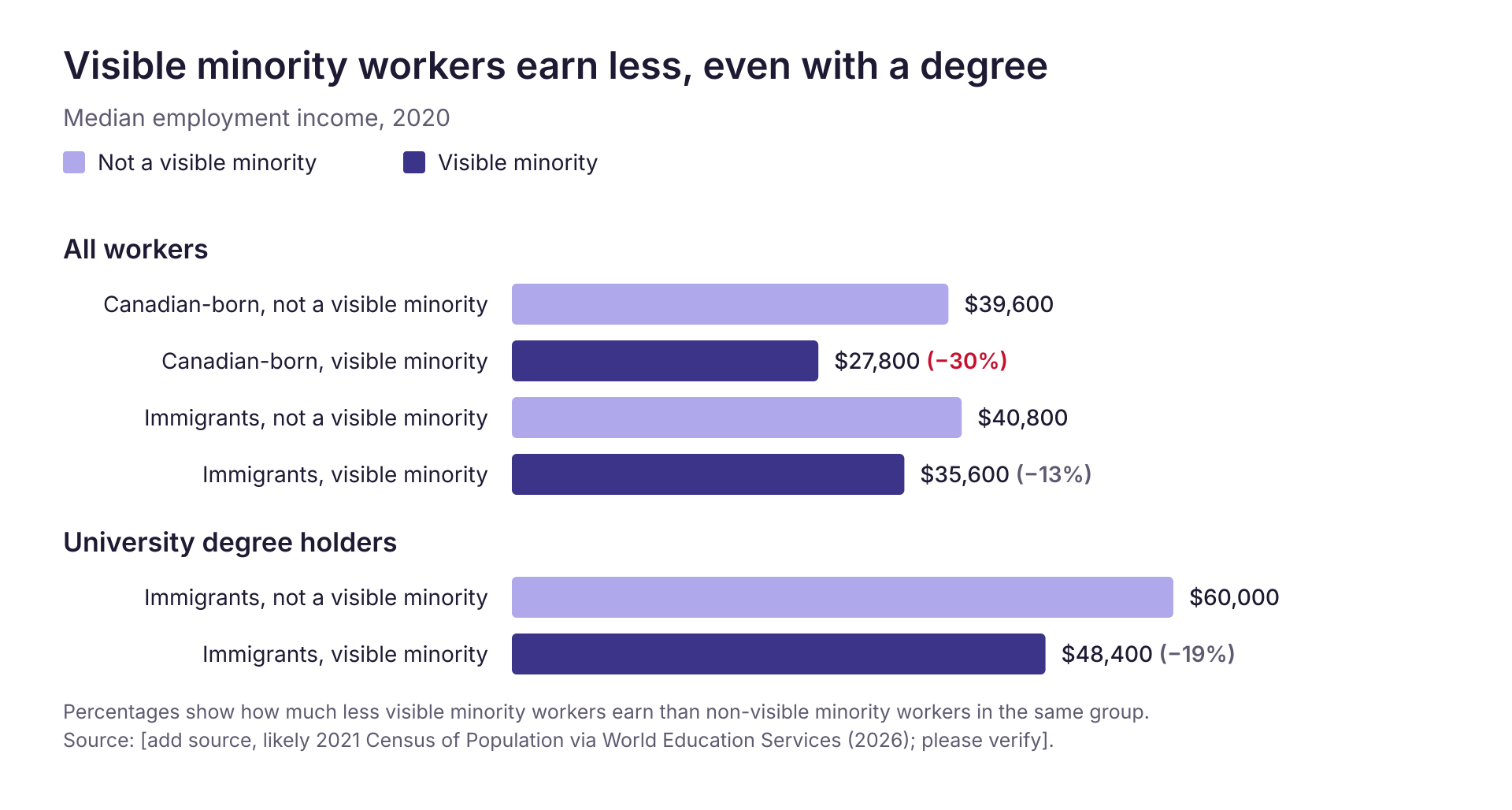
Visible minority immigrants earned $5,200 less than their non-visible minority immigrant counterparts, “adding a race-based penalty to the immigrant wage gap.”
The WES data notes that higher education doesn’t eliminate these disparities. Visible-minority immigrants with university degrees earned 24% less than non-visible minority immigrants with university degrees and 37.4% less than non-visible minority Canadian-born degree holders.
What Newcomer Women can do About the Wage Gap
While the data is infuriating, it doesn’t need to be disempowering. Hidden among the data are tips and resources newcomers can use to start to close that pay gap. Here are the top tips I found:
Have your Foreign Credential Recognized as Early as Possible
The data above showed that the pay gap for women was higher when their degree is from abroad. Plus, Windmill Microlending notes that women newcomers who have their international credentials recognized to work in their trained professions see a 3.8x increase in their earnings.
Here’s what that raise would look like, in monetary figures:
| Earnings before | After (3.8x) |
| $20,000 | $76,000 |
| $25,000 | $95,000 |
| $30,000 | $114,000 |
This data is relevant only to Windmill Microlending’s clients, so it may not be broadly applicable. However, the lesson about getting foreign credentials recognized and moving into a career (compared to a survival job) holds true.
Resources to help: Contact your local newcomer settlement services provider to find resources to help you have your foreign credentials recognized in Canada. Just search for Newcomer Settlement Services [Your Town/Region], and you may be able to find support.
Reminder: Budget 2027 announced a change in access to settlement services after arrival. From April 2027, federally funded settlement services can only be accessed by economic immigrants for five years after landing.
Get Canadian Work Experience in Your Field
The data released about women newcomer’s earnings seems to reliably suggest that working in a skilled job in Canada is a strong pathway to higher earnings. Given how highly educated women newcomers tend to be, it’s clear they have a lot to offer Canadian workplaces.
We know – this may be easier said than done, especially in Canada’s current job market.
But, we also know that perseverance, hard work, and accessing the right resources can help get your foot in the door. You can start with newcomer settlement services in your area, and with our guide to finding jobs in Canada. .
Find a Mentor
The WES report highlights mentorship as a key way “to help newcomers translate expertise into commensurate employment”. There are many programs across Canada that link newcomers to established Canadian residents for mentorship – often for free. So, it’s helpful to look for local resources as a starting point.
Research The Market Rate and Negotiate
It is commonplace in Canada to negotiate your compensation when you apply for a role. It’s not rude, and negotiating your salary and overall package can result in better wage outcomes for applicants. Though, apparently just 1-in-3 professionals in Canada try to negotiate a better salary when offered a job – and women are less likely than men to ask for higher pay, and they’re also less likely to get it.
I still thought this was worth including. There’s room for women, generally, to get better at negotiating their salary packages. And knowing the market rates is a strong starting point. Here are some bullet point, high-level tips to use when negotiating a salary:
- Your previous salary from abroad is the wrong starting point. Use local rates from your city if possible, including recent listings for other, similar roles. Canada’s figures from Job Bank are relevant but illustrative only.
- Compare your experience to the job’s requirements and, if you meet most of the requirements or exceed the requirements in any level, push for a salary at the higher end of the range. Point to your experience to justify why.
- If there’s no room to move on the base salary, ask for other compensation, like wellness benefits, extra vacation, paid training, or covering licensing or credential-recognition fees and professional memberships.
Lastly, it can be helpful to practice these conversations before having them. You can work with a mentor, if you have one, or another resource at the settlement organisation. If they aren’t easily accessible, AI platforms like ChatGPT, Gemini, or Claude, can also offer feedback here – though always think critically about feedback from an LLM.
You Bring More Than Your Paycheque
The numbers are frustrating, but they don’t define what you’re worth. Every credential you get recognized, every connection you make, and every salary conversation you prepare for helps close the gap, for you and for the women who arrive after you.
We’re here to help along the way. Sign up for the Moving2Canada newsletter for free guides, job-search tips and the latest immigration updates. And if this piece helped you, please share it with a newcomer woman in your life.
If you have tips for women newcomers in Canada, or if you’d like to share your story, feel free to write to me at [email protected]. I’d love to share your wisdom with our community.
About the author

Stephanie Ford
She/Her
Finance, Law and Immigration Writer
Stephanie is a content creator who writes on legal and personal finance topics, specializing in immigration and legal topics. She earned a Bachelor of Laws and a Diploma in Financial Planning in Australia. Stephanie is now a permanent resident of Canada and a full-time writer at Moving2Canada.
Read more about Stephanie Ford
Citation
Ford, Stephanie.
"The $15,000 Pay Gap No One Warned Newcomer Women About (& How to Fight Back)."
Moving2Canada.
Last modified November 25, 2026.
https://moving2canada.com/2026/11/newcomer-women-pay-gap-2026/.
Copy for Citation
Featured Stories

Immigration • Nov 25, 2026
What Canada’s 2027 Immigration Levels Plan Doesn’t Count
Read more

Immigration • Nov 25, 2026
The $5,000 Red Seal Completion Bonus: What Newcomers Need to Know (and Why Most Work Permit Holders Are Left Out)
Read more

Express Entry • Nov 25, 2026
6,000 Candidates Invited in French Express Entry Draw; CEC Draw Still Awaited
Read more

Immigration • Nov 24, 2026
Conservatives Ask MPs to Reject Canada’s 2027 Immigration Levels Plan: What That Could Mean
Read more