Canada has updated its Job Bank wage rates for 2026, with potential implications for foreign workers and people planning to apply for permanent residence.
The new hourly prevailing wages were published on November 18, 2026. These wages are used to assess job offers under several immigration programs, including the Temporary Foreign Worker Program (TFWP), certain International Mobility Program (IMP) categories, and some Provincial Nominee Program (PNP) streams.
The new figures could also influence which occupations qualify for additional Express Entry points in the future.
Here’s what the latest update means for your immigration plans.
Key Takeaways
- Canada updated its Job Bank occupational wage rates on November 18, 2026.
- Some employers may need to increase foreign workers’ wages or adjust job offers to meet updated requirements.
- The new figures could affect eligibility under certain Provincial Nominee Program streams.
- Some occupations could eventually gain or lose additional Express Entry CRS points, but no changes have been announced yet.

Live Webinar - Ask Us Anything
Ask Us Anything Live on November 20
Join RCIC Rebecca Major and the Moving2Canada team to discuss all things immigration and life in Canada, live. We'll be answering your questions live too, so don't miss out.
Get Notified When We're Live
What Changed in Canada’s Job Bank Wages?
On November 18, 2026, Job Bank updated its low, median, and high hourly wages across Canada.
These figures are available at the national, provincial, territorial, and regional levels. The median wage, which represents the midpoint of reported wages, is particularly important because it helps determine wage requirements under several immigration programs.
You can check the latest wages for your occupation and location using Job Bank’s wage search tool.
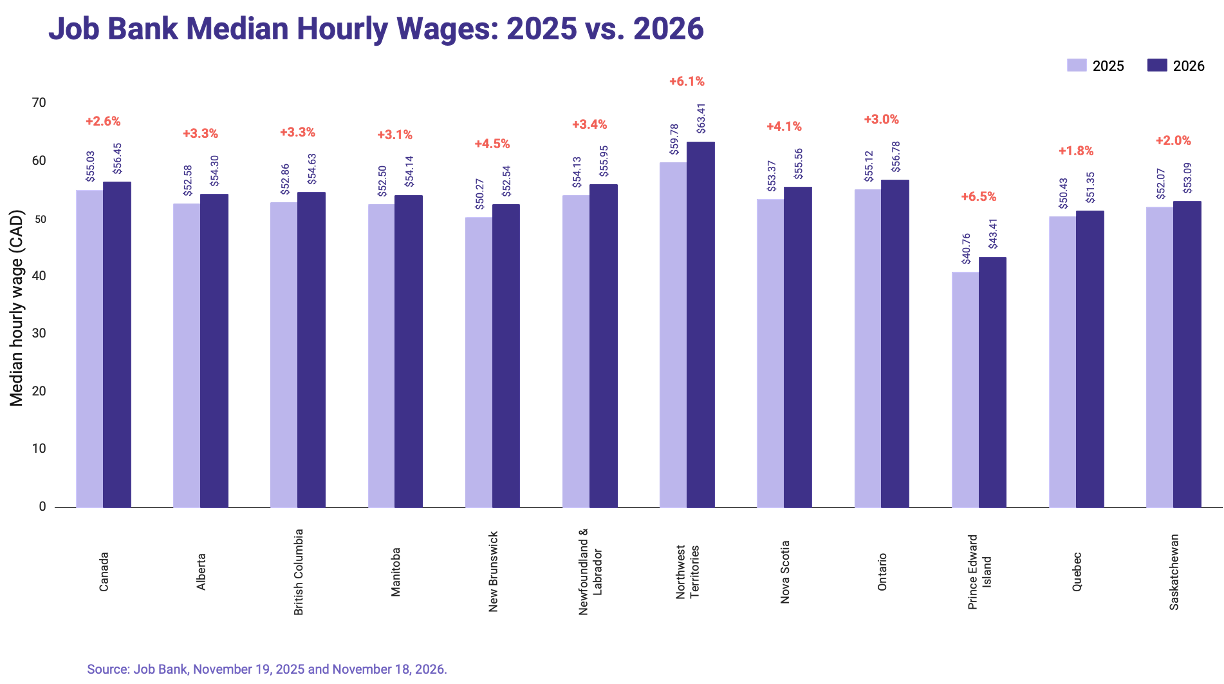
The graph below compares how median hourly wages have changed across Canada and by province and territory in 2026.
3 Ways Canada’s Wage Updates Can Impact Your Immigration Plans
The latest Job Bank wage updates could affect your immigration plans in three main ways.
If you’re a foreign worker, the changes could affect the salary your prospective or current Canadian employer must offer you.
If you’re applying for permanent residence through a PNP, the changes could affect whether your job offer qualifies. And if you’re an Express Entry candidate, the new wage figures could eventually impact how many additional CRS points you receive for high-wage work experience or a qualifying job offer.
Let’s look at each of these in more detail.
1. Foreign Workers: Your Job Offer or Salary May Change
The wage update could affect both foreign workers planning to work in Canada and those already employed here.
New Job Offers Under the Temporary Foreign Worker Program
If you’re planning to work in Canada under the TFW program, the employer must generally offer you at least the prevailing wage for your occupation and location.
This is the higher of:
- The Job Bank median wage for your occupation and economic region, or
- The wage paid to Canadian citizens and permanent residents doing similar work at the same location.
If the prevailing wage increases, your employer may need to offer a higher salary to get a positive Labour Market Impact Assessment (LMIA). A positive LMIA confirms that hiring a foreign worker is unlikely to have a negative impact on Canada’s labour market.
This applies to both the High-Wage and Low-Wage Streams of the TFWP, as well as applicable LMIAs supporting permanent residence.
One thing to note: The update does not directly change the wage thresholds used to determine whether an LMIA falls under the High-Wage or Low-Wage Stream. These are calculated separately using Statistics Canada’s Labour Force Survey data.
LMIA-Exempt Job Offers Under the IMP
Employers do not need an LMIA to hire foreign workers through the International Mobility Program (IMP). However, some IMP work permit categories, like the Intra Company Transfer – Specialized Knowledge category (C63), still require employers to meet prevailing wage requirements.
For these categories, employers must offer at least the Job Bank median wage or the comparable wage paid to Canadian workers, whichever is higher.
If the applicable wage increases, employers may need to adjust their job offers. The rules vary by IMP category, so not all LMIA-exempt job offers are affected.
Pay Increases for Existing Foreign Workers
If you’re already working in Canada under the TFWP, your employer may need to increase your pay to meet the updated prevailing wage.
Employers must review prevailing wages annually and make any necessary adjustments by January 1, 2027.
For example, if you’re earning $25 per hour and the prevailing wage increases to $27, your employer may need to raise your pay accordingly.
If you’re already earning more than the new prevailing wage, no increase may be needed.
If the prevailing wage decreases, your employer cannot reduce your pay below the amount approved in the LMIA.
Employers who fail to meet wage requirements could face penalties, including fines or restrictions on hiring foreign workers.
2. Provincial Nomination: Your Job Offer May Need to Meet New Wage Requirements
The Job Bank wage update could also affect your eligibility for permanent residence through certain Provincial Nominee Programs (PNPs).
Many employer-supported PNP streams require job offers to meet minimum wage requirements.
For example:
- Ontario Workforce Priority Stream: Job offers generally must meet or exceed the Job Bank median wage for the occupation and region. Recent Ontario graduates in TEER 0–3 occupations can qualify with wages meeting the Job Bank low-wage level.
- British Columbia PNP Skilled Worker and Health Authority streams: Offered wages must fall within the range published by WorkBC or Job Bank for the occupation and location. Wages must also be comparable to those paid to Canadian workers doing similar jobs.
If the applicable wage increases, a job offer that previously met the requirements may no longer qualify. Your employer may need to increase the offered salary before you apply for PNP.
3. Express Entry: Some Occupations Could Gain or Lose CRS Points
On November 3, 2026, IRCC introduced a new Labour Market Integration factor that awards points for eligible Canadian work experience or qualifying job offers in high-wage occupations.
The wage update could eventually affect which occupations qualify as “high-wage”. However, it does not change your high-wage occupation points or CRS score at this time.
Depending on the occupation’s wage level, candidates can receive up to 100 additional points for a qualifying job offer or 70 extra points for high-wage occupation experience.
IRCC currently lists 186 occupations across the three high-wage categories. This list is based on wage information from 2023 to 2025. When IRCC next reviews the list, newer wage data could affect how occupations are categorized.
Disclaimer:
The following section covers possibilities, not guaranteed changes. IRCC uses wage information from multiple sources and looks at the highest level reached over a three-year period. National wage benchmarks also change, so an increase or decrease in Job Bank wages does not necessarily mean an occupation will be recategorized.
For now, IRCC’s high-wage occupation list remains unchanged.
Which Occupations Could Gain More CRS Points?
Our analysis of Job Bank’s 2025 and 2026 wage datasets revealed several high-wage occupations where national median hourly wages increased.
| Occupation | NOC | Current tier | 2025 wage | 2026 wage | Increase |
|---|---|---|---|---|---|
| Recreation, sports and fitness program directors | 50012 | 1.3× | $36.63 | $43.02 | 17.4% |
| Supervisors, logging and forestry | 82010 | 1.3× | $34.85 | $40.00 | 14.8% |
| Assessors, business valuators and appraisers | 12203 | 1.3× | $35.00 | $39.66 | 13.3% |
| Deck officers, water transport | 72602 | 1.3× | $41.36 | $46.00 | 11.2% |
| Geoscientists and oceanographers | 21102 | 1.5× | $50.00 | $56.25 | 12.5% |
| Mathematicians, statisticians and actuaries | 21210 | 1.5× | $51.00 | $56.82 | 11.4% |
| Computer engineers | 21311 | 1.5× | $52.50 | $57.69 | 9.9% |
These wage increases could influence future high-wage occupation classifications. However, whether an occupation moves into a higher tier will depend on IRCC’s assessment of multiple wage datasets and the national wage benchmarks.
But if it does happen, moving from the 1.3x to the 1.5x category would mean an increase from 20 to 40 additional points for Canadian work experience, or from 50 to 70 points for a qualifying job offer.
Moving from 1.5x to 2x could increase the available points from 40 to 70 for work experience, or from 70 to 100 for a job offer.
Which Occupations Could Lose CRS Points?
Other high-wage occupations saw national median hourly wages decline.
| Occupation | NOC | Current tier | 2025 wage | 2026 wage | Decrease |
|---|---|---|---|---|---|
| Air traffic controllers | 72601 | 1.5× | $54.88 | $49.54 | 9.7% |
| Forestry professionals | 21111 | 1.5× | $47.00 | $43.00 | 8.5% |
| Physicists and astronomers | 21100 | 1.5× | $56.49 | $52.46 | 7.1% |
| Chemical engineers | 21320 | 1.5× | $51.92 | $49.27 | 5.1% |
| Mining engineers | 21330 | 2× | $60.00 | $57.69 | 3.9% |
These occupations could face a lower classification in a future review, potentially reducing the additional CRS points available to eligible candidates.
However, a decline in the latest wage figures does not automatically mean an occupation will move down.
How We Identified These Occupations
We compared national median hourly wages in ESDC’s November 2025 and November 2026 datasets, focusing on occupations already included in IRCC’s high-wage list. We identified occupations with notable increases or decreases in wages. We did not look at occupation that could be added to the high-wage occupation list in the future.
What the Job Bank Wage Update Means for You
Whether you’re already working in Canada or planning to apply for a work permit or permanent residence, the latest wage update can impact your immigration plans. Here’s what it could mean for you:
- If you’re planning to work in Canada: Check whether your job offer meets the latest wage requirements, particularly if your employer needs an LMIA or you’re applying through an IMP category with prevailing-wage rules.
- If you’re already working in Canada: If you’re employed under the TFWP, check whether your employer needs to increase your pay to meet the updated prevailing wage.
- If you’re applying through a PNP: Make sure your job offer still meets the applicable wage requirements before submitting your application.
- If you’re in the Express Entry pool: Your CRS points remain unchanged. You don’t need to update your profile because of the new wage figures.
- If you’re planning to apply through Express Entry in the future: Keep an eye on the high-wage occupation list and wage trends, especially if you’re considering different career paths in Canada. Future changes could affect how many CRS points you get for your occupation.
Sign up for the Moving2Canada newsletter to get updates as they happen, so you know what’s changing and whether it could help you.

About the author

Sugandha Mahajan
She/Her
Content Marketer
Born and raised in New Delhi, India, Sugandha moved to Canada as a permanent resident in early 2020, just weeks before the pandemic shut everything down. She has first-hand experience with many common newcomer challenges, including navigating the Express Entry system, finding a job without Canadian experience, and figuring out small talk. To deepen her understanding of the field, she is currently pursuing a Graduate Diploma in Immigration & Citizenship Law at Queen’s University.
Read more about Sugandha Mahajan
Citation
Mahajan, Sugandha.
"Canada Updates Job Bank Wages: 3 Ways This Could Affect Your Immigration Plans."
Moving2Canada.
Last modified November 18, 2026.
https://moving2canada.com/2026/11/canada-updates-job-bank-wages-3-ways-this-affects-your-immigration-plans/.
Copy for Citation
Featured Stories

Express Entry • Nov 18, 2026
IRCC Changes Express Entry Researchers Category: Teaching and Research Assistants Removed
Read more

Express Entry • Nov 18, 2026
High-Wage CRS Points Boosted Scores by an Average of 44 Points Among Community Respondents
Read more

Canadian Citizenship • Nov 18, 2026
Canadian Citizenship Test: How It Works and How to Pass
Read more

Finances • Nov 18, 2026
The Issue with Invisible Money and How to Make it Visible Again
Read more