Imagine spending years or even a decade collecting post-secondary credentials and work experience, with the goal of getting Canadian PR. But even as you dream of building a fulfilling career in Canada, you know that you have a 1 in 3 chance at that life.
This shocking stat comes from a new report by the Institute for Canadian Citizenship (ICC) called Selected but Neglected.
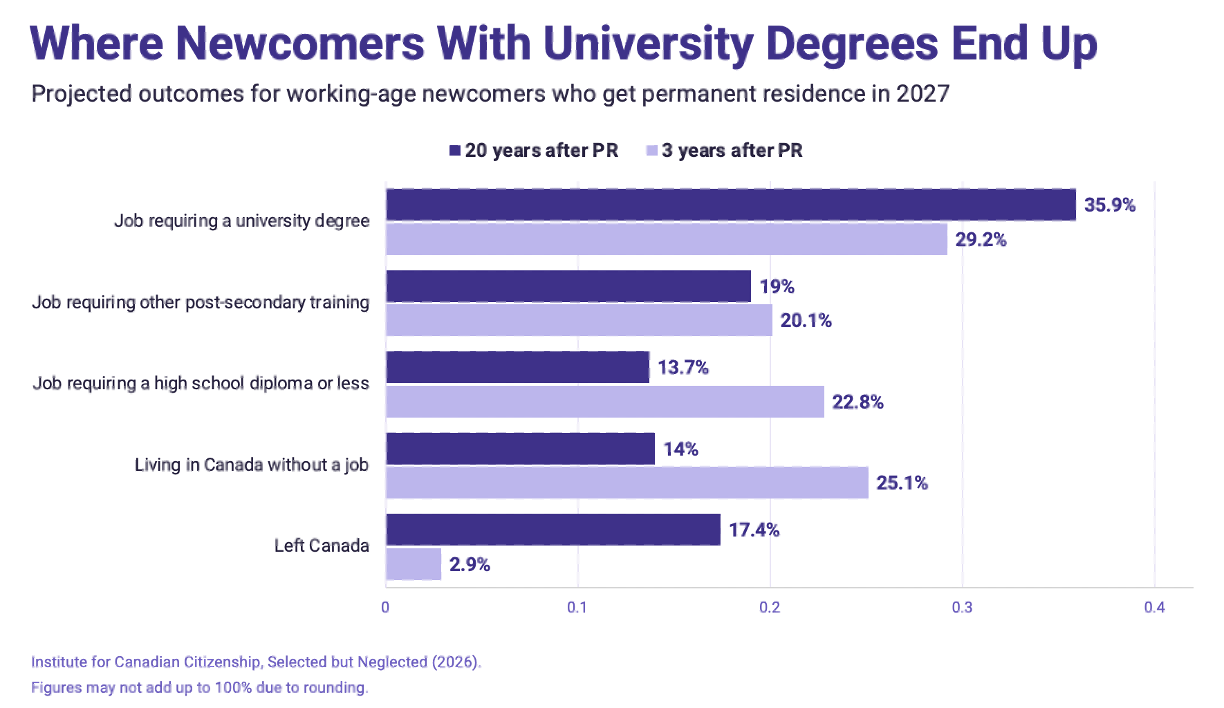
The report projects that only 35.9% of new permanent residents with university degrees will hold jobs that typically require a degree 20 years later. By then, 17.4% are expected to have left Canada.
It also projects that the situation will be worse in in-demand fields like healthcare. Only 29.4% of those with degrees in medicine, dentistry, veterinary medicine or optometry will hold a job that typically requires a degree three years after getting PR.
Canada uses the Express Entry system to invite skilled workers in categories like health care. ICC’s report asks what happens after people get PR. How many find jobs that use their education?
Key Takeaways
The report focuses on working-age newcomers with university degrees who get PR in 2027.
- When they get PR, about 190,000 new permanent residents will be aged 25 to 64 and hold a university degree.
- Three years after PR, about one in four will be living in Canada without a job.
- Twenty years after PR, about one in three will be working in jobs that usually require less education. 17.4% will have left Canada.
These estimates are based on the 2027 immigration levels plan but exclude time-limited measures.
The report calls for fairer licensing rules and asks employers to give more weight to skills and experience gained abroad.
The First Few Years Can Be Especially Hard
Canada’s Immigration Levels Plan sets a regular target of 380,000 new permanent residents for 2027. The ICC’s forecast leaves out admissions under one-time and time-limited measures.
The study looks at people aged 25 to 64 with university degrees, including people who earn a degree after getting PR.
Three years after getting PR, fewer than three in 10 are projected to work in a job that usually requires a degree. 22.8% are expected to work in jobs that usually require a high school diploma or less. About one in four are projected to be living in Canada without a job.
Job Prospects Improve Over Time, but Many Remain Underemployed
Even after 20 years, about one in three are projected to be working in jobs that usually require less education than the degree they have. Another 14% are expected to live in Canada without a job.
17.4% of university-educated newcomers will leave within 20 years. The ICC’s technical supplement explains that the researchers used gaps in past tax filings to estimate departures.
Of those who are projected to stay in Canada, 16.6% will be significantly overqualified for their jobs 20 years after getting PR.
That’s about twice the rate of 8.5% for Canadian-born people of similar ages with university degrees.
Earlier census data show that fewer immigrants with university degrees were working in jobs that required a degree. Among those who had a job and had lived in Canada for more than 10 years, the share fell from 62.2% in 2001 to 55.2% in 2021.
If that trend continues, the ICC says its long-term forecast may be too optimistic.
What the Forecast Shows for Health Care
The ICC study looked at newcomers with degrees in medicine, dentistry, veterinary medicine and optometry.
It found that finding any job can be harder in the first few years for newcomers with these health degrees. Three years after getting PR, 39.1% are projected to be living in Canada without a job — that’s 14 percentage points higher than the other newcomers with university degrees.
Three years after getting PR, only 29.4% of health professionals in these fields are projected to work in a job that usually requires a university degree. That share rises to 50.9% after 20 years.
Among those who are still in Canada after 20 years, the projected share is 61.6%. In the 2021 census, it was 88.1% for Canadian-born people of similar ages with the same types of degrees.
A job can count as a match even if it’s outside the person’s field. For example, a dentist who takes a job in another field that requires a university degree still counts. The share working in the profession they trained for could be lower.
The ICC estimates that roughly 5,700 newcomers with health care degrees will receive PR in 2027. By 2030, about 3,870 of them will still be in Canada but either have no job or be working in a job below their education level.
If about a third of them, or 1,290 people, could qualify and practise as family doctors, they could fill about 5% of Canada’s projected shortage of 25,642 doctors. That would come from a single year of PR admissions, without raising immigration levels.
The Solution: Fair Licensing and Better Hiring Practices
Although IRCC is selecting the right talent through Express Entry and targeted immigration programs, Canada falls short on actually making use of those skills.
In a 2019 analysis, RBC Economics estimated that closing the gaps in pay and employment between immigrants and Canadian-born workers could add up to $50 billion a year to Canada’s economy.
The ICC report points to licensing rules and hiring practices as two reasons newcomers can struggle to get back into their field.
It makes four recommendations:
- Make licensing fairer. The report recommends that the government pass a Fair Licensing Act modelled on the Canada Health Act. It proposes tying federal funding to whether provinces and territories meet standards for assessing foreign qualifications fairly and on time.
- Change how employers assess candidates. Ideally, employers should drop Canadian work experience requirements and assess what candidates can do. The report suggests that governments could help small businesses assess work experience gained abroad.
- Set national targets for jobs that match newcomers’ education. IRCC should set measurable targets for increasing the share of newcomers who work in jobs that match their level of education. It should also report regularly on how many newcomers are overqualified for their jobs.
- Track who leaves Canada. IRCC should report each year on how many immigrants leave and look more closely at who leaves and why.
At the report launch, ICC CEO Daniel Bernhard pointed to Nova Scotia’s Physician Assessment Centre of Excellence (PACE) as a licensing approach other provinces could build on. Through PACE, eligible doctors trained abroad see patients under supervision during a 12- to 20-week assessment. Those who pass and get licensed commit to practising in Nova Scotia for three years, often in rural communities.
What This Means if You Plan to Work in Canada
Finding a job in your field may take longer than you expect. Many newcomers start out in jobs that require less education or work outside the field they trained in. The report projects that more newcomers will find jobs that match their level of education over time, though many will still be overqualified for the work they do.
If your job requires a licence, contact the licensing body in the province or territory where you want to work. Ask which documents you need, how long the process usually takes and what steps you can start before you move. This can significantly shorten the time it takes you to enter the job market.
An educational credential assessment can show regulators and prospective employers how your degree compares with a Canadian one.
As you plan your move, budget for a job search that may take longer than you’d hoped. It can also help to look for related roles you can do while you apply for a licence or search for a job in your field.

About the author

Sugandha Mahajan
She/Her
Content Marketer
Born and raised in New Delhi, India, Sugandha moved to Canada as a permanent resident in early 2020, just weeks before the pandemic shut everything down. She has first-hand experience with many common newcomer challenges, including navigating the Express Entry system, finding a job without Canadian experience, and figuring out small talk. To deepen her understanding of the field, she is currently pursuing a Graduate Diploma in Immigration & Citizenship Law at Queen’s University.
Read more about Sugandha Mahajan
Citation
Mahajan, Sugandha.
"20 Years After PR, Only 1 in 3 Newcomers With Degrees Will Have Jobs That Require One."
Moving2Canada.
Last modified November 26, 2026.
https://moving2canada.com/2026/11/20-years-after-pr-only-1-in-3-newcomers-will-degrees-will-have-jobs-that-need-one/.
Copy for Citation

Featured Stories

Finances • Nov 26, 2026
Big Bills Keep Wrecking Your Budget? You May Be Missing This One Thing
Read more

Express Entry • Nov 26, 2026
600 ITAs in First STEM Category Express Entry Draw Since 2024, Cut-Off Jumps to 547
Read more

Finances • Nov 25, 2026
The $15,000 Pay Gap No One Warned Newcomer Women About (& How to Fight Back)
Read more

Immigration • Nov 25, 2026
What Canada’s 2027 Immigration Levels Plan Doesn’t Count
Read more