By Dane Stewart
Updated on June 3, 2026

A Complete Budget Guide
In this guide, we’ll look at the cost to move to Canada from the US, including immigration fees, moving costs, health insurance, housing, and the first few practical expenses that come with starting your life in Canada.
Moving to Canada from the US in 2026 generally costs between $15,000 and $30,000 USD for an individual or a family, factoring in immigration fees, logistics, and initial settlement expenses. Your exact budget will depend heavily on your immigration pathway, how much you bring with you, and where you plan to live in Canada.
And, fair warning: Toronto and Vancouver are not cheap. Beautiful, yes. Affordable? That depends on your definition of affordable.
Key Takeaways
- An individual moving from the US to Canada should budget at least around $17,310 USD for immigration fees, settlement funds, basic moving costs, and short-term health insurance.
- A family of four should budget at least around $28,000 USD to move from the US to Canada, including immigration costs, settlement funds, and basic moving expenses.
- The biggest cost drivers are usually immigration fees, moving and shipping costs, private health insurance, and housing costs.
- Express Entry is one of the fastest permanent resident pathways for skilled workers, but Americans may also be eligible for work permits, family sponsorship, a Provincial Nominee Program (PNP), or study permits.
How Much Does It Cost To Move From The US To Canada?
Moving from the US to Canada usually involves two major categories of costs: the cost of the immigration process and the cost of actually moving.
For individuals, you should budget at least $17,310 USD to make the move to Canada from the US. For a family of four, the minimum budget is closer to $28,000 USD.
These estimates include basic immigration costs, basic moving services, short-term health insurance, and early housing. They do not include the full cost of living once you arrive, long-term housing costs, furniture, childcare, vehicle import costs, or professional immigration advice.
In other words, these figures are the floor, not the ceiling. Here’s a table with the top line numbers:
| Costs Breakdown for a U.S.-to-Canada Move | ||
|---|---|---|
| Cost | Amount CAD | Amount USD |
| Immigration Fees | $2,600 | $1,900 |
| Settlement Funds | $15,263 | $11,150 |
| Immigration Advice (optional) | $3,800 | $2,800 |
| Basic Moving Service | $1,000 | $730 |
| 3 Months Health Insurance | $1,000 | $730 |
| Total Minimum Costs | $23,663 | $17,310 |
We’ll break this down in more detail below.
Immigration Costs: Express Entry, Work Permits, and Family Sponsorship
Your immigration costs will depend on how you plan to move to Canada.
Some Americans move to Canada through permanent residence pathways like Express Entry or family sponsorship. Others first come on a work permit or study permit before applying for Canadian permanent residence later.
There is no single “move to Canada” application. There are many immigration pathways, each with its own costs, requirements, processing times, and paperwork. Thrilling stuff, I know.
Express Entry and Canadian permanent residence costs
Express Entry is one of Canada’s main systems for managing skilled worker applications. It covers several economic immigration programs, including the Federal Skilled Worker Program, Canadian Experience Class, and Federal Skilled Trades Program.
If you’re applying for permanent resident status through Express Entry, your costs may include:
- language testing,
- an Educational Credential Assessment,
- a medical exam,
- biometrics,
- police certificates,
- document translation or certification,
- and government processing fees.
Yes, you may need a language test even if you’re a native English speaker moving to Canada from the US. Canada loves paperwork, and Canada especially loves standardized paperwork.
As a rough estimate, an individual applying through Express Entry should budget at least $1,800 USD for upfront immigration costs. This includes items like language testing, an Educational Credential Assessment, biometrics, medical exam costs, and application fees from Immigration, Refugees and Citizenship Canada (IRCC).
Language testing for immigration can range from $300 to $450 CAD. An Educational Credential Assessment (ECA) can cost approximately $240 to $350 CAD, depending on the provider and delivery options. Medial examinations for immigration can cost between $200 and $500 CAD per person, though the exact cost will vary by physician and location.
Express Entry has two layers of application fees, updated most recently on April 30, 2026. First, the principal applicant and accompanying spouse/common-law partner must each pay a processing fee of $990 CAD. All accompanying dependent children must pay a processing fee of $260 CAD. This processing fee is due upon submission of the PR application. Next, approved adult applicants must pay a $600 CAD Right of Permanent Residence Fee (RPRF).
(As of April 30, 2026, government fees for permanent residency increased.)
The Express Entry system processes approximately 80 percent of applications for skilled workers within six months, making it one of the fastest immigration pathways to permanent residency in Canada. Although, that six-month timeline does not include the time it takes to create an Express Entry profile, enter the pool, wait for an Invitation to Apply (ITA), and gather your documents – which can take several months, or longer.
Important note: The Express Entry system may be undergoing significant changes over the course of the next year as the government proposes reforms. Follow that story here.
Settlement funds
If you apply through Federal Skilled Worker or Federal Skilled Trades, you may need to show proof of settlement funds. These funds prove that you have enough money to support yourself and your family after arriving in Canada.
These funds are not paid to the Canadian government. They remain your money. But you need to show that you have access to them as part of the immigration process.
As of July, 2025, the settlement funds requirement for an individual is $15,263 CAD, or about $11,150 USD. For a family of four, the requirement is $28,362 CAD, or about $20,700 USD.
These numbers are typically updated each July, so if you’re reading this article after July, 2026, be sure to check the latest IRCC settlement funds requirement before applying.
A note for Canadian Experience Class candidates: you usually do not need to show proof of settlement funds if you are applying through CEC.
What's the real cost of living in Canada? Find out by city
Provincial Nominee Programs
A Provincial Nominee Program, or PNP, allows a Canadian province or territory to nominate candidates for permanent residency based on local labour market needs.
This can be a strong option for Americans with work experience in an in-demand field, a job offer from a Canadian employer, or a connection to a specific Canadian province like previous work or study experience.
Some provinces charge nomination fees, while others do not. These fees vary by province and can change over time. If you’re pursuing a PNP, check the rules for the specific province you’re targeting.
And yes, each province has its own Provincial Nominee Program containing multiple different streams. Because one immigration system apparently wasn’t enough. If you want to sort through the various PNP options, you can filter using our PNP Live Tracker Tool.
Family sponsorship
Family sponsorship is a direct immigration pathway that allows Canadian citizens and permanent residents to sponsor their spouse, common-law partner, or dependent children for permanent residence in Canada.
For example, Canadian citizens and permanent residents can sponsor spouses, common-law partners, and dependent children for permanent residence.
Family sponsorship costs can include sponsorship fees, permanent residence processing fees, biometrics, medicals, police certificates, and document preparation costs. As of April 30, 2026, the IRCC fees for sponsoring a spouse or partner at $1,260 CAD which includes the processing fee and RPRF.
Work permits and job offers
A job offer can change your budget, but it does not automatically make moving to Canada cheap or easy.
Some work permits require a Labour Market Impact Assessment, or LMIA. In most LMIA-based situations, the employer making the job offer is responsible for the LMIA fee. However, you may still need to budget for your work permit application, biometrics, credential documents, relocation costs, and the first few months of living expenses.
There are also LMIA-exempt work permit options. For some US citizens, the Canada-United States-Mexico Agreement, or CUSMA, can create a faster pathway to a Canadian work permit in certain professional occupations. This is similar to the TN Visa in the United States. You still need to meet the specific requirements, including having a qualifying job offer from a Canadian employer and the right professional credentials.
If you’re applying for a job in Canada, you may also need to budget for credential upgrades, professional licensing, or industry-specific certifications.
Study permits
Some Americans move to Canada as international students. A Canadian study permit can allow you to attend a designated learning institution, and some graduates may later qualify for a Post-Graduation Work Permit and eventually permanent resident status.
This pathway can work well for some people, but it can also be expensive. International tuition fees can easily cost in the tens of thousands of dollars per year. Add to that living expenses, housing, and health insurance costs and being an international student can be an expensive prospect.
If you’re considering the study route, do the math carefully before committing.
Cost for Immigration Consultants & Lawyers
Finally, you may wish to hire an immigration consultant to help you navigate Canada’s immigration system. The costs will vary depending on your chosen pathway and the level of service you choose, but typically run from 2,800–3,600 USD.

Ready to take the next step toward your Canadian dream?
Moving And Shipping Costs: What To Budget
Once the immigration side is sorted, there are the practical costs of moving.
This is where expenses can vary wildly.
If you’re moving lightly, driving yourself, and bringing only a few personal items, you may be able to keep costs relatively low. If you’re moving a full household, hiring a professional mover, importing a vehicle, and storing items temporarily, the price can climb quickly.
For individuals, we estimate a basic moving service at around $1,000 CAD, or about $730 USD. For a family, basic moving services start around $1,800 CAD. A full-service professional mover can easily cost $7,000 USD or more, and in some cases significantly higher depending on distance and volume.
We recommend getting at least six quotes from movers, since the costs can vary so widely.
A full-service moving company may charge for packing, insurance, specialty items, storage, and delivery timelines. If you’re moving furniture, musical instruments, artwork, tools, or other valuable items, ask about insurance and replacement coverage before signing anything.
Do you pay customs or duties on household goods?
Luckily, there’s generally no customs or duties payable on used household goods you bring with you when moving to Canada, as long as the items qualify under Canada’s rules. Most household goods are duty-free if owned and used for at least six months prior to moving.
Here’s the basic idea: if the goods are your personal or household items, and you owned, possessed, and used them before moving to Canada, they may qualify for duty-free import. New goods, commercial goods, or items purchased shortly before moving may be treated differently.
While household items are usually duty-free, items valued over $10,000 CAD may incur taxes upon importation.
The bottom line? Make a detailed list of what you’re bringing, keep receipts where possible, and review CBSA rules before crossing the border.
Should you bring your car to Canada?
For many families, selling your car before moving is one of the easiest ways to save money.
Canadian car prices are often comparable to those in the US, and importing a vehicle can involve taxes, inspections, repairs, registration costs, and compliance with Transport Canada standards.
In the current version of this article, we estimated that taxes, inspections, and repair costs for bringing a car can total more than $10,000 CAD in some cases.
That does not mean importing a car is always a bad idea. But it does mean you should check the numbers before assuming it will save money.
Healthcare, Banking, and First-Month Setup Costs
Moving to Canada also comes with a handful of first-month setup costs. These are easy to underestimate because they don’t always feel like “moving costs” until you’re actually paying them.
Health insurance
Canada’s healthcare system is very different from the US system.
Eligible Canadian citizens and permanent residents generally receive public health insurance through their province or territory. Unlike the US, where healthcare costs can be high and often require insurance, most basic healthcare services in Canada are provided at no charge at the point of service for those eligible. But, newcomers may not be covered immediately.
During your first months in Canada, your eligibility for provincial health insurance coverage depends on your province of residence and your immigration program.
In some provinces, new residents must wait three months before they become eligible for provincial health insurance coverage. During this waiting period, private health insurance is strongly recommended.
We estimate health insurance for an individual at around $1,000 CAD for the first three months, or about $730 USD. For a family of four, we estimated about $3,000 CAD, or roughly $2,150 USD. The exact costs will depend on the type of plan, coverage, limits, deductibles, and more.
You can get compare tailored health insurance quotes from our partners, Cigna Healthcare and BestQuote, to see what coverage may cost for your specific situation.
Trusted Health Insurance Partners
BestQuote Travel & Health Insurance
Cigna Healthcare - Health Insurance for Stays 4+ Months
Banking and financial setup
Opening a Canadian bank account is one of those boring-but-necessary settlement steps.
You’ll likely need a Canadian account to receive payroll, pay rent, set up utilities, transfer funds, build credit history, and manage everyday expenses in Canadian dollars.
Opening a Canadian bank account is essential for managing finances, and many banks offer newcomer packages that include benefits like no-fee banking for a limited time.
How Can Scotiabank Help You Succeed In Canada?
Receive emails from Scotiabank. Moving2Canada’s trusted banking partner will provide you with the right tools, resources, and advice to guide you through your banking journey as you settle into your new life.
Taxes for US citizens
A quick note for American citizens: moving to Canada does not necessarily end your US tax filing responsibilities.
US citizens are generally required to file US tax returns even while living abroad. Canada and the US have tax treaties that help prevent double taxation in many situations, but cross-border tax can get complicated quickly.
If you have investments, property, business income, retirement accounts, or significant assets, it’s worth speaking with a cross-border tax professional before you move.
It ain’t glamorous, but it’s potentially very important.
Housing Costs in Canada: Where You Save or Spend
Once you’re in Canada, your day-to-day cost of living will depend heavily on where you settle. Housing is usually the biggest variable.
Toronto and Vancouver are the classic examples: popular, opportunity-rich, beautiful in different ways, and expensive. Smaller cities and mid-sized communities can be much more affordable, though job opportunities, transit, and community supports vary.
Before moving, research the local housing market carefully. Rent, vacancy rates, neighbourhoods, commute times, and availability can change dramatically by city and province.
If possible, try to arrange temporary housing before arrival, especially if you’re moving to a competitive rental market like Toronto, Vancouver, or parts of the Greater Toronto Area.
Initial housing costs may require a budget of $3,000–$5,000 CAD for first month’s rent and security deposit in major cities. You may need several thousand dollars available for first month’s rent, deposits where applicable, temporary accommodation, furniture, and setup costs.
[Insert Budget Calculator CTA]
The Individual Cost of Living in Canada’s Biggest Cities
Once you’re in Canada, the day-to-day costs will depend largely on where you live. Let’s look at two of the most popular cities for newcomers: Toronto and Vancouver.
For individuals, the estimated monthly cost of living, excluding rent, is:
- Toronto: 1,498 CAD, or about 1,084 USD
- Vancouver: 1,521 CAD, or about 1,100 USD
Moving with a family? Here’s an overview of typical monthly expenses for a family of four in two of Canada’s largest cities: Toronto and Vancouver.
| Expense Category | Toronto (CAD) | Toronto (USD) | Vancouver (CAD) | Vancouver (USD) |
|---|---|---|---|---|
| Food & Groceries | 1,300 | ~940 | 1,350 | ~975 |
| Utilities (Electricity, Internet, etc.) | 230 | ~166 | 220 | ~159 |
| Childcare | 1,590 | ~1,151 | 1,580 | ~1,144 |
| Transportation | 520 | ~378 | 560 | ~407 |
| Miscellaneous (Entertainment, Fitness, etc.) | 460 | ~333 | 480 | ~349 |
| Total (Excluding Rent) | 5,498 | ~3,981 | 5,588 | ~4,048 |
| 3-Bedroom Apartment (City Center) | 4,192 | ~3,036 | 5,085 | ~3,682 |
| 3-Bedroom Apartment (Suburbs) | 3,442 | ~2,493 | 3,862 | ~2,796 |
You can see the breakdown for each of these on Numbeo’s Toronto vs Vancouver comparison.
Of course, rent changes the picture dramatically. A person living with roommates in a smaller city will have a very different monthly budget than someone renting a one-bedroom apartment in Toronto city centre.
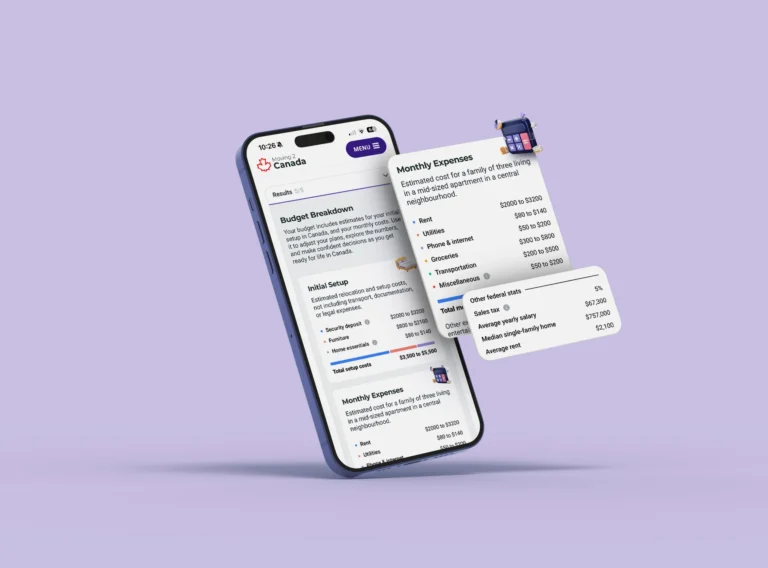
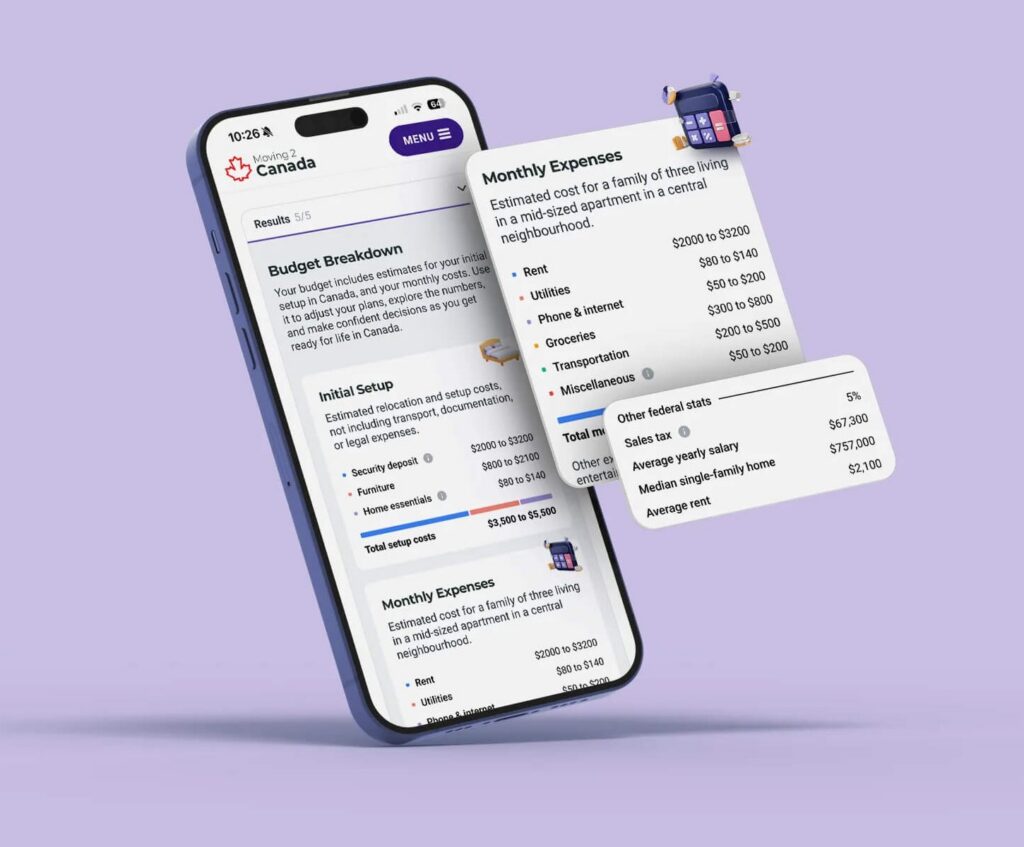
Want to better understand your likely costs? Try out our budget calculator.
What Unexpected Costs Should I Plan For?
Even a careful budget can miss a few things. Some common unexpected costs include temporary accommodation, furniture, utility deposits, winter clothing, car insurance, driver’s licence exchange fees, professional licensing, school supplies, and short-term gaps in employment.
You should also leave room for immigration delays. A delayed application can mean paying for extra months of rent, travel, storage, insurance, or temporary status in Canada.
A sensible approach is to build a contingency fund on top of your minimum moving budget. If you can, aim for several months of living expenses. If that’s not possible, at least give yourself a buffer for the first 60 to 90 days.
Canada is wonderful. Canada is also expensive when you first arrive. Both things can be true.
How To Save Money When Moving To Canada
There are a few practical ways to reduce your moving costs. First, compare multiple mover quotes. Not two. Not three if you’re feeling tired. Get several. Moving costs from the US to Canada can vary dramatically depending on the company, route, timing, and how much you bring.
Second, move less stuff. This sounds obvious, but shipping furniture across a border can cost more than replacing some items after arrival.
Third, think carefully before importing your car. For many families, selling a vehicle in the US and buying one in Canada may be the more affordable option.
Fourth, avoid peak moving periods if possible. Summer moves can be more expensive, especially for families trying to arrive before the school year begins.
Finally, use newcomer benefits where available. Some provinces, cities, settlement organizations, banks, and insurers offer newcomer-specific supports or discounts.
Small savings add up quickly when you’re rebuilding your life in a new country.
Frequently Asked Questions
Is it cheaper to live in Canada or the USA?
It depends where you live. Some costs may be lower in Canada, especially basic healthcare costs for those eligible for public health insurance. Other costs, including housing, groceries, telecom plans, and taxes, can be higher depending on the province and city.
Toronto and Vancouver are among Canada’s most expensive housing markets. Smaller cities and provinces may offer a lower cost of living, but job opportunities and salaries also vary.
How much money do you need in your bank to move to Canada?
For an individual moving from the US to Canada, we recommend budgeting at least around $15,500 USD for the move. For a family of four, the minimum budget is closer to $28,000 USD.
If you’re applying through certain PR pathways, such as the Federal Skilled Worker Program or Federal Skilled Trades Program, you may also need to show proof of settlement funds. These funds remain yours, but you must prove you have access to them.
Can a US citizen move to Canada permanently?
Yes, a US citizen can move to Canada permanently if they qualify for Canadian permanent residence. Common pathways include Express Entry, family sponsorship, a Provincial Nominee Program, and certain work or study pathways that can later lead to obtaining permanent residence.
Being an American citizen does not automatically give you the right to live permanently in Canada. You still need to qualify under a Canadian immigration program.
Can US citizens work in Canada?
US citizens need the correct authorization to work in Canada. Under the Canada-U.S.-Mexico Agreement (CUSMA), U.S. citizens can work in Canada without a Labour Market Impact Assessment (LMIA) in certain professions, streamlining the process for skilled workers. Others may need an employer-supported work permit, open work permit, or another type of authorization.
If you plan to work in Canada, confirm your eligibility before accepting a role or making the move.
Do I need private health insurance when moving to Canada?
In many cases, yes. Some provinces have a waiting period of up to three months before new residents can access public health insurance. Private health insurance is strongly recommended during any waiting period.
Even after public coverage begins, some services may not be covered, including certain dental care, prescription drugs, vision care, and paramedical services, unless you have additional private insurance.
About the author