This article was updated more than 6 months ago. Some information may be outdated.
There’s a lot to consider when you apply to universities in Canada as an international student. Immigration considerations, like the Provincial/Territorial Attestation Letters, might be top of mind – as well as just getting accepted to the college or university you’re interested in.
But have you ever considered access to healthcare as part of your destination planning? A new report from the Canadian Health Coalition and Madhu Nerma Migrant Justice Centre suggests it’s worth spending some time thinking about.
In this post, we explore the differences in access to healthcare for international students across Canada’s provinces and territories. We’ll answer your burning questions about where international students get free healthcare and outline the costs of healthcare across Canada.
Key Takeaways
- Alberta, New Brunswick, Prince Edward Island, Saskatchewan, and the Northwest Territories offer free access to public health care for international students.
- BC, Nova Scotia, and Newfoundland and Labrador offer access to public health care but at varying costs.
- Manitoba, Ontario, and Yukon do not offer access to public health care and require international students to get private coverage.
- Quebec’s access to healthcare varies depending on whether you’re from a signatory country.
Plus a quick note: healthcare in Canada is managed at the provincial and territorial level. So, each province and territory in Canada has its own healthcare system. Each has its own rules and requirements for international students. Any reference to Canadian healthcare systems means all the various healthcare systems across the country.

Settle into life in Canada
Organizing health care in Canada is just one aspect of settling in. Register for tips, email updates, and content curated just for you!
Subscribe Now (Unsubscribe Whenever)
Immigration Status in Canada and Access to Healthcare
Before we dig in deeper, I wanted to point out that your status in Canada will make a difference when it comes to healthcare access. If you’re studying for less than six months and are in Canada as a visitor, you likely won’t qualify for any access to Canada’s healthcare systems. Visitors generally aren’t given access to the system, even if international students are covered for free.
If you’re here as an international student with temporary status, you can find out more about your access to coverage and the costs in the article below. But, it’s worth noting that when your study permit expires, your access to care may change. It’s important to consider every change in your status in Canada as a flag to check your access to the healthcare system in the province or territory you’re living in.
Finally, if you switch institutions, this should also trigger a quick check on your healthcare access. Medical costs in Canada tend to be lower than the US, for example, but if you don’t have coverage, the costs can quickly add up.
So, Where in Canada Do International Students Get Free Healthcare?
Here’s how the Canadian Health Coalition and Madhu Verma Migrant Justice Centre outline access to the Public Health Care System (and whether it’s free):
- Alberta: Yes — and it’s free
- British Columbia: Yes — but it’s not free
- Manitoba: No — not applicable
- New Brunswick: Yes — and it’s free
- Newfoundland and Labrador: Yes — and it’s free
- Northwest Territories: Yes — and it’s free
- Nova Scotia: Yes — free after one year of study
- Ontario: No — not applicable
- Prince Edward Island: Yes — and it’s free
- Quebec: It depends on country of origin — but it’s free for students from signatory countries only
- Saskatchewan: Yes — and it’s free
- Yukon: No — not applicable.
In other words, it’s a two-step process for international students to get access to healthcare for free in Canada.
First, international students need access to the publicly-funded system.
Second, if granted, that access may be either free or it may cost that international student a fee.
Is all healthcare free for international students in these provinces?
Even where international students get free access to the public healthcare system, not all healthcare services are provided for free. This is also true for Canadian permanent residents and citizens.
Canada’s various public healthcare systems do not cover all health care services. Things like dental care, medication, vision care, physiotherapy, remedial massage and the like are not covered in the public system. So, people need to either pay out-of-pocket or rely on employer-provided benefits or private health plans.
So, even if you’re an international student studying in one of Canada’s provinces that provides free access to the local public system, it’s still worth considering buying a private policy to cover the cost of medications and other health services. Our partner, Cigna, offers private healthcare policies to international students studying in Canada for more than 4+ months. You can get a free quote from Cigna Healthcare.
How much does health insurance cost in Canada for international students?
Health insurance costs vary quite a lot for international students depending on whether they have access to the publicly-funded system or not (that’s what we covered in the section above).
Here’s what that looks like across Canada:
Regions in Canada That Offer Free Access To Public Healthcare Systems
- Alberta, New Brunswick, Northwest Territories, Prince Edward Island and Saskatchewan: No cost for public health coverage.
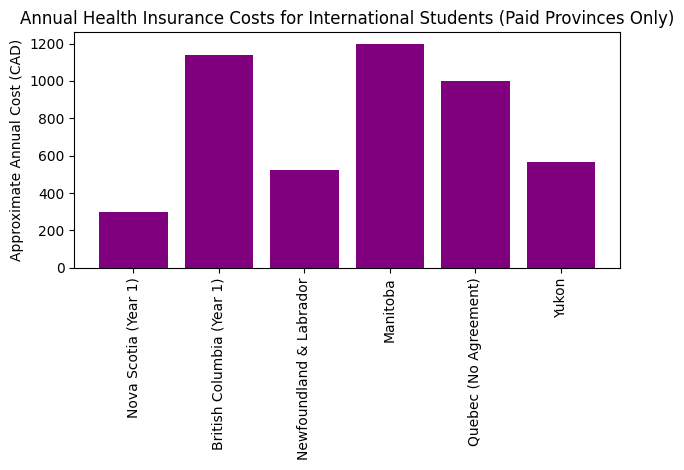
- In Nova Scotia, publicly funded coverage is free after one year of study, but the first year requires a health plan from the university. Costs will vary depending on the education institution, but may be around $300 annually.
- In Quebec, international students from countries that have signed a social security agreement with Quebec get free access to the healthcare system. Those countries include Belgium, Denmark, Finland, France, Greece, Luxembourg, Norway, Portugal, Romania, Serbia and Sweden.
Provinces in Canada That Offer Paid Access To Public Healthcare Systems
- In BC, international students pay $237 for temporary private coverage before the provincial Medical Services Plan (MSP) kicks in, and then $75 per month. MSP coverage often takes around 3 months to secure.
- In Newfoundland and Labrador, international students can access the territory’s healthcare system but must initially enroll in the Foreign Health Insurance Plan, which costs $261.59 per semester. They may opt out of the Foreign Health Insurance Plan once they have enrolled in the territorial healthcare system.
Regions That Don’t Offer Public Healthcare Access to International Students
Finally, there are the provinces and territories in Canada that don’t offer access to the publicly funded healthcare system for international students. Here’s what that looks like:
- In Manitoba, international students need to buy private health insurance. This is usually through the Manitoba International Student Health Plan, through Blue Cross, or the private insurance plan offered by their institution. The Manitoba International Student Health Plan costs $1,200 each year.
- In Ontario, the costs vary depending on the university’s group plan. This insurance is usually included in university fees, but it’s worth confirming with your institution.
- In Quebec, international students from countries that don’t have an agreement with Quebec need to buy private coverage. This costs around $1,000 annually, depending on your circumstances and the provider chosen.
- In Yukon, you must buy a group health insurance plan – which includes a dental plan. Costs are $565 for a full year of coverage, and $390 for eight-month coverage, offered to those starting in the winter semester.
The Difference Between Access to the Healthcare System and Access to Care
If you’re an international student in Canada, it’s also important to know that having public or private health coverage doesn’t guarantee easy access to care.
Recent reporting shows that Canadians are having trouble securing a family doctor within Canada. The report also notes that Canadians are having a hard time accessing diagnostic testing, seeing specialists, and accessing emergency care.
In other words, there’s a difference between being covered and actually being able to find and see a doctor when you need one.
So, what can you do if you’re concerned about access to care in Canada?
- Consider finding a private insurance company that offers telehealth services and has generally good availability.
- If you want to make the most of your access to healthcare (assuming that’s an option), start searching for a family doctor soon after you arrive in Canada. Bear in mind that it may take quite a while for you to find one.
- Remember that the various public healthcare systems across Canada don’t cover all of your medical needs. Get to know the difference between covered services and those that aren’t covered so you aren’t stuck with a surprise bill. You can start learning about the gaps in Canada’s healthcare systems here.
If you’d like to stay in the loop about Canadian immigration and all things life in Canada, join our community. There are over 180k members (and counting) who regularly get insights like this one, right in their inbox. You’d be in great company.
About the author

Stephanie Ford
She/Her
Finance, Law and Immigration Writer
Stephanie is a content creator who writes on legal and personal finance topics, specializing in immigration and legal topics. She earned a Bachelor of Laws and a Diploma in Financial Planning in Australia. Stephanie is now a permanent resident of Canada and a full-time writer at Moving2Canada.
Read more about Stephanie Ford
Citation
Ford, Stephanie.
"Do International Students in Canada Get Free Healthcare? It Depends."
Moving2Canada.
Last modified February 11, 2026.
https://moving2canada.com/features/do-international-students-in-canada-get-free-healthcare/.
Copy for Citation
Featured Stories

Immigration • Oct 16, 2026
Will High-Wage Occupation Points Impact Category-Based Express Entry Draws?
Read more

Immigration • Oct 16, 2026
Could the October 16 CRS Update Push Express Entry Draw Scores Above 530?
Read more

IEC • Oct 16, 2026
Working Holiday Canada News, IEC Pools and Invitations
Read more
Immigration • Oct 16, 2026
How to Update Your Express Entry Profile for Canada’s New Job Offer Rules
Read more