This article was updated more than 6 months ago. Some information may be outdated.
If you’ve been watching Express Entry lately, you’ve probably noticed that French is playing a much bigger role. In 2025, French-speaking candidates made up 42% of Express Entry invitations, with 48,000 invitations tied to French ability. That’s a massive share, and it’s happening at the same time Canada is reducing overall permanent resident intake targets over the next few years.
The mood is tense. English-only candidates with strong profiles are asking, “How am I not getting picked?” Many have Canadian education, work experience, and high CRS scores. It’s not necessarily because their profile is weak. It’s because the system is inviting certain groups more often than others.
In this article, we’ll break down what changed, why French is being favoured, and what that means if you’re deciding whether learning French is realistic for you.

What Changed, And Why French Rose to the Top
First, it helps to zoom out and look at what’s changed over the past few years. Express Entry launched in 2015 as a points-based ranking system. The pitch was simple: build a strong profile, score high, and you’ll have a chance to be invited. It didn’t guarantee an invitation, but it felt predictable.
Then, in 2023, the federal government introduced category-based selection. That change gave IRCC the ability to run draws for specific groups it wanted to prioritize, instead of only inviting the top scorers across the whole pool.
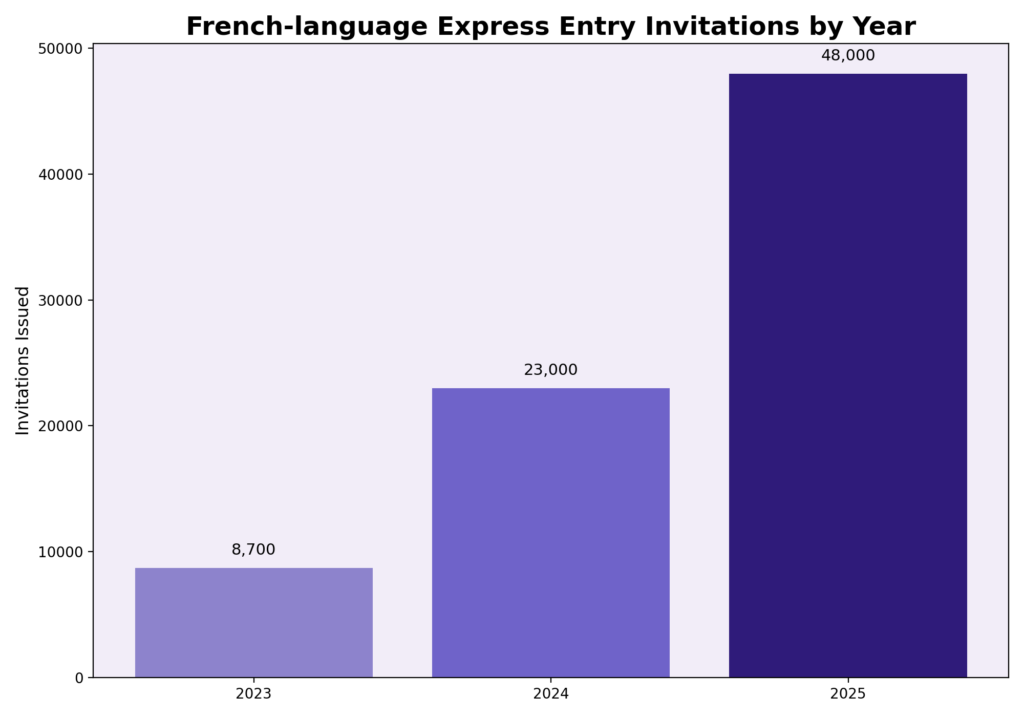
This resulted in IRCC issuing 110,266 invitations across 42 Express Entry rounds in 2023. Six of those were French-language draws that issued 8,700 invitations. French-speaking was the most common category-based draw that year, even though most invitations still came through other streams.
In 2024, category-based selection ramped up, and French led the category-based draws. IRCC held 52 Express Entry rounds and issued 98,903 invitations in total. French-language draws made up 23,000 of all ITAs, meaning nearly one in four invitations (about 23%) that year went to French-speaking candidates.
French has remained one of the priority categories, and it’s supported by Canada’s most recent immigration levels plan. Ottawa says it wants to strengthen French-speaking communities outside Quebec, where the French-speaking population has been shrinking for years. The plan sets targets to increase francophone immigration outside Quebec, reaching 12% by 2029.
Why High-Scoring Candidates Felt Sidelined in 2025
By 2025, the frustration building wasn’t hard to understand. It only grew stronger as the year went on. In 2025, there were nine (often large) francophone draws. In total, Express Entry issued 113,998 invitations that year, and 48,000 of them went to French-speaking candidates – about 42%.
French draw cut-off scores were mostly in the low 400s, ranging from 379 to 481. Meanwhile, other draws selected fewer people and often had higher cut-offs, sometimes in the high 400s and even above 500. In the most recent French-language draw in December, 6,000 invitations went out with a cut-off score of 399.
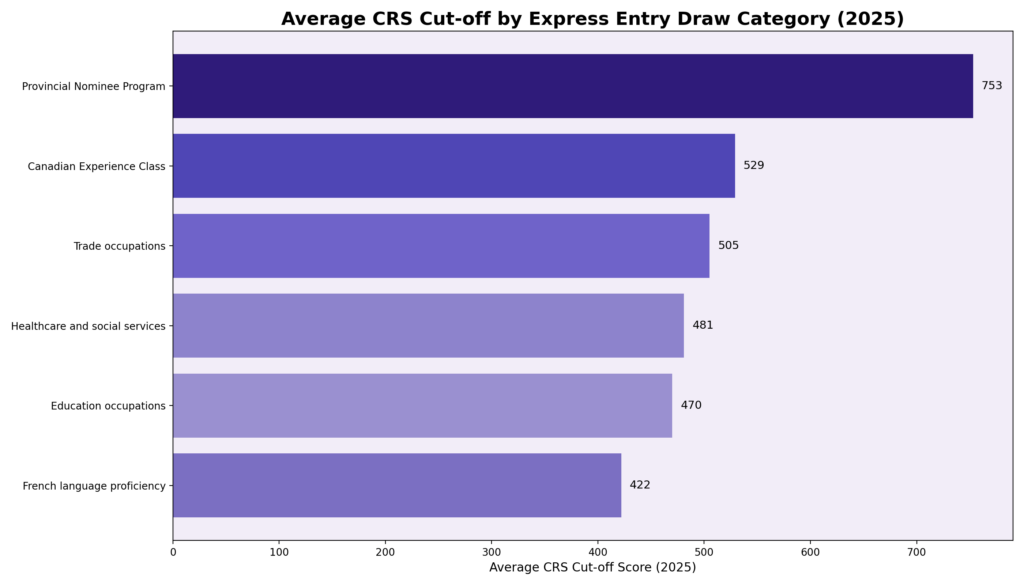
Now put yourself in the shoes of someone who scores 505, speaks excellent English, has Canadian work experience, works in a skilled trade and still doesn’t get an invitation.
That’s why you keep seeing the same reactions across the Express Entry community: “I did everything right,” “I’m tired of the rules changing,” and “French feels like my only chance.” Some candidates believe that policy goals matter more than a strong work and skills profile.
Part of the tension is that the government is using Express Entry to support broader goals – not just to pick the highest score. Critics argue this can make the system feel less tied to labour market needs, especially since Canada is admitting fewer permanent residents.
IRCC’s response is that French-draw candidates still have to meet the same basic eligibility rules as everyone else, and that it invites the highest-ranked candidates within the French category. In other words, the government’s view is that these candidates can succeed and will contribute to Canada’s economy – they’re just being selected under a different priority.
The Real-World Result: People Are Studying French Under Pressure
As it became clear that French was being prioritized, many candidates shifted their focus fast. We’ve seen the conversation happening a lot recently online across platforms like Reddit and Facebook. People who never planned to learn French are now signing up for classes, hiring private tutors, and booking language tests. Some are studying a few hours a day on top of full-time work. Others treat it like exam prep: drills, practice tests, and a lot of stress.
Is learning French really Worth it?
byu/That-Visit4261 incanadaexpressentry
And there’s a reason it feels intense: to qualify for the French-language category, candidates need at least NCLC 7 in speaking, listening, reading, and writing. That’s a serious level, not something you pick up in a few weekends.
Is French a Shortcut, or a High-Risk Investment?
Learning French can help raise your CRS score and give you access to French-language draws, where cut-off scores have often been lower. Beyond French-language draws, French language skills will boost your CRS even if you’re never invited through a French draw. If you reach NCLC 7+ in French, you can get 25 extra points (if your English is low or you don’t test in English) or 50 points (if you also score CLB 5+ in English). For some people, that’s the difference between “close” and “invited.” Just remember that TEF Canada and TCF Canada results expire after two years, so timing matters.
Also being a government priority, the focus isn’t likely to disappear overnight. Still, as more people study French and qualify, the advantage may shrink as competition grows.
But it isn’t a guaranteed ticket. The tests are hard, and you need strong, test-ready French. It also takes time, especially if you’re starting from zero while balancing work and life.
So, the honest answer is that learning French can be leverage but it’s not a magic solution.
Is It Too Late to Start Learning French?
Before you commit, ask one simple question: can you fit French study into your life without burning out? If you can set aside study time each week and work toward a test-ready level, French can be a smart long-term move. If you can’t right now, that’s okay too. The best goals are those you can keep up, not last-minute scrambles.
But timing does matter. Learning a new language takes time and effort. Even if you start early in 2026, you’ll likely need at minimum most of the year to reach a test-ready level, which means your results could land late 2026 or into 2027, depending on how much time you can invest.
To know whether learning French now is likely to pay off in the long run, it helps to look at where Canada is heading beyond 2026. The latest Immigration Levels Plan prioritises francophone newcomers outside Quebec, with a target of 12% by 2029. This direction is reinforced by recent federal investments, including a $3.6 million IRCC commitment in November 2025 to support francophone immigration outside Quebec, and an additional $640,000 from Canadian Heritage for a project focused on helping French-speaking newcomers integrate and strengthen francophone communities.
Together, these signals suggest that French will remain an important priority for at least the next few years. But given that reaching the required language level typically takes at least 12 months, those considering French would benefit from making a decision sooner rather than later.
Want help making sense of Express Entry changes as they happen? Join our newsletter for clear updates straight to your inbox.
About the author

Freya Devlin
She/Her
Content Writer
Having recently moved to Canada, Freya offers a current perspective on the challenges and opportunities of starting fresh. Whether that's the understanding hassle of jargon-filled paperwork, searching for a place to live, or simply discovering those little things that make a place feel like home. She is excited to continue writing content for newcomers to Canada that is clear and helpful.
Read more about Freya Devlin
Citation
Devlin, Freya.
"Why More Express Entry Candidates Are Turning to French."
Moving2Canada.
Last modified January 15, 2026.
https://moving2canada.com/features/learning-french-for-express-entry/.
Copy for Citation
Featured Stories

Express Entry • Oct 21, 2026
Express Entry: Labour Market Integration Factors (LMIF)
Read more

Express Entry • Oct 21, 2026
Express Entry High-Wage Occupations List: Eligible Jobs and CRS Points
Read more

Immigration • Oct 21, 2026
International Student Arrivals Skyrocket in August, But Remain 53 Percent Below 2024 Levels
Read more

Immigration • Oct 21, 2026
Canada’s PR Admissions Drop 15 Percent in August 2026
Read more