
Canada’s job market data for October revealed Canada has lost around 46,000 jobs so far in 2026, with the job market being roughly the same now as it was at the same time last year (with a slightly lower unemployment rate).
Canada’s job market data for October revealed Canada has lost around 46,000 jobs so far in 2026, with the job market being roughly the same now as it was at the same time last year (with a slightly lower unemployment rate).
But that’s the national picture. When you zoom in on individual provinces and individual industries, things get a little more interesting.
For newcomers, this matters more than the headline unemployment rate. The province you choose and the field you work in can shape your job prospects, salary, quality of life, and permanent residence prospects.
That’s why we’re breaking down the Canadian job market in more detail this month. Let’s dive in.
Key Takeaways
- Healthcare is driving job growth in Canada, led by Ontario, Alberta, and BC. Quebec is the exception here, where healthcare jobs shrank year-over-year.
- Retail is shrinking in Canada’s biggest markets (excluding Quebec).
- Nova Scotia grew fastest, with employment increasing by over 4% in 12 months.
- Construction is growing fastest in the Prairie provinces, with construction jobs in both Alberta and Saskatchewan increasing by 9.5% and 10.6% respectively.
- Almost all of the jobs lost in Canada in the past 12 months were lost in Quebec.
- You can learn more about the labour market in Canada.

Live Webinar - Ask Us Anything
Ask Us Anything Live on November 20
Join RCIC Rebecca Major and the Moving2Canada team to discuss all things immigration and life in Canada, live. We'll be answering your questions live too, so don't miss out.
Get Notified When We're Live
The national picture: health care up, retail down
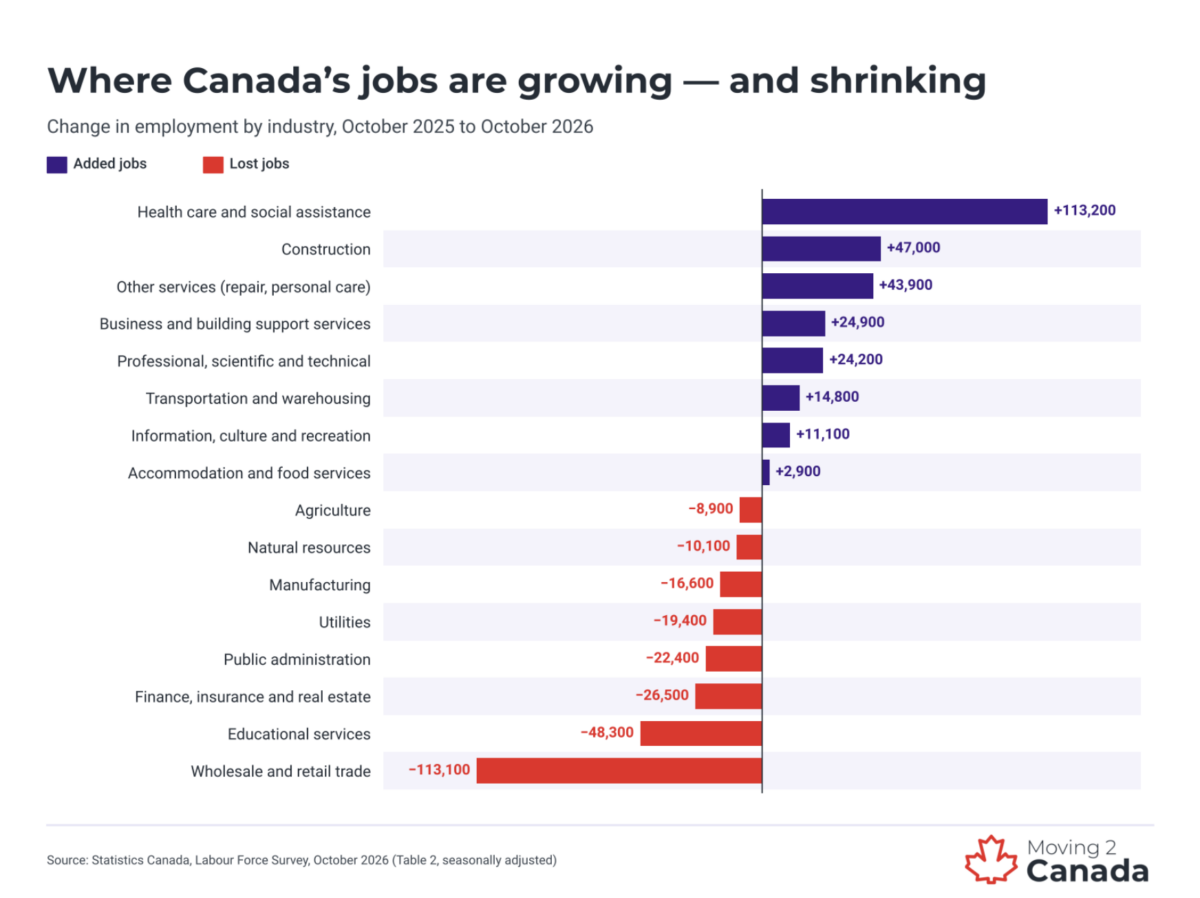
For context, StatsCan tracks job data across 16 broad industries. Half of those industries gained jobs between October 2025 and October 2026, while the other half lost jobs across the same period. Unfortunately, Canada’s economy has 46,000 fewer jobs in October 2026 than it did at the same time in 2025.
Here’s a graphic showing the sector-by-sector breakdown:
Where the jobs are growing, province by province
Canada’s job market has shifted quite dramatically over the past 12 months, with all provinces and territories growing jobs, at least modestly, except Quebec. Job losses have hit Quebec’s economy hard, painting a stark contrast to the rest of the country.
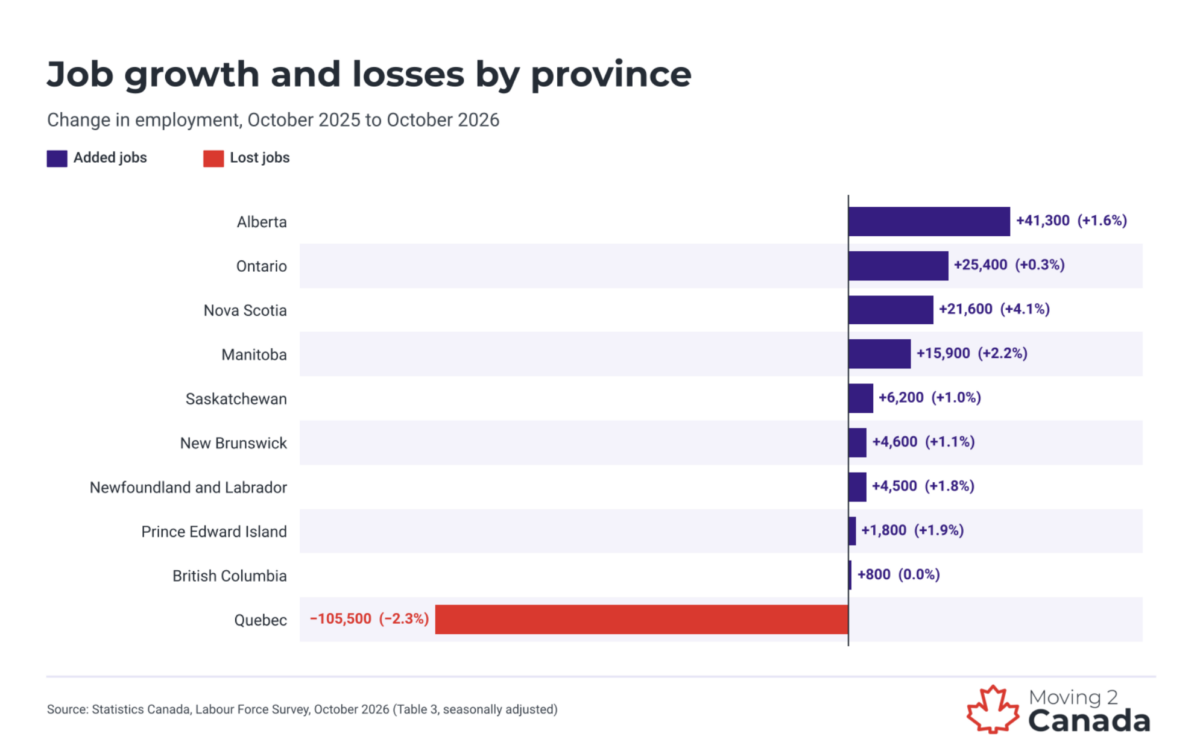
Digging into the data closely, here’s a look at provincial changes in jobs by industry:
| Province | Jobs added in a year | Biggest growth industry | Biggest decline | Unemployment rate (Oct 2026) |
|---|---|---|---|---|
| British Columbia | +800 (0.0%) | Health care (+31,400) | Retail and wholesale (-21,900) | 6.30% |
| Alberta | +41,300 (+1.6%) | Health care (+42,900) | Accommodation and food (-12,900) | 7.30% |
| Saskatchewan | +6,200 (+1.0%) | Health care (+5,400) and manufacturing (+5,400) | Retail and wholesale (-6,300) | 5.90% |
| Manitoba | +15,900 (+2.2%) | Business and building support (+5,300) | Finance and real estate (-5,500) | 5.00% |
| Ontario | +25,400 (+0.3%) | Health care (+61,200) | Retail and wholesale (-78,900) | 7.30% |
| Quebec | -105,500 (-2.3%) | Accommodation and food (+53,100) | Health care (-36,500) | 5.70% |
| New Brunswick | +4,600 (+1.1%) | Retail and wholesale (+3,700) | Public administration (-3,300) | 7.40% |
| Nova Scotia | +21,600 (+4.1%) | Professional and technical services (+4,700) | Business and building support (-1,200) | 6.20% |
| Prince Edward Island | +1,800 (+1.9%) | Retail and wholesale (+2,100) | Manufacturing (-1,200) | 7.40% |
| Newfoundland and Labrador | +4,500 (+1.8%) | Health care (+2,600) | Business and building support (-1,800) | 8.70% |
British Columbia
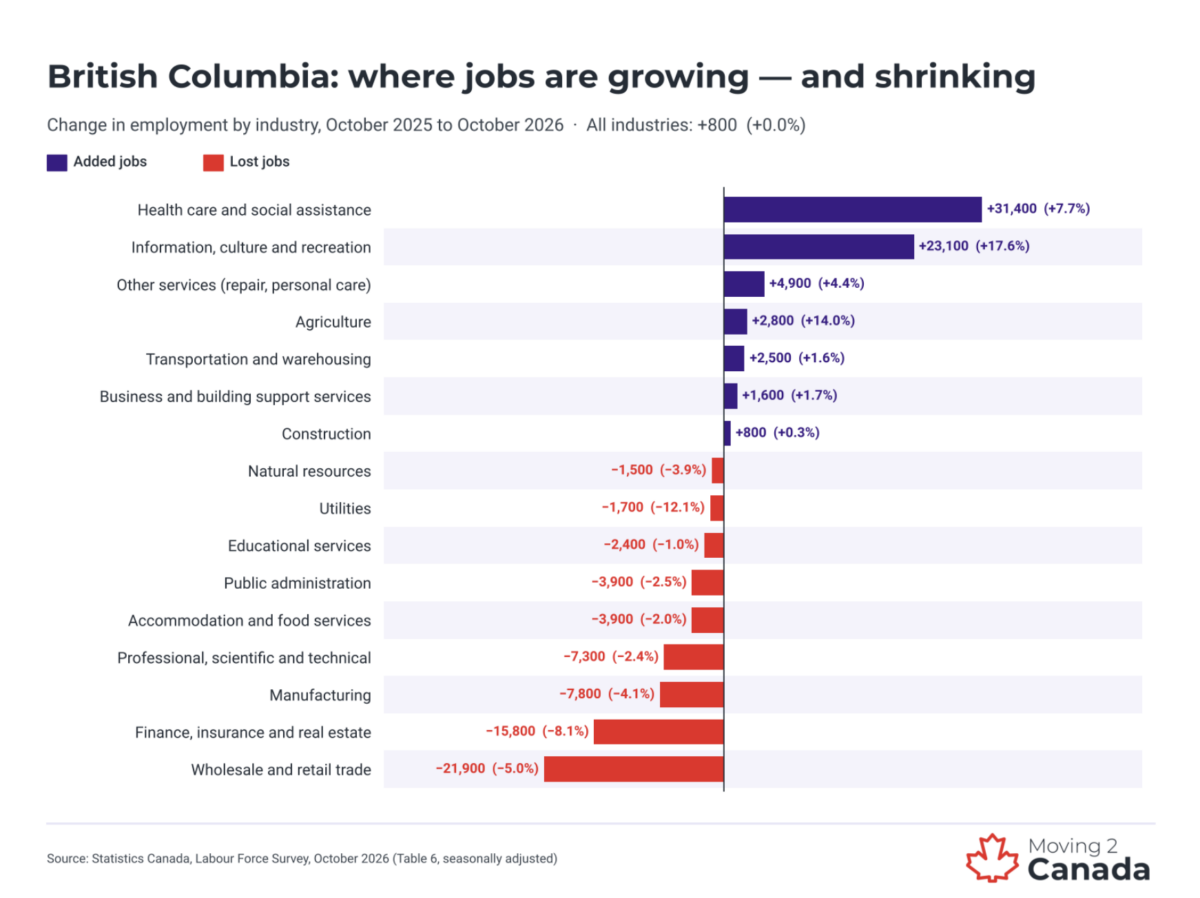
BC’s total employment barely moved over the year (+800), and unemployment ticked down slightly (-.3) from 6.6% to 6.3% in October 2026.
Job growth was driven largely by health care, which added 31,400 jobs (+7.7%). Information, culture and recreation also grew strongly, up 23,100 jobs (+17.6%). Construction was essentially flat, despite some fairly significant construction projects planned in BC.
The losses were in retail and wholesale (-21,900), finance and real estate (-15,800) and manufacturing (-7,800). Professional, scientific and technical services also slipped.
Alberta
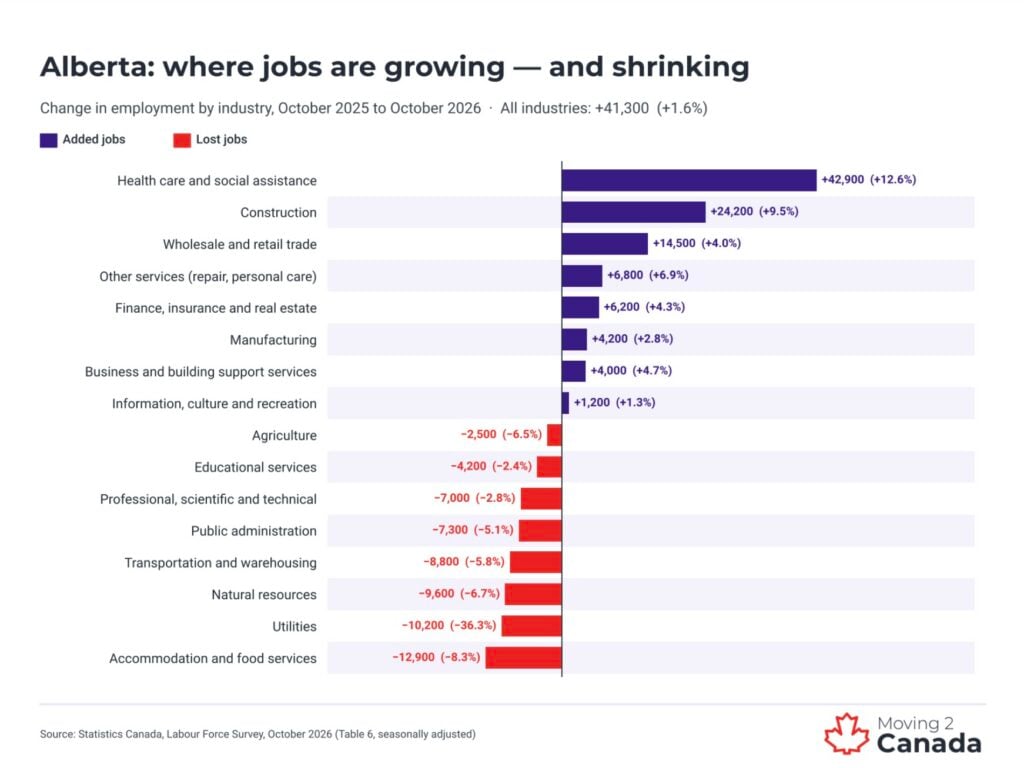
Alberta added 41,300 jobs over the year, despite this, unemployment only fell slightly from 7.6% to 7.3% – and Alberta experienced the biggest unemployment rate in the country between September to October 2026.
In terms of job growth, two industries did most of the work. Health care grew by 42,900 jobs (+12.6%), the fastest health care growth of any large province. Construction added 24,200 jobs (+9.5%).
As you can tell from the unemployment rate, not every industry in Alberta is booming. Accommodation and food services (-12,900), utilities (-10,200) and natural resources (-9,600) all shrank, and Alberta lost 24,000 jobs in October alone.
Tip for working with this data:
I can’t analyse all the differences and similarities between the provinces here. But use the data to compare how your industry is doing across Canada’s provinces and territories. For example, the data for BC and Alberta reveals that wholesale and retail trade grew in Alberta while shrinking in BC, as did finance-related roles, and manufacturing. Conversely, transportation and warehousing shrank in Alberta and grew in BC.
Saskatchewan
Saskatchewan’s growth is in goods-producing industries, which added 11,400 jobs (+8.5%). Manufacturing grew 20.2% (+5,400) and construction grew 10.6% (+5,100), the fastest construction growth in the country. Health care added 5,400 jobs (+5.2%), and accommodation and food added 4,000 (+12.0%).
Retail and wholesale (-6,300), professional and technical services (-4,500) and public administration (-4,200) shrank. Unemployment is low at 5.9%.
Manitoba
Manitoba added 15,900 jobs (+2.2%) and has Canada’s lowest unemployment rate at 5.0%. Growth was spread across smaller industries: business and building support services (+5,300, +31.2%), other services like repair and personal care (+4,600, +16.3%), construction (+3,400, +5.6%) and manufacturing (+3,300, +4.8%). Agriculture also grew 13.5% (+2,000).
Finance and real estate lost 5,500 jobs (-11.3%). Health care was nearly flat (+1,000).
Ontario
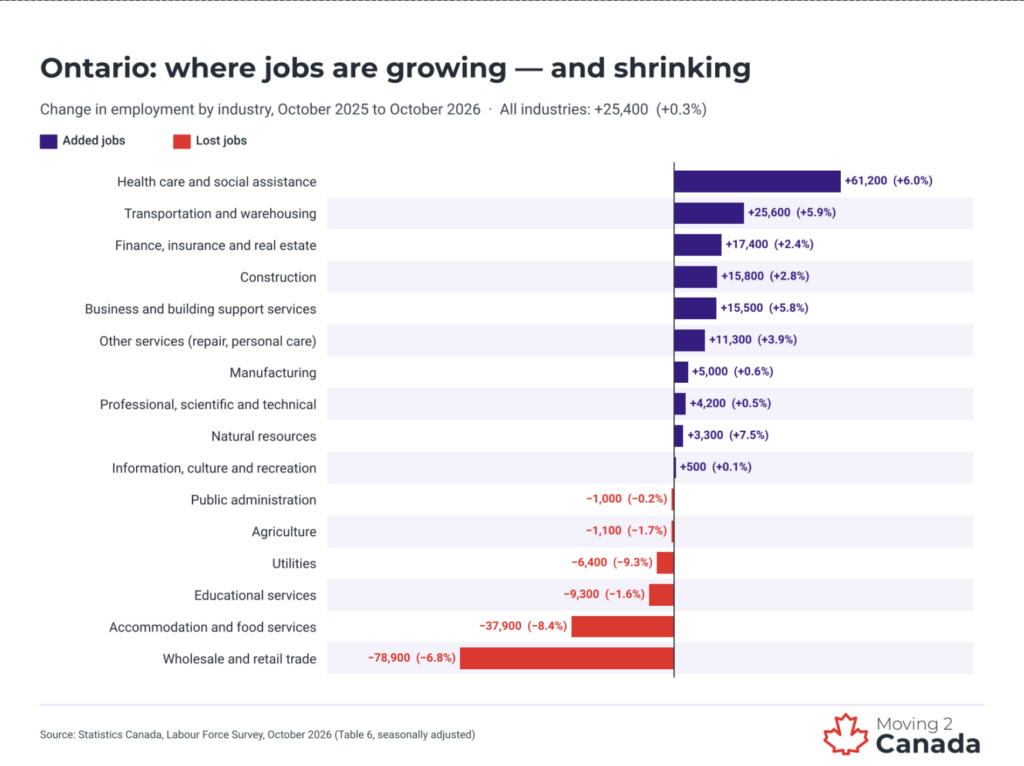
Ontario’s total number of jobs barely grew (+25,400, +0.3%), and it’s relatively high unemployment rate barely shrank over the year, decreasing from 7.6% to 7.3%. One bright spot is that it added 61,200 health care jobs, the largest gain of any industry in any province. Transportation and warehousing (+25,600), finance and real estate (+17,400), construction (+15,800) and business support services (+15,500) also grew.
Ontario is also where retail is shrinking fastest. Retail and wholesale lost 78,900 jobs (-6.8%), and accommodation and food lost 37,900 (-8.4%). If you’re counting on a retail or restaurant job as your first step in Toronto or another Ontario city, expect a lot of competition.
Quebec
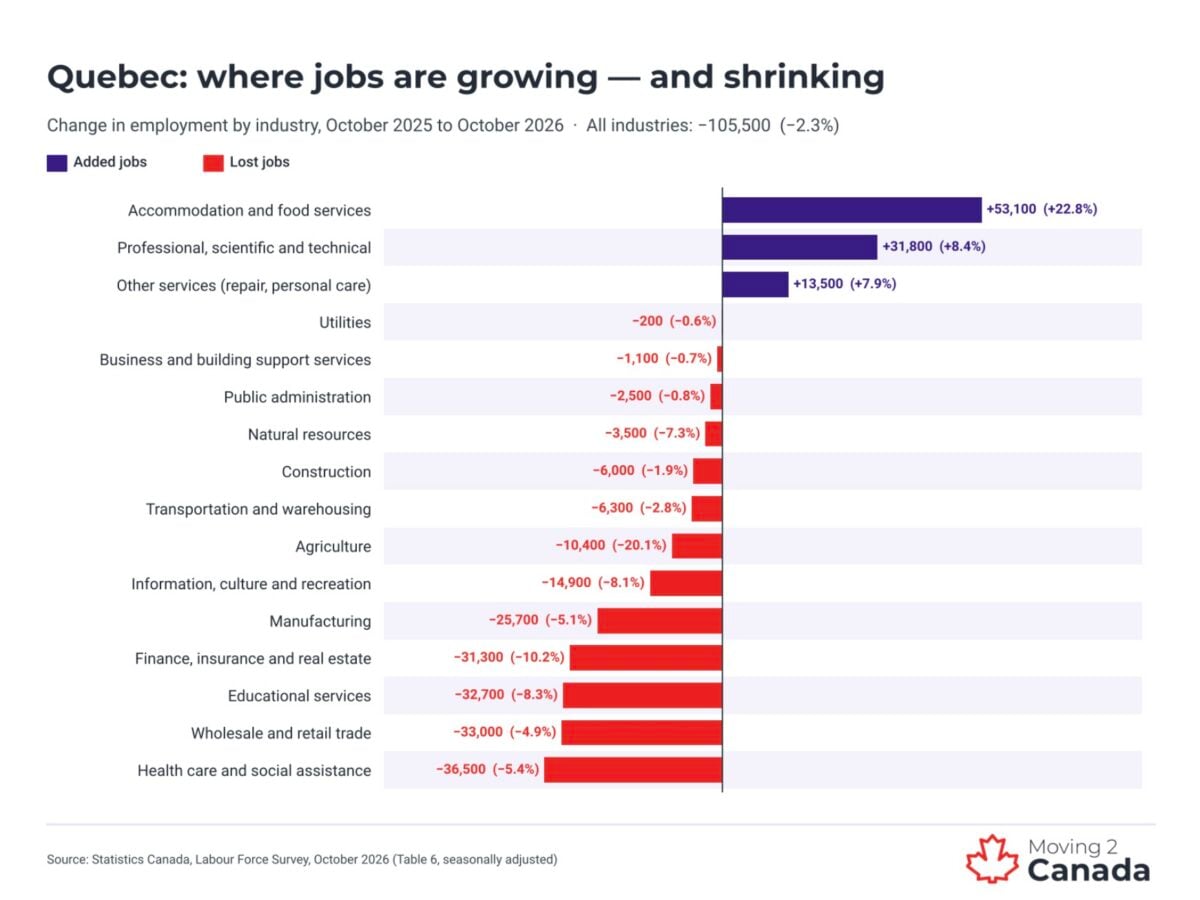
Quebec lost 105,500 jobs over the year (-2.3%), more than any other province. Despite this, it maintains a relatively low unemployment rate of 5.7% – and increase of just .4%.
Health care (-36,500), retail and wholesale (-33,000), education (-32,700), finance (-31,300) and manufacturing (-25,700) all shrank.
Two industries bucked the trend. Accommodation and food services added 53,100 jobs (+22.8%), and professional, scientific and technical services added 31,800 (+8.4%). Quebec’s unemployment rate is still low at 5.7%, partly because fewer people are looking for work.
New Brunswick
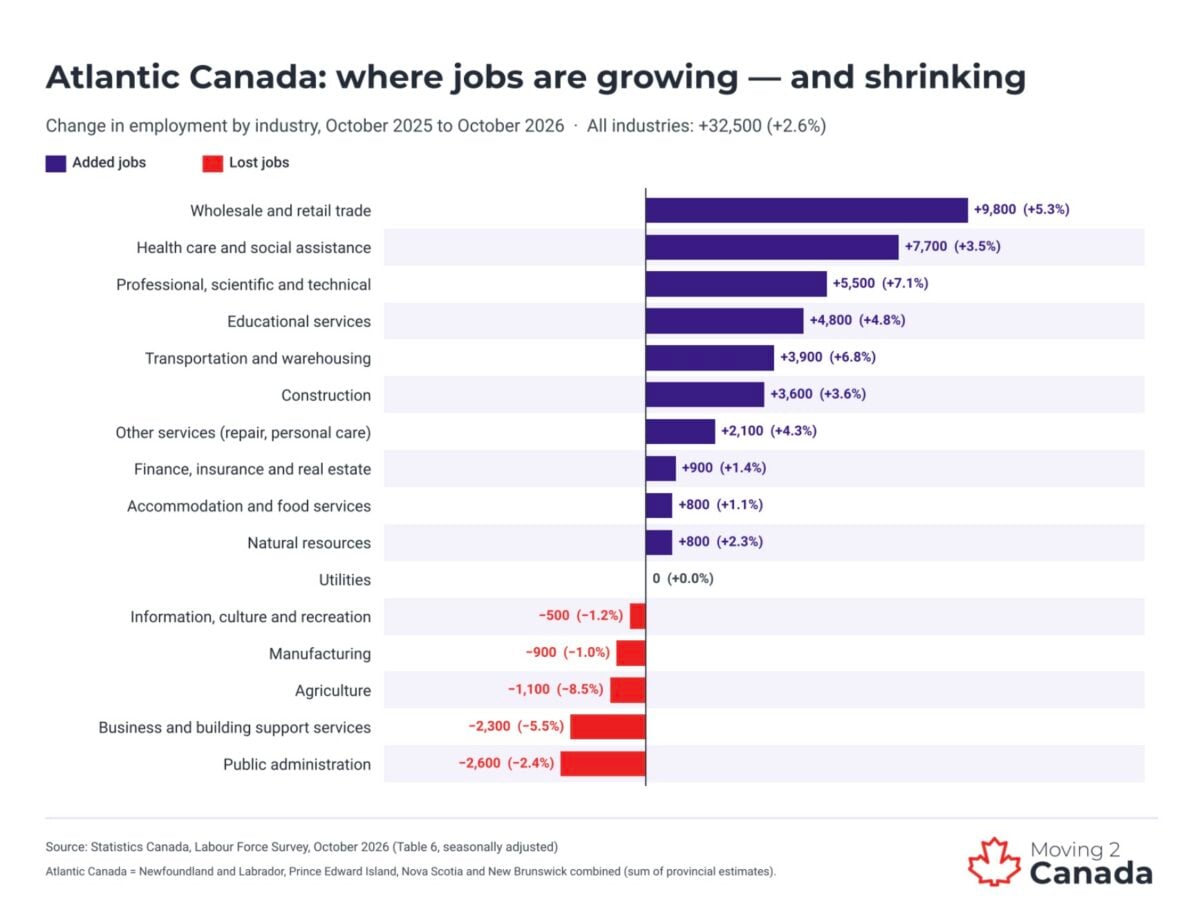
New Brunswick added 4,600 jobs (+1.1%). Retail and wholesale (+3,700), health care (+1,600), construction (+1,400, +4.5%) and education (+1,300) all grew. Public administration lost 3,300 jobs (-8.7%).
Nova Scotia
Nova Scotia had the fastest job growth of any province, adding 21,600 jobs (+4.1%). Growth was broad: professional, scientific and technical services (+4,700, +12.2%), health care (+3,500), retail and wholesale (+3,400), transportation and warehousing (+3,000, +12.5%) and education (+3,000, +7.4%). Construction added 1,700 jobs.
Very few industries lost ground, with the biggest drop in business and building support services (-1,200).
Prince Edward Island
PEI added 1,800 jobs (+1.9%). Retail and wholesale (+2,100) and education (+1,100) grew, while manufacturing (-1,200) and agriculture shrank. PEI is small, so its industry numbers can swing a lot from month to month.
Newfoundland and Labrador
Newfoundland and Labrador added 4,500 jobs (+1.8%), led by health care (+2,600, +5.5%). Professional and technical services (+1,000, +8.5%) and natural resources (+900, +5.9%) also grew. The province still has Canada’s highest unemployment rate at 8.7%, down from 9.1% in September.
Should You Move Provinces Based on Jobs Data?
Whether or not you should move depends on your unique circumstances. You need to consider your skills, lifestyle, family, the cost of living, and your immigration prospects if you aren’t already a permanent resident in Canada.
We’ve bundled some of our most helpful resources that can help you make this decision below:
If you work in health care. Express Entry runs category-based draws for healthcare and social services occupations, and a dedicated category for physicians with Canadian work experience. Most provinces also have a dedicated healthcare stream, and you can track the latest provincial invitations on our PNP live tracker.
If you work in construction or the trades. Look at Express Entry’s trades category draws for potential leads for permanent residence in 2027. Alberta and Saskatchewan are where construction is growing fastest, so it could be worthwhile looking into jobs in those regions. Our sister company Outpost Recruitment places construction professionals with employers across Canada, free of charge.
If you’re open to a smaller community, the Atlantic Immigration Program, the Rural Community Immigration Program and the Francophone Community Immigration Pilot link permanent residence to a job offer in a specific region. There are increased quotas for the AIP and RCIP in 2027 under Canada’s recently published 2027-2029 Immigration Levels Plan, so there may be more opportunities here than in past years (though these remain highly competitive).
If you need a job offer first, our list of Canadian companies previously approved for an LMIA helps you target employers who have hired from abroad before, and our Jobs Board lists current openings. If you’re from an eligible country and within its age limit (up to 30 or 35, depending on the country), International Experience Canada may be an option too.
Not sure which program works for you? Take our immigration quiz, or track the latest provincial invitations on our PNP live tracker.
If you’re unsure how Canada’s changing job market could affect your employment opportunities or pathway to permanent residence, consider booking a consultation with our in-house RCIC, Rebecca Major. You can book yours here.
About the author

Stephanie Ford
She/Her
Finance, Law and Immigration Writer
Stephanie is a content creator who writes on legal and personal finance topics, specializing in immigration and legal topics. She earned a Bachelor of Laws and a Diploma in Financial Planning in Australia. Stephanie is now a permanent resident of Canada and a full-time writer at Moving2Canada.
Read more about Stephanie Ford
Citation
Ford, Stephanie.
"Tracking Canadian Jobs By Industry: A Province By Province Analysis."
Moving2Canada.
Last modified November 11, 2026.
https://moving2canada.com/2026/11/canada-job-market-by-province-and-industry-2026/.
Copy for Citation
Featured Stories

Family Sponsorship • Nov 11, 2026
Canada Cuts Family Sponsorship Targets for 2027, But Additional PR Spaces Could Reduce Backlogs
Read more

Express Entry • Nov 11, 2026
How Long Will Express Entry Draws Be Paused For?
Read more

Immigration • Nov 11, 2026
The Demographics of Canadian Permanent Residence Admissions
Read more

Immigration • Nov 11, 2026
A New Startup Pilot? Budget 2026 Wants to Bring Innovators to Canada
Read more