Canada's new Express Entry changes will give additional points to candidates with work experience or job offers in high-wage occupations, potentially making it harder for other candidates to compete for permanent residence.
Starting November 3, 2026, eligible candidates can receive up to 70 additional Comprehensive Ranking System (CRS) points for Canadian work experience in a high-wage occupation, or up to 100 points for a qualifying job offer.
But what if your occupation is not on the high-wage list? Does that mean the end of your Express Entry journey?
Not necessarily. You may still qualify for Canadian PR through Express Entry.
In this article, we explore several ways to improve your chances of receiving an invitation to apply (ITA). That said, it’s worth looking beyond Express Entry for occupation-specific opportunities, as some provinces have their own priority occupation lists.

Our Immigration Consultant
Rebecca Major
Moving2Canada offers transparent Canadian immigration services with advice you can trust. Led by Rebecca Major (RCIC #511564), we deliver professional, regulated, and efficient support with one clear goal: to guide you confidently through your Canadian immigration journey.
Schedule a consult
1. Explore Career Progression or Job Offers in High-Wage Occupations
This first one is obvious. If you can get into a high-wage occupation, you absolutely should try.
Under the new rules, candidates can receive additional CRS points for at least 12 months of eligible Canadian work experience or a qualifying job offer in a high-wage occupation.
This means securing a qualifying job offer in a high-wage occupation or progressing into a more senior or specialized role could improve your Express Entry prospects.
That said, don’t assume that a promotion or role progression will necessarily place you in a high-wage occupation. IRCC defines high-wage occupations as those with a median wage of at least 1.3x the national median wage. There is also a detailed list of all the NOCs that qualify as high wage.
As an example, if you’re working in Canada as a payroll clerk (NOC 13102), a promotion to a payroll supervisor role (NOC 12011) will not qualify you for the high-wage occupation points. However, if you were to then get promoted to financial administrator (NOC 10010), you would be in a high-wage occupation with a median wage of at least twice the average median wage.
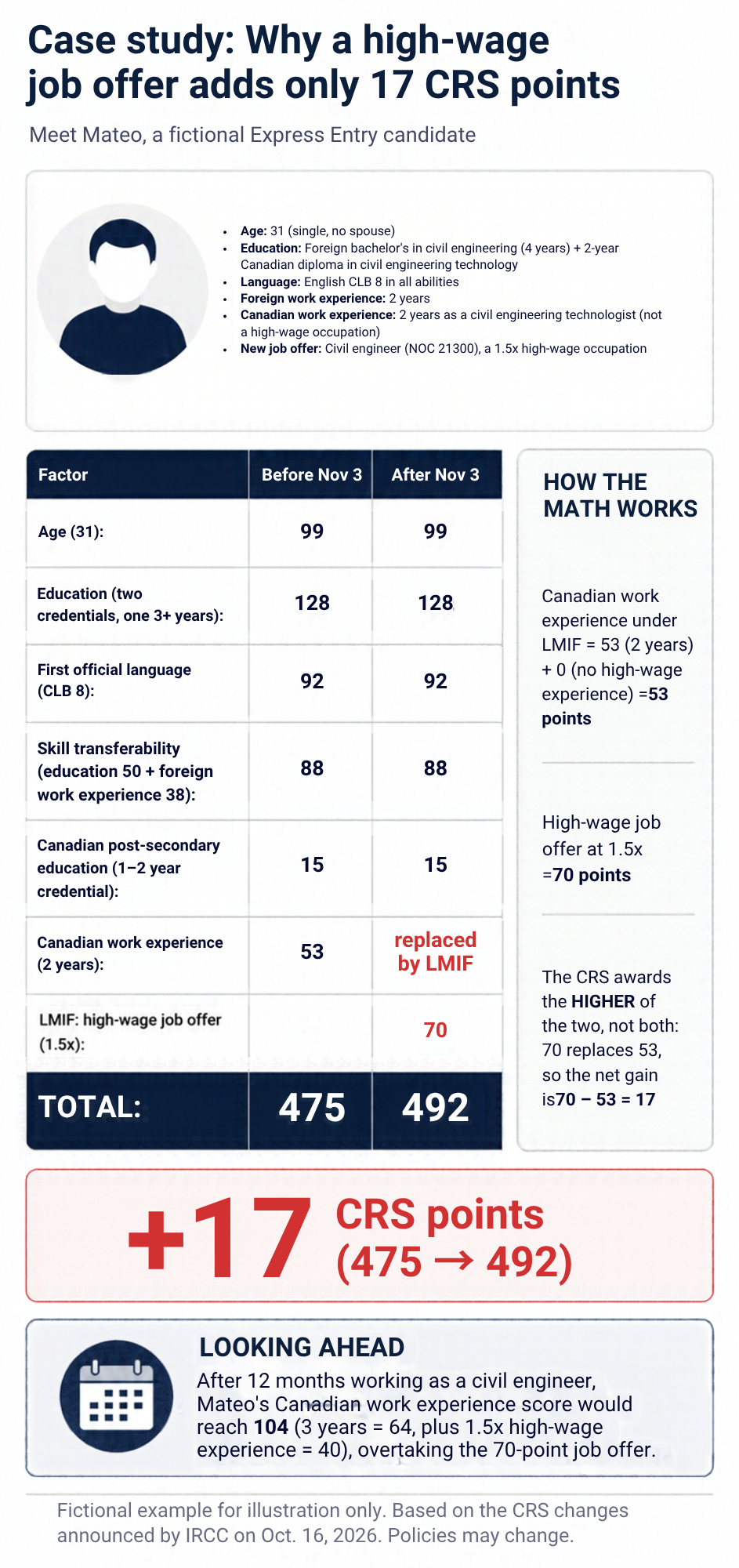
You cannot combine points from both Canadian experience and a high-wage job offer. If you qualify for both, you receive whichever provides the higher score.
Gain Canadian Work Experience in a High-Wage Occupation
To qualify for additional points through Canadian work experience, you need at least 12 months of eligible experience in one or more high-wage occupations.
Depending on the wage threshold, you could receive 20, 40, or 70 additional CRS points.
| High-wage occupation level | CRS Points |
|---|---|
| At least 12 months in one or more occupations at 2x the median wage | 70 |
| At least 12 months in occupations at 1.5x the median (but not as much as 2x) | 40 |
| At least 12 months in occupations at 1.3x the median (but not as much as 1.5x) | 20 |
Importantly, you do not necessarily need to change jobs to qualify. If you previously worked in a high-wage occupation in Canada, that experience may still count, provided it was gained within the past 10 years.
If you are considering moving into a high-wage occupation, remember that you will need to accumulate the required experience before you can claim these additional points.
Secure a Qualifying Job Offer in a High-Wage Occupation
A qualifying job offer in a high-wage occupation can provide 50, 70, or 100 additional CRS points, depending on the occupation’s wage threshold.
| High-wage occupation level | CRS Points |
|---|---|
| At least 2x the median wage | 100 |
| At least 1.5x the median wage | 70 |
| At least 1.3x the median wage | 50 |
Unlike the Canadian work experience pathway, you do not need to complete 12 months of work in the high-wage occupation to qualify for these points.
However, keep in mind that candidates who claim high-wage job offer points cannot also receive the regular points for Canadian work experience. You should compare your potential CRS score under both pathways before deciding whether pursuing a job offer makes sense.
For example, let’s assume you have two years of Canadian work experience in a non-high-wage occupation. That is worth 53 CRS points. Now, you receive a qualifying job offer in an occupation where the median wage is 1.5x the national average. This high-wage job offer is worth 70 points.
In this case, it would make sense to get the high-wage job offer points, but your CRS score will only increase by 17 points (70 minus 53).
2. Improve Your Express Entry CRS Score Without High-Wage Points
There are other ways to improve your CRS score and make your profile more competitive in the Express Entry pool. These include:
- Improve your language test results:Higher English or French scores can increase your core CRS and skill transferability points. Proficiency in French or both official languages gives you an added advantage.
- Gain additional Canadian work experience:Even if your occupation is not high-wage, eligible experience in TEER 0–3 occupations can earn you between 40 and 80 CRS points.
- Improve your education credentials:Completing additional education or obtaining an Educational Credential Assessment (ECA) for foreign qualifications could increase your score.
- Review your spouse’s qualifications:Your spouse’s education, language proficiency, and Canadian work experience may contribute additional CRS points. These points, however, may not remain the same next year.
3. Check If Your Occupation Qualifies for Category-Based Express Entry Draws
Your occupation does not necessarily need to be classified as high-wage for you to qualify under one of Canada’s Express Entry priority categories.
For 2026, Canada has nine occupation related categories targeting:
- Health care and social services
- Science, technology, engineering and mathematics (STEM)
- Trades
- Education
- Transport
- Physicians with Canadian work experience
- Senior managers with Canadian work experience
- Researchers with Canadian work experience
- Skilled military recruits
There is also a category for candidates with French-language proficiency.
Many occupations included in these categories do not qualify for high-wage points.
If you have experience in an eligible occupation, you could potentially receive an invitation through a category-based draw even without additional high-wage points.
For most occupational categories, candidates must have at least 12 months of qualifying work experience in a single eligible occupation within the previous three years. Some categories specifically require Canadian work experience.
However, the addition of high-wage points could also push up CRS cut-offs in category-based draws. If many candidates in a category receive additional points, the minimum score needed for an invitation could increase, making these draws more competitive for candidates who do not qualify for high-wage points.
Also keep in mind that IRCC reviews its category-based selection priorities annually and may introduce changes for 2027.
During consultations earlier this year, the department explored narrowing occupational categories in 2027 to focus more closely on long-term labour shortages and other economic priorities.
So don’t assume that the current occupation lists will remain unchanged.
4. Learn French to Improve Your Score or Qualify for French-Language Draws
Strong French-language skills can get you up to 50 additional CRS points, depending on your English-language proficiency.
You may also qualify for French-language category-based Express Entry draws if you have shown at least NCLC 7 in all four French-language abilities: reading, writing, listening, and speaking.
Unlike occupational categories, French-language selection is not restricted to a specific list of NOC codes.
This means even if you’re working in an occupation that is neither high-wage nor prioritized under occupational categories, you may still have an opportunity to receive an invitation.
If you have already studied French, improving your proficiency may be more achievable than pursuing an entirely new career.
Outside of Express Entry, several provinces have provincial nomination spaces set aside for Francophone candidates too.
5. Explore Provincial Nominee Programs for Canadian PR
If your occupation does not qualify for high-wage points, a Provincial Nominee Program (PNP) could provide another pathway to Canadian permanent residence.
Provinces and territories select immigration candidates based on their own economic needs, labour shortages, and regional priorities. These priorities do not necessarily match the federal high-wage occupation list.
For example, a province may prioritize workers in construction, health care, education, or other sectors where employers are struggling to fill positions.
Some PNP streams require a job offer from an employer in the province, while others consider candidates based on their work experience, occupation, or connections to the province.
Some PNP streams (typically those that require experience in a TEER 0-3 occupation) are aligned with Express Entry. If you receive a provincial nomination through an Express Entry-aligned stream, you can receive an additional 600 CRS points.
Non-Express Entry PNP streams, also called base streams, allow eligible candidates to apply for permanent residence outside the Express Entry system after receiving a provincial nomination.
Remember that provincial priorities and nomination allocations can change throughout the year. Also, meeting a stream’s eligibility requirements does not necessarily guarantee selection.
6. Canada’s High-Wage Occupation List for Express Entry May Change
Just because your occupation is not on the high-wage list today does not mean it will never qualify.
Two upcoming updates could affect which occupations qualify for high-wage CRS points.
First, Canada’s Job Bank generally updates its occupational wage data annually, with another update expected soon (possibly in November 2026). Since IRCC uses national median wages to determine high-wage occupations, new data could potentially change which occupations meet the required thresholds.
Occupations could be added to the list, removed, or moved into different wage tiers.
Second, Statistics Canada is expected to release an updated National Occupational Classification (NOC 2026) in December 2026.
The update will revise several occupational classifications, potentially affecting how certain jobs are categorized. This could also have implications for the high-wage occupation list.
7. Watch for Further Express Entry CRS Changes
The introduction of high-wage occupation points may not be the last major change to Canada’s Express Entry system.
IRCC has been reviewing broader changes to the Comprehensive Ranking System, including how candidates are assessed for their potential economic success in Canada. If implemented, these changes could impact rankings in the pool.
Proposals being considered include awarding additional CRS points for certain practice-ready professional licences, removing bonus points for French-language proficiency, and eliminating spousal factor points.
However, the government has not finalized these proposals or announced when additional changes may take effect.
For now, candidates should focus on improving their scores under the existing rules while keeping track of new announcements.
The Moving2Canada team will continue to closely track changes to Express Entry, CRS points, and Canada’s immigration programs. Sign up for our newsletter to stay informed about the latest developments and how they could affect your chances of Canadian permanent residence.
If you’re unsure how the new high-wage occupation points affect your Express Entry profile or which immigration pathways are available to you, speak with a regulated Canadian immigration consultant for personalized guidance.

About the author

Sugandha Mahajan
She/Her
Content Marketer
Born and raised in New Delhi, India, Sugandha moved to Canada as a permanent resident in early 2020, just weeks before the pandemic shut everything down. She has first-hand experience with many common newcomer challenges, including navigating the Express Entry system, finding a job without Canadian experience, and figuring out small talk. To deepen her understanding of the field, she is currently pursuing a Graduate Diploma in Immigration & Citizenship Law at Queen’s University.
Read more about Sugandha Mahajan
Citation
Mahajan, Sugandha.
"Not in a High-Wage Occupation? How to Improve Your Chances for Canadian PR."
Moving2Canada.
Last modified October 27, 2026.
https://moving2canada.com/2026/10/not-in-a-high-wage-occupation-improve-your-chances-of-canadian-pr/.
Copy for Citation








Featured Stories

Express Entry • Oct 28, 2026
Canada Issues 150 ITAs in Second Transport Occupations Express Entry Draw of 2026
Read more

Express Entry • Oct 27, 2026
5,000 French-Speaking Candidates Invited in October 27 Express Entry Draw
Read more

Work • Oct 27, 2026
Foreign Interest in Canadian Jobs Has Dropped by More Than Half Since 2023: Indeed Study
Read more

Immigration • Oct 27, 2026
Your Virtual Wedding in Utah Doesn’t Count for Canadian Immigration
Read more