
The Bank of Canada increased its interest rate today, from 2.25% to 2.5%. This is the first increase in the BoC interest rate in over three years. As a newcomer to Canada, you may not be familiar with how this decision might impact you. In this article, we outline what this change means for Canada’s economy, as well as you personally.
Key Takeaways
- The Bank of Canada raised its key interest rate from 2.25% to 2.5% today, its first increase in over three years, to keep high oil prices from causing lasting inflation.
- Borrowing is getting more expensive, so many newcomers with mortgages or other loans will feel it in their monthly budgets, while savers may earn a little more.
- Home buyers can borrow less, but a cooler market may make prices easier to negotiate, and more hikes are possible before inflation returns to target. Renters are also in a position to negotiate rental terms.
Understanding the Bank of Canada’s Interest Rate
The Bank of Canada’s goal is to promote the economic and financial well-being of Canadians. Its mandate includes:
- Adjusting interest rates to stop prices from rising too fast (inflation).
- Looking out for problems in the banking system, and solving them when needed.
- Designing and printing Canada’s bank notes (with a focus on safety).
- Running the federal government’s bank accounts and helping it borrow money.
- Making sure payment systems are safe.
This week’s interest rate announcement relates to the first part of its mandate: raising and lowering interest rates to manage inflation (stop prices from rising too quickly).
What happened this week?
The bank lifted the rate by 25 basis points to 2.5%, as widely expected. (A “basis point” is one-hundredth of a percent, so 25 basis points is 0.25%.) The rate had been at 2.25% for about a year.
Why did they do it?
Prices are rising too fast, mostly because of high oil prices. The Bank of Canada’s goal with this rate hike is to stop high oil prices from turning into a long-lasting inflation problem. The Bank of Canada’s Governor Tiff Macklem said inflation should end the year at 3.5% and stay around 3% for most of next year (which is higher than they want it to be), before getting back close to the 2% target by mid-2028.
You can watch Governor Tiff Macklem discuss the economy in the media briefing accompanying today’s decision here.
Interest Rate Trends in Canada
To put today’s rate hike in perspective, we created a graph showing where the Bank of Canada interest rate in Canada has been set since the historic lows in 2021. Note that these are not the same as the interest rate your bank offers, though they are related.
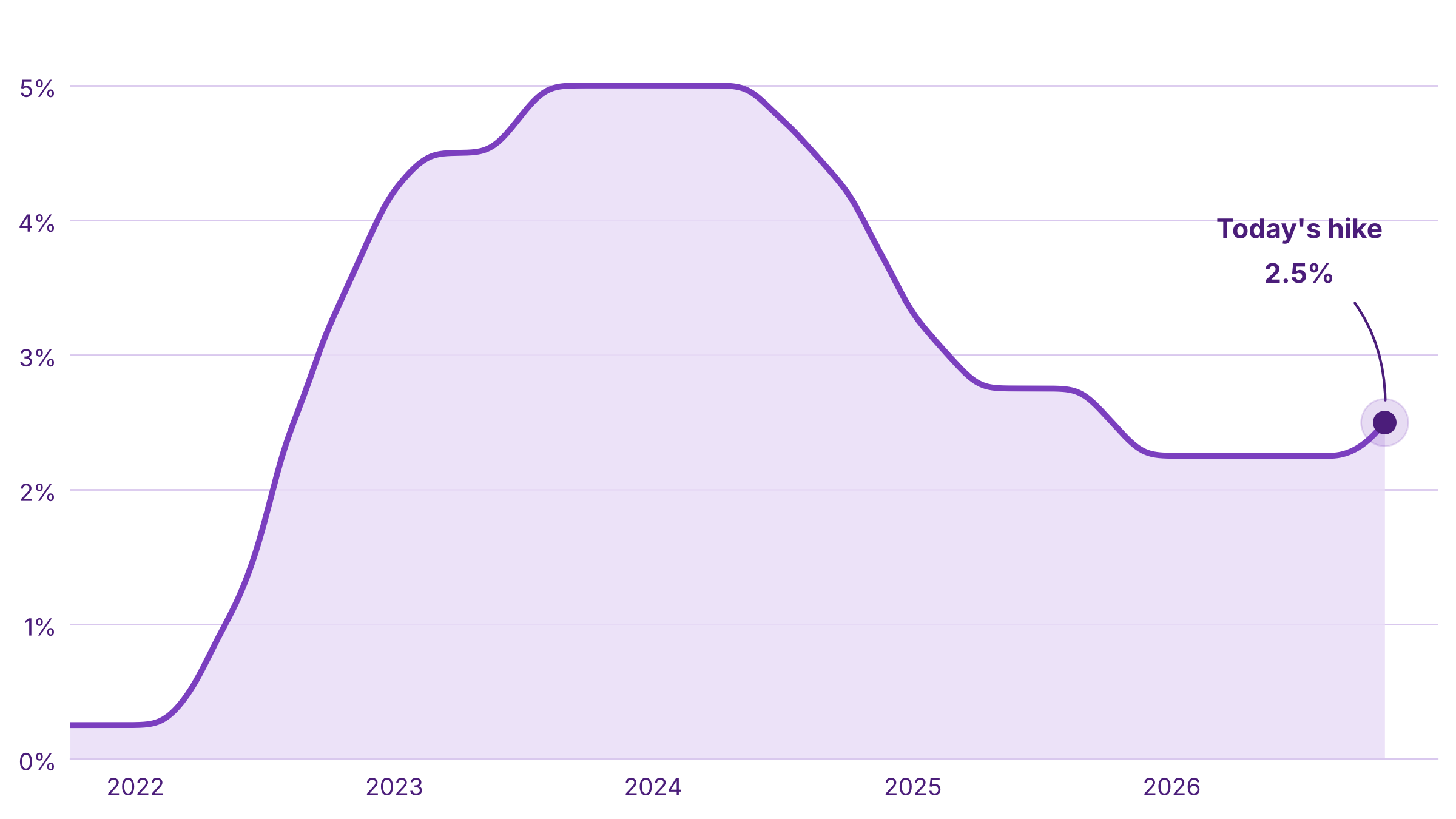
Simplified view of the Bank of Canada’s policy rate, October 2021 to October 2026
What The October 2026 Interest Rate Hike Means for Newcomers
The Bank of Canada’s interest rate has some broad direct and indirect impacts on Canada’s economy. Some of these broader impacts may have a direct impact on you and your family:
Mortgage Rates May Rise
There are direct and indirect impacts on mortgage rates whenever the interest rate rises.
Direct Impact on Variable Rate Mortgages
The direct impact is on variable rate mortgages. An interest rate rise causes the banks’ variable rates to rise, so households with a typical variable rate mortgage will likely pay more for their mortgage because of this change.
According to Scotiabank, “there are two types of variable-rate mortgages:
- Adjustable payment variable rate: Your interest rate fluctuates with the lender’s prime rate. In a declining rate environment, your payments will decrease. This can free up cash and help with affordability. If rates go up, your payments will rise.
- Fixed payment variable rate: Your payments are consistent each month, but if interest rates go up, more of your payment goes toward interest and less to your principal. If interest goes down, the opposite occurs.”
Here are two fictional, but realistic, examples, for illustration:
Adjustable payment variable rate mortgage:
Amara bought a condo in Calgary with a $400,000 variable mortgage at prime minus 0.50% (3.95% → now 4.20%), paid over 25 years. Her payment rises from about $2,093 to $2,148 a month, roughly $55 more.
Fixed payment variable rate mortgage:
Callen has a $400,000 variable mortgage over 25 years at prime minus 0.50%. His mortgage has a fixed payment, so it stays at $2,093 a month even though the rate went up today from 3.95% to 4.20%. What changes is how that payment is split:
| Before the hike | After the hike | |
|---|---|---|
| Monthly payment | $2,093 | $2,093 |
| Goes to interest | about $1,306 | about $1,388 |
| Pays down the loan | about $787 | about $705 |
That means about $82 less each month goes toward paying off his home. If his rate stays at 4.20%, he’ll need roughly an extra year (26 years instead of 25) to pay off the mortgage, and he’ll pay close to $29,000 more in interest over the life of the loan.
Indirect Impact on Fixed Rate Mortgages
If you already have a fixed rate mortgage, or if you have a pre-approval with a fixed rate, then today’s rate change most likely won’t impact your mortgage payments in the near term. Though, if your mortgage is coming up for renewal, it’s possible you will need to renew your mortgage at a rate higher than your existing rate. It’s important to keep an eye on economic news, especially as your mortgage comes up for renewal, to understand how your payments may be impacted.
If you’re shopping for a new fixed mortgage, those rates follow the bond market and may already reflect this news. This is because when the Bank of Canada raises rates, or signals that more hikes may come, investors expect higher returns. In response, the Government of Canada bond yields usually rise, often before the hike happens. Lenders base fixed mortgage rates mainly on these bond yields, especially the five-year bond, so fixed rates tend to rise along with them.
Mixed Impact on Buying Your First Home
Mortgage rates matter because lenders decide how much you can borrow based on how much of your income the monthly payment would take. When rates go up, the same monthly budget covers a smaller loan. For example, if you can afford about $2,150 a month on a 25-year variable mortgage, today’s hike cuts what you can borrow from roughly $410,000 to about $400,000. Lenders also “stress test” you at a higher rate, so every increase shrinks your buying power a little more. If you’re getting close to buying and you’re concerned about the potential for future rate increases, ask your lender about a pre-approval, which can lock in a rate for a few months while you shop.
Keep in mind that higher rates affect every buyer, not just you. When borrowing costs more, homes often stay on the market longer, and sellers may get fewer offers for their listing. That can give first-time buyers more room to negotiate. You may be able to offer below the asking price, keep conditions like a home inspection or financing approval in your offer, or ask the seller to cover some costs. How much room you may get depends on your local market, so do some research or consult with local realtors to get a better understanding of your market.
The Impact on Renters
Since we’re already discussing housing, interest rate increases can have an indirect impact on the cost of renting in Canada. If your landlord’s mortgage costs more, it’s possible they will pass the costs onto you (if local regulations allow them to increase your rent, that is).
That said, rental markets across much of Canada have cooled over the past two years, according to Rentals.ca data. If your landlord wants to raise your rent, it is okay to negotiate with them. You can show them similar listings at a lower price point to counter their rent increase.
How The Interest Rate Impacts Lines of Credit and Credit Cards
Lines of credit and home equity lines often follow the prime rate. Since the prime rate is directly impacted by the Bank of Canada’s interest rate, it’s likely that those carrying a balance on a line of credit or HELOC will pay more as a result of the interest rate increase.
Example: Raj owes $10,000 on a line of credit at prime + 2%. His rate increased .25% as a result of the interest rate increase. That’s about $25 more per year, or roughly $2 a month. It may seem small, but it adds up if you carry a balance for a long time.
Many Canadian credit cards have a fixed rate, which isn’t tied to prime. Credit cards are among the most expensive debts you can carry, so paying them off every month is usually smart. This means that you don’t carry a balance, and you won’t pay interest so long as you comply with your credit cards full payment terms. (You will usually pay interest if you only make minimum payments towards your credit card or carry a balance from month to month.)
High-Interest Savings Accounts and GICs May Pay More
High-interest savings accounts and GICs (Guaranteed Investment Certificates) may pay more because of the interest rate increase.
What’s Next for Canada’s Interest Rate?
The Bank of Canada’s Governor Tiff Macklem isn’t certain whether more rate increases will happen in 2026, so we won’t speculate here.
Specifically, the Bank said in its press release:
“There could be a need to increase the policy rate further, but given uncertainties, Governing Council agreed to proceed carefully.”
The next decision is December 9, 2026. If you’re interested in what financial experts think is going to happen, here’s Scotiabank’s forecast.
About the author

Stephanie Ford
She/Her
Finance, Law and Immigration Writer
Stephanie is a content creator who writes on legal and personal finance topics, specializing in immigration and legal topics. She earned a Bachelor of Laws and a Diploma in Financial Planning in Australia. Stephanie is now a permanent resident of Canada and a full-time writer at Moving2Canada.
Read more about Stephanie Ford
Citation
Ford, Stephanie.
"Bank of Canada Raises Interest Rate for First Time in Over Three Years: Here’s How That Impacts Newcomers."
Moving2Canada.
Last modified October 28, 2026.
https://moving2canada.com/2026/10/bank-of-canada-interest-rate-increase-october-2026/.
Copy for Citation








Featured Stories

Living • Oct 28, 2026
Canada’s Attitude Towards Immigration Improved in 2026
Read more

Express Entry • Oct 28, 2026
Canada Issues 150 ITAs in Second Transport Occupations Express Entry Draw of 2026
Read more

Express Entry • Oct 28, 2026
Not in a High-Wage Occupation? How to Improve Your Chances for Canadian PR
Read more

Express Entry • Oct 27, 2026
5,000 French-Speaking Candidates Invited in October 27 Express Entry Draw
Read more