
This article was updated more than 6 months ago. Some information may be outdated.
Vulnerable worker permits have seen a dramatic surge in recent years. The number of these permits increased from just over 2,000 in 2023 to more than 5,100 in 2024, and then to nearly 10,000 in 2025, representing almost a five-fold increase in just two years.
Canada’s Open Work Permit for Vulnerable Workers is an LMIA exempt work permit. It is designed to protect temporary foreign workers who are experiencing abuse, or are at risk of abuse, at their employment in Canada. It allows eligible workers to leave unsafe jobs and obtain an open work permit, without needing a new employer-specific job offer or a Labour Market Impact Assessment (LMIA).
On February 6, 2026, IRCC implemented a significant overhaul of its operational instructions and processing guidelines. These changes offer prospective applicants and decision-makers far greater clarity on eligibility, evidence, and how these applications are assessed. The timing of this overhaul is not accidental.
As this program becomes increasingly relied upon, clarity and consistency in how applications are processed are critical. In this article, we’ll explore what’s changed in the operational instructions and why it matters.

Our Immigration Consultant
Rebecca Major
Moving2Canada offers transparent Canadian immigration services with advice you can trust. Led by Rebecca Major (RCIC #511564), we deliver professional, regulated, and efficient support with one clear goal: to guide you confidently through your Canadian immigration journey.
Schedule a consult
What’s Driving the Change?
The most compelling reason behind IRCC’s recent overhaul is simple: usage of the vulnerable worker open work permit has surged to a rate that cannot be ignored.
Using IRCC open-source data compiled by Moving2Canada, the growth is exponential in recent years.
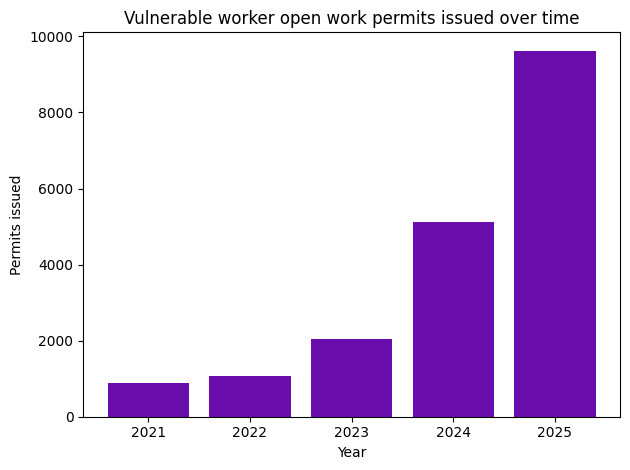
2021: 875 permits issued 2022: 1,080 permits issued 2023: 2,040 permits issued 2024: 5,115 permits issued 2025: 9,625 permits issued
This trajectory makes it clear that what was once a relatively niche protection mechanism has become a widely relied-upon pathway for temporary foreign workers facing unsafe or exploitative employment conditions. With application volumes rising quickly, the need for clearer rules and more consistent decision-making were inevitable.
The Biggest Change: Clear Guidance on What Doesn’t Constitute Abuse
The single most significant operational shift is IRCC’s decision to explicitly outline examples of situations that may not constitute abuse for the purposes of a vulnerable worker open work permit.
For the first time, IRCC now lists scenarios that generally fall outside the scope of the program, including:
- Layoffs due to lack of work or business circumstances outside the employer’s control, where the layoff was carried out fairly and without abuse
- Termination for cause, where the reason for dismissal was reasonable and non-abusive
- Fraudulent job offers where the worker knew there was no job, such as paying for an offer while understanding employment would need to be found independently
- Applications where an OWP-V is sought primarily as a way to extend status, without evidence of abuse or risk of abuse as defined in the regulations
This clarification is important for two reasons.
First, it gives processing officers clearer boundaries, helping ensure more consistent and defensible decisions at a time when volumes are increasing rapidly. Second, it allows potentially eligible foreign workers to better assess their own situation before applying, reducing confusion and unnecessary refusals.
Crucially though, IRCC emphasizes that these examples are not exhaustive. Officers retain discretion to assess each case individually, and situations may still qualify even if they do not align perfectly with the examples listed. This preserves the program’s flexibility while providing much-needed structure.
The updated instructions expand and refine examples of abuse which were included previously, too.
Other Notable Updates to the Program
IRCC also introduced several additional updates that significantly affect how vulnerable worker applications are processed:
- Stronger procedural fairness requirements: Officers must now clearly document how evidence was weighed, explain credibility concerns, and justify refusals in greater detail within GCMS.
- More flexible evidence handling: A missing letter of explanation or IMM 0017 form should not, on its own, result in refusal. Officers are encouraged to request missing information where appropriate.
- Clearer interview guidance: The updated instructions outline when interviews should be conducted, including in cases involving credibility concerns or extrinsic evidence, and provide step-by-step instructions for recording interviews in GCMS.
- Expanded operational detail: New guidance covers document translations, handling of extrinsic evidence, and how officers should approach cases involving trauma or limited documentation.
Why Is the Vulnerable Worker Permit Being Used More?
The sharp rise in vulnerable worker open work permits does not exist in a vacuum. While it is not possible to attribute the increase to a single cause, it closely coincides with heightened scrutiny and sustained criticism of the Temporary Foreign Worker Program (TFWP) over the past year.
Public reporting and media investigations have increasingly highlighted systemic concerns, including:
- gaps in employer compliance and oversight
- ongoing recruitment fee abuses
- employer-specific (tied) work permits that limit worker mobility
- significant barriers to reporting unsafe or exploitative working conditions
As awareness of these issues grows, so too does awareness of the vulnerable worker open work permit. It is known to be a practical and lawful exit option for workers who feel trapped in harmful employment situations,resulting in more applications.
But it goes further. It highlights deeper, unresolved issues within the Temporary Foreign Worker Program, and employer-specific (closed) work permits more generally. As scrutiny of employer practices, recruitment models, and closed work permits continues to grow, the vulnerable worker permit is increasingly being used to fill gaps that existing enforcement and compliance mechanisms have struggled to address.
By its nature, the program remains largely reactive. It offers a pathway out only once abuse has occurred or risk has become acute, rather than preventing harm from happening in the first place. While the vulnerable worker open work permit is an important and necessary protection, it does not address the root causes that make workers vulnerable to exploitation.
In that sense, its rapid expansion should be read as a signal, not just of need to offer greater guidance, but of systemic abuse within Canada’s temporary worker system that remains unresolved.
About the author


Rebecca Major
She/Her
Regulated Canadian Immigration Consultant
Rebecca Major is a Regulated Canadian Immigration Consultant (R511564) with over 15 years of Canadian Immigration experience, gained after graduating with a Bachelor of Laws in the UK. She specializes in Canadian immigration at Moving2Canada.
Read more about Rebecca Major
Citation
Major, Rebecca.
"Canada’s Vulnerable Worker Open Work Permit: What’s New and Why It Matters."
Moving2Canada.
Last modified February 10, 2026.
https://moving2canada.com/news/canada-vulnerable-worker-open-work-permit-changes/.
Copy for Citation
Featured Stories

Immigration • Oct 16, 2026
Will High-Wage Occupation Points Impact Category-Based Express Entry Draws?
Read more

Immigration • Oct 16, 2026
Could the October 16 CRS Update Push Express Entry Draw Scores Above 530?
Read more

IEC • Oct 16, 2026
Working Holiday Canada News, IEC Pools and Invitations
Read more

Immigration • Oct 16, 2026
How to Update Your Express Entry Profile for Canada’s New Job Offer Rules
Read more