
This article was updated more than 6 months ago. Some information may be outdated.
Artificial intelligence is moving fast. In the past year alone, tools like ChatGPT, Claude, and other AI systems have gone from experimental technology to something many people use at work every day.
Naturally, this raises an important question for workers: which jobs are actually at risk?
This week, AI company Anthropic published a large study analyzing how AI is already being used across different occupations. The report looks at millions of anonymized interactions with AI systems to understand which types of work are most exposed to automation.
In this article, we break down the key findings from the report and what they might mean for workers in Canada.
What the Anthropic Report Found
Anthropic’s researchers analyzed how people are currently using AI tools like Claude across many industries. Instead of predicting the future in theory, they examined real-world usage data to see which job tasks are already being automated.
One of the biggest findings is that, so far, AI doesn’t usually replace entire jobs. Instead, it tends to automate specific tasks within jobs. For example, writing reports, summarizing documents, coding software, and analyzing data are tasks that AI systems can already help with or sometimes complete on their own.
The report also distinguishes between two concepts:
- Theoretical AI coverage: jobs where AI could potentially automate many tasks.
- Observed AI usage: jobs where workers are already actively using AI tools today.
The gap between those two numbers is important. Some jobs could theoretically be heavily automated, but in practice workers may only be using AI for small parts of the job.
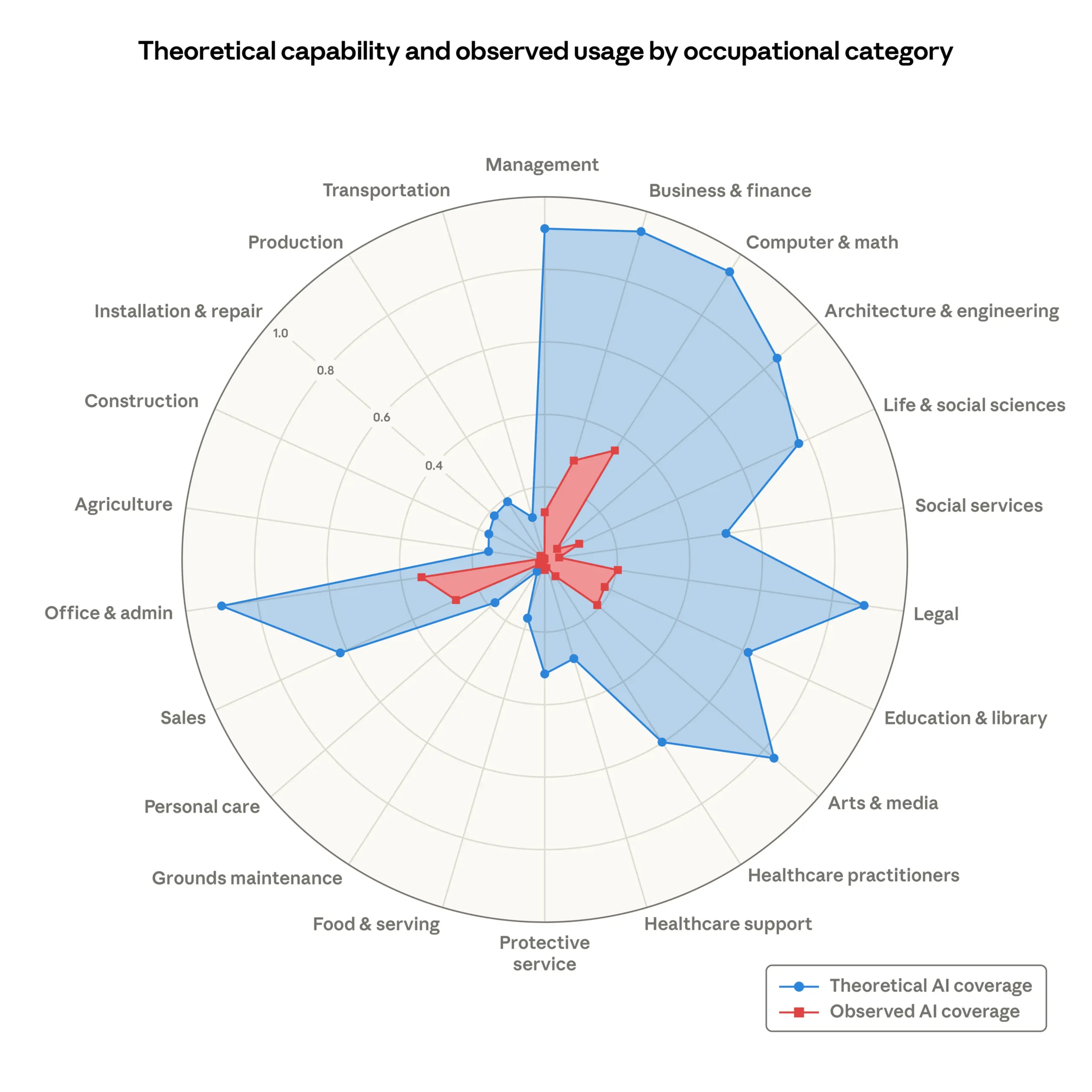
In general, the report found that knowledge-based jobs are the most exposed, particularly roles involving writing, analysis, and digital information. By contrast, jobs involving physical work, skilled trades, or in-person services currently show much lower AI exposure.

The 10 occupations most exposed to AI
The Anthropic report also identified specific occupations where AI tools are already being used heavily. These jobs involve a lot of digital work, information processing, or customer interaction.
According to the report, the 10 jobs currently seeing the highest AI usage include:
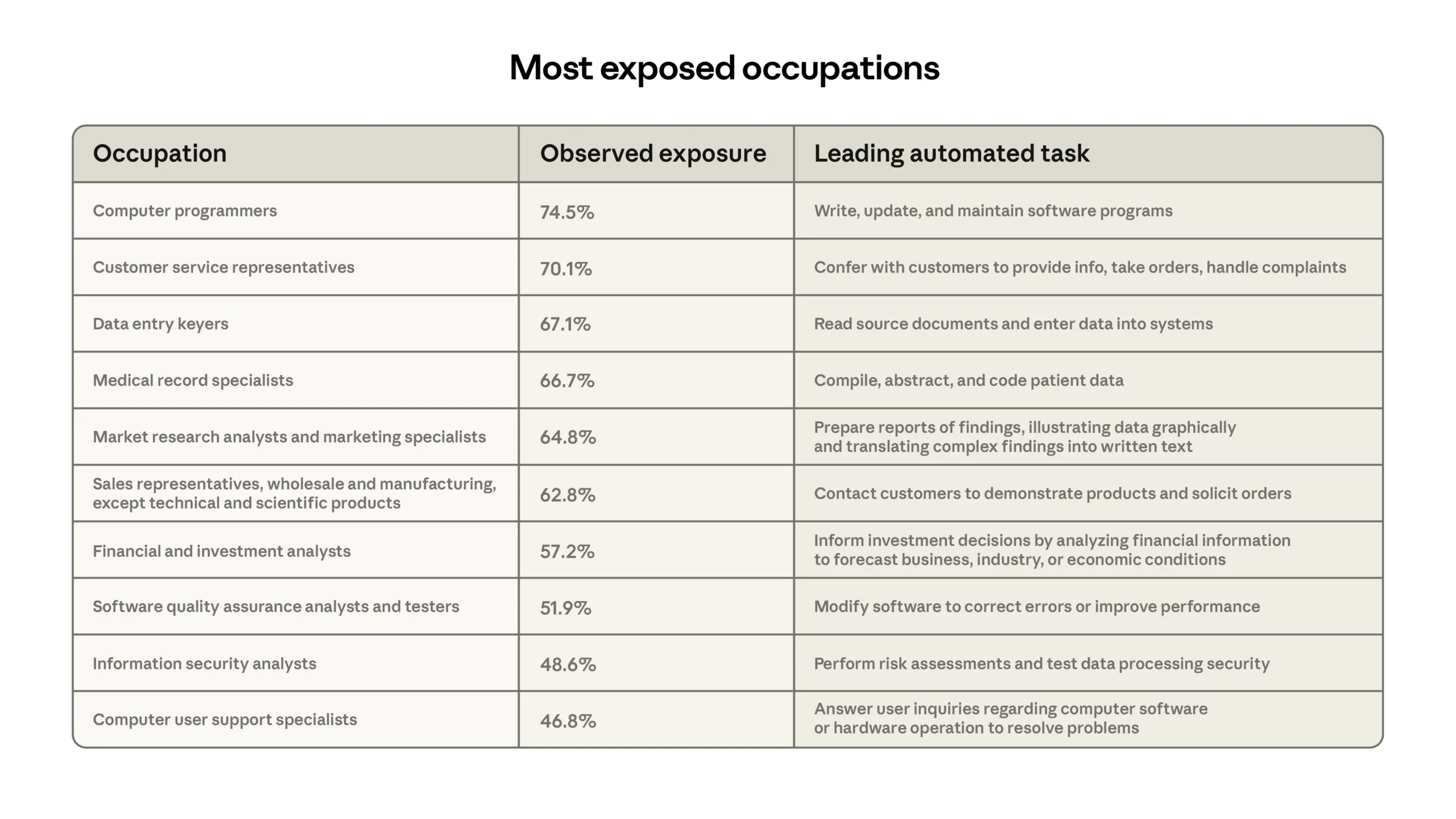
Most of these roles share one thing in common: a large portion of the work happens on a computer and involves processing information. That makes them easier for AI tools to assist with.
However, even in these occupations the technology often assists workers rather than replaces them outright. For example, AI might help a programmer write code faster – or help a customer service agent draft responses more efficiently.
Other occupations that could be affected in Canada
While Anthropic’s report is global, several Canadian studies point to similar trends.
Statistics Canada has noted that jobs involving routine cognitive tasks, such as administrative work, data processing, and some customer service roles, may be more exposed to automation over time. At the same time, many occupations that require hands-on work or in-person interaction remain much harder to automate. This includes jobs in healthcare, skilled trades, construction, and personal services.
In Canada specifically, analysts have also pointed to potential pressure on entry-level office roles, where tasks like drafting emails, summarizing documents, and basic research can increasingly be handled by AI tools.
This doesn’t necessarily mean those jobs will disappear. But it does suggest that the nature of those roles may change as companies integrate AI into their workflows. It also aligns with other analysts who have observed that it is harder for young workers to find entry-level positions in certain industries.
How Canadian workers can prepare for AI
Despite all the headlines, most experts agree that – at least in the immediate future – AI is more likely to change jobs than eliminate them entirely. In many workplaces, employees are already using AI to help with tasks like writing, coding, research, and data analysis.
The best preparation is learning how to work alongside these tools rather than ignoring them. If you want a deeper look at how to prepare for the age of AI, check out our guide on preparing for AI in the workforce.
AI is already reshaping parts of the labour market, especially in digital and knowledge-based roles, but the impact is uneven. Some occupations are seeing rapid change, while others remain largely untouched for now.
For Canadian workers, the most important takeaways are awareness and preparation. Understanding where AI is being adopted and how it’s being used can help you adapt, learn new tools, and stay competitive in a changing job market.
Want more updates on the Canadian jobs market? Be sure to register for the Moving2Canada newsletter. It’s 100% free!
About the author

Dane Stewart
He/Him
Canadian Immigration Writer
Dane is an award-winning digital storyteller with experience in writing, audio, and video. He has more than 7 years’ experience covering Canadian immigration news.
Read more about Dane Stewart
Citation
Stewart, Dane.
"Which Jobs Will AI Replace in Canada?."
Moving2Canada.
Last modified April 10, 2026.
https://moving2canada.com/features/which-jobs-will-ai-replace-canada/.
Copy for Citation
Featured Stories

Work • Oct 16, 2026
How International Candidates Should Explain Their Immigration Status
Read more
Work • Oct 9, 2026
Fewer Canadian Cities Now Eligible for LMIAs from October 9
Read more

Work • Oct 9, 2026
The Resume Mistakes Recruiters Notice Immediately
Read more

Work • Oct 2, 2026
What Employers Want to See in a Canadian Job Interview with International Applicants
Read more