
New regional unemployment rates came into effect on October 9, 2026, changing where Canadian employers can hire temporary foreign workers through the low-wage Labour Market Impact Assessment (LMIA) stream.
The latest update is less encouraging than the previous quarter. Only 11 Census Metropolitan Areas (CMAs) now have unemployment rates below 6 percent, down from 15 in July.
Six regions have lost eligibility for low-wage LMIA processing, including Halifax, Fredericton, Kingston, and Regina. Meanwhile, two regions in British Columbia have regained eligibility.
The key takeaway here: If you are relying on an employer to obtain an LMIA to support a new work permit or extend your stay as a worker in Canada, your options are more limited for the next few months. If you’re living and working in a city where the unemployment rate has increased, these changes could affect your options.
Key Takeaways
- Only 11 CMAs have unemployment rates below 6 percent, compared with 15 in July.
- Six regions lost eligibility: Halifax, Fredericton, Kingston, St. Catharines-Niagara, Regina and Lethbridge.
- Two regions have regained eligibility: Kamloops and Chilliwack, both in British Columbia. The decrease in unemployment rate for both cities was dramatic.
- Thunder Bay is now the only Ontario CMA below the 6 percent threshold.
- The new rates apply from October 9, 2026, to January 7, 2027.
- You can get broader context about Canada’s unemployment rates and economic factors impacting them in our recently-updated labour market report.

Our Immigration Consultant
Rebecca Major
Moving2Canada offers transparent Canadian immigration services with advice you can trust. Led by Rebecca Major (RCIC #511564), we deliver professional, regulated, and efficient support with one clear goal: to guide you confidently through your Canadian immigration journey.
Schedule a consult
Why Do Unemployment Rates Matter for LMIA Applications?
Since September 26, 2024, Employment and Social Development Canada (ESDC) has refused to process certain low-wage LMIA applications for positions located in CMAs where unemployment is 6 percent or higher. (Remember, ESDC is responsible for assessing an LMIA, and then the application with a positive LMIA goes across to IRCC for immigration-related assessment).
The restriction applies to positions offering wages below the applicable provincial or territorial wage threshold.
For employers and foreign workers, this means that even if an employer is willing to support an LMIA application, the unemployment rate in their region could prevent the application from being processed. Yes – this means most employers are not able to access low-wage LMIAs in any of the regions with an unemployment rate above 6% for the next three months – even if they can’t source other suitably qualified workers.
ESDC updates the applicable unemployment rates every three months, so employers in CMAs across Canada are subject to fluctuations in whether they can receive a positive LMIA or not based on these figures.
Importantly, there are exemptions for certain critical and/or in-demand occupations and sectors. These exemptions cover sectors like construction, food manufacturing, hospitals, nursing and residential care facilities, and primary agriculture.
Six Regions Lose Eligibility For Low-Wage LMIA Processing
Six regions that were below the unemployment threshold in July have now reached or exceeded 6 percent.
- Halifax, NS: 6.1%
- Fredericton, NB: 6.2%
- Kingston, ON: 6.3%
- St. Catharines-Niagara, ON: 6.5%
- Regina, SK: 6.7%
- Lethbridge, AB: 6.0%
Five of these regions only regained eligibility in July. This shows that unemployment rates in these areas are highly variable in the current economy.
Halifax, Fredericton, Kingston, St. Catharines-Niagara and Regina all dropped below the 6 percent threshold in the previous update. Now, just three months later, they have moved back above it.
Lethbridge also lost eligibility, with its unemployment rate increasing to exactly 6 percent. Because the restriction applies to regions with unemployment rates of 6 percent or higher, applications in Lethbridge are now affected.
For foreign workers whose employers were planning to submit low-wage LMIA applications in these regions, the change could have an immediate impact.
Two British Columbia Regions Regain Eligibility
There is better news for employers and foreign workers in Kamloops and Chilliwack.
Both regions have fallen below the 6 percent threshold, allowing eligible employers to submit low-wage LMIA applications again.
- Kamloops, BC: Unemployment fell from 7.0% in July to 3.6% in October, a decrease of 3.4 percentage points.
- Chilliwack, BC: Unemployment fell from 7.9% in July to 5.6% in October, a decrease of 2.3 percentage points.
Kamloops recorded a particularly significant improvement, with unemployment falling by 3.4 percentage points.
Chilliwack also saw a substantial decline of 2.3 percentage points.
Both regions had lost eligibility in July, again showing how quickly the situation can change between quarterly updates.
Remember, being below the unemployment threshold does not guarantee LMIA approval. ESDC will still consider the remaining elements of the application. Then, applicants with a positive LMIA must still meet all other requirements of the Temporary Foreign Worker Program to receive their approved work permit from IRCC.
Which Canadian Cities Are Eligible For Low-Wage LMIA Processing?
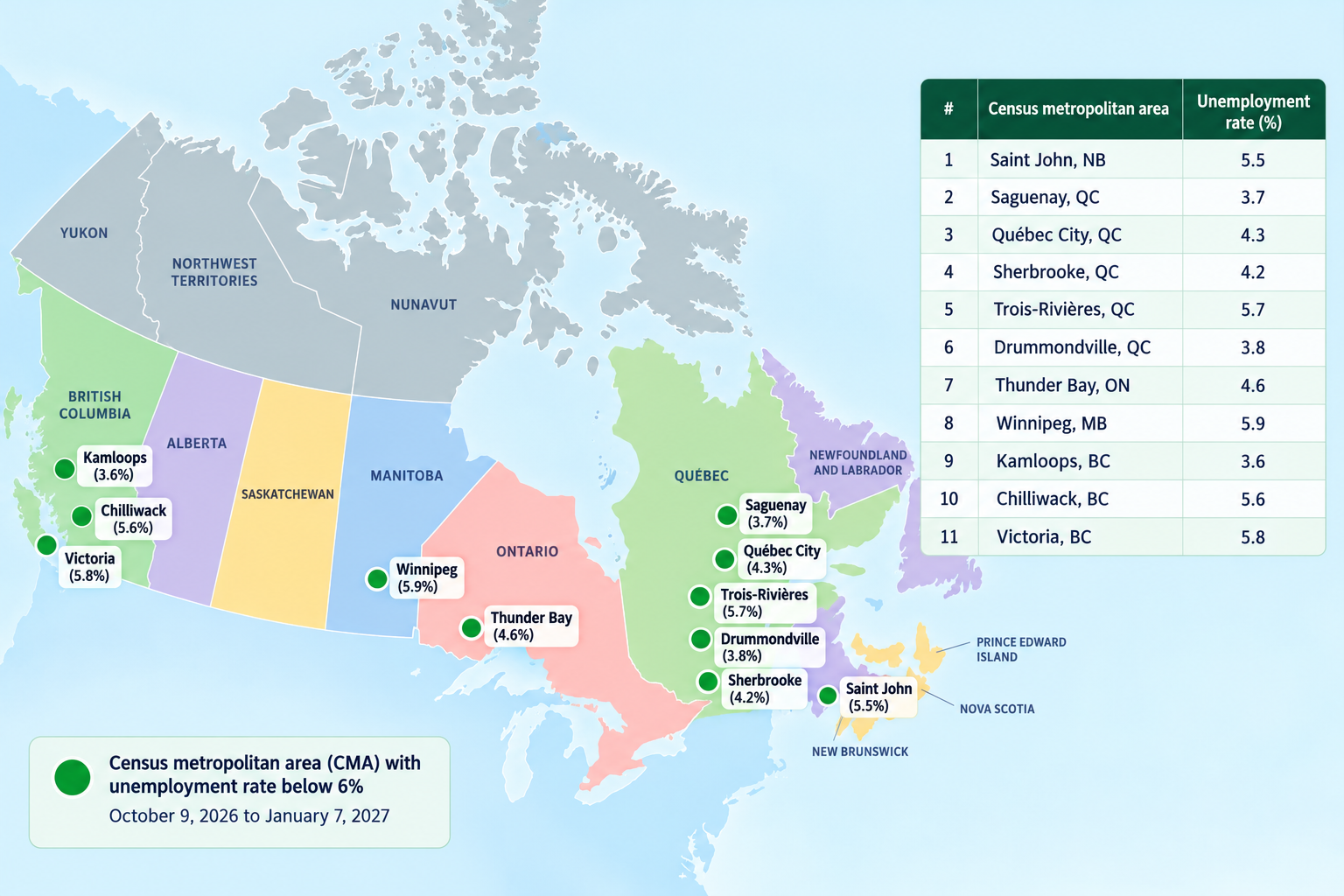
From October 9, 2026, the following 11 CMAs have unemployment rates below 6 percent.
-
Saint John, NB: 5.5%
-
Saguenay, QC: 3.7%
-
Québec City, QC: 4.3%
-
Sherbrooke, QC: 4.2%
-
Trois-Rivières, QC: 5.7%
-
Drummondville, QC: 3.8%
-
Thunder Bay, ON: 4.6%
-
Winnipeg, MB: 5.9%
-
Kamloops, BC: 3.6%
-
Chilliwack, BC: 5.6%
- Victoria, BC: 5.8%
Quebec continues to have the greatest number of eligible CMAs, with five regions below the threshold.
British Columbia now has three eligible regions, compared with just one in July.
Ontario has only one eligible CMA, while Alberta and Saskatchewan have none.
Employers in these 11 regions can generally submit low-wage LMIA applications, provided they meet the other program requirements.
Which Canadian Cities Are Restricted From Low-Wage LMIA Processing?
The remaining 30 CMAs have unemployment rates of 6 percent or higher.
Unless an exemption applies, ESDC will refuse to process new low-wage LMIA applications for positions in these regions.
-
St. John’s, NL: 6.4%
-
Halifax, NS: 6.1%
-
Moncton, NB: 8.1%
-
Fredericton, NB: 6.2%
-
Montréal, QC: 7.2%
-
Ottawa-Gatineau, ON/QC: 7.9%
-
Kingston, ON: 6.3%
-
Belleville-Quinte West, ON: 6.4%
-
Peterborough, ON: 6.3%
-
Oshawa, ON: 9.8%
-
Toronto, ON: 7.5%
-
Hamilton, ON: 7.4%
-
St. Catharines-Niagara, ON: 6.5%
-
Kitchener-Cambridge-Waterloo, ON: 7.6%
-
Brantford, ON: 6.3%
-
Guelph, ON: 7.5%
-
London, ON: 9.1%
-
Windsor, ON: 7.9%
-
Barrie, ON: 6.2%
-
Greater Sudbury, ON: 6.2%
-
Regina, SK: 6.7%
-
Saskatoon, SK: 6.5%
-
Lethbridge, AB: 6.0%
-
Calgary, AB: 6.4%
-
Red Deer, AB: 6.9%
-
Edmonton, AB: 7.6%
-
Kelowna, BC: 8.6%
-
Abbotsford-Mission, BC: 7.6%
-
Vancouver, BC: 7.0%
-
Nanaimo, BC: 6.6%
Employers in communities outside CMAs are generally not subject to this particular unemployment-rate restriction, although other LMIA requirements still apply.
What if the City I Live In Isn’t Listed as a CMA?
This likely means that you live in a small city that’s unaffected by the current immigration policy. These restrictions only apply to cities classed as CMAs, which is (broadly) a city of at least 100,000 people – with a few other qualifiers if you want to get into the weeds.
If your city isn’t listed as a CMA, then your employer can apply for an LMIA through ESDC without worrying about the unemployment rate. All other qualifying criteria will still apply to you though.
What Stands Out From The October 2026 Update?
Several figures stood out to us.
Ontario continues to have limited options.
Thunder Bay is now the only Ontario CMA below the threshold. Oshawa has the highest unemployment rate on the list at 9.8 percent, followed by London at 9.1 percent.
Alberta has no eligible CMAs.
Lethbridge was the only Alberta region below the threshold in July, but its rate has now reached 6 percent. Calgary remains above the threshold at 6.4 percent.
Quebec remains comparatively favourable.
Five CMAs are below 6 percent, including Drummondville, where unemployment fell from 5.7 percent to 3.8 percent. However, Montréal remains restricted at 7.2 percent. These figures are surprising, considering Quebec has seen considerable job losses in the last few months.
British Columbia has seen the biggest improvement in eligibility.
Kamloops and Chilliwack have rejoined Victoria as eligible regions. Vancouver, however, remains above the threshold at 7.0 percent, while unemployment in Kelowna climbed to a province-wide high of 8.6 percent.
It’s important that employers and foreign workers check the unemployment rates before submitting an LMIA application.
What Do These LMIA Changes Mean for Foreign Workers?
If your employer is planning to apply for an LMIA, the first step is to establish whether your position falls within the low-wage stream and whether the work location is in a restricted CMA.
If the unemployment rate is 6 percent or higher, ESDC will generally refuse to process the low-wage application unless an exemption applies.
If you have already submitted an application for an LMIA in an area that was previously eligible and now isn’t, don’t despair. The applicable unemployment rate is determined by the date the employer submits the LMIA application.
For example, if an eligible employer submitted an LMIA for a position in Halifax on October 8, the previous unemployment rate of 5.9 percent applies, rather than the new rate of 6.1 percent.
These changes also don’t impact existing work permits or their expiry dates.
What if my work permit is expiring?
If your employer cannot obtain a new LMIA because of the regional unemployment rate, you may need to explore other options.
Depending on your circumstances, the other options include:
- Applying for an LMIA-exempt work permit, if you qualify, or
- Considering whether your employer could offer a higher salary that meets the requirements of the high-wage LMIA stream, or
- Applying for permanent residence or citizenship, if you quality.
In terms of increasing your salary, it’s worth noting that any salary increase must be reasonable and justifiable for your occupation and the work you perform. Employers should not artificially increase wages simply to get around the low-wage LMIA restrictions.
It’s important to explore your options well before your current work permit expires.
When Will The LMIA Unemployment Rates Change Again?
The current unemployment rates apply to LMIA applications submitted from October 9, 2026, to January 7, 2027.
The next update is scheduled for January 8, 2027.
About the author

Stephanie Ford
She/Her
Finance, Law and Immigration Writer
Stephanie is a content creator who writes on legal and personal finance topics, specializing in immigration and legal topics. She earned a Bachelor of Laws and a Diploma in Financial Planning in Australia. Stephanie is now a permanent resident of Canada and a full-time writer at Moving2Canada.
Read more about Stephanie Ford
Citation
Ford, Stephanie.
"Fewer Canadian Cities Now Eligible for LMIAs from October 9."
Moving2Canada.
Last modified October 9, 2026.
https://moving2canada.com/2026/10/lmia-unemployment-rates-october-2026/.
Copy for Citation
Featured Stories

Work • Oct 9, 2026
The Resume Mistakes Recruiters Notice Immediately
Read more

Immigration • Oct 8, 2026
What I Tell Clients Who Are Relying on a Category-Based Express Entry Draw
Read more

Immigration • Oct 7, 2026
Canada Immigration Levels Plan 2027–2029: Predictions and Expected Targets
Read more

Living • Oct 7, 2026
Daylight Saving Time to Get Even More Confusing: B.C., Alberta, Manitoba Won’t Turn Clocks Back
Read more