Canada plans to welcome 135,300 permanent residents annually through family sponsorship, refugee protection, and other humanitarian immigration programs between 2027 and 2029.
Under the 2027–2029 Immigration Levels Plan, non-economic immigration will account for 35.6% of Canada’s overall permanent residence target of 380,000 annually.
Family sponsorship targets will fall from 84,000 in 2026 to 81,000 in 2027, a decrease of 3.6%. Refugee and protected person admissions will remain unchanged at 49,300, while humanitarian and compassionate admissions will decline from 6,900 to 5,000.
Overall, non-economic immigration targets will decrease by 4,900 admissions, or 3.5%, compared with 2026. However, the 2027 targets are virtually unchanged from the 2027 projections announced in the 2026–2028 Immigration Levels Plan.
At the same time, the government is introducing additional permanent residence spaces to help clear application backlogs, including applications from spouses, partners, children, and other humanitarian applicants already living in Canada.
Key Takeaways
- Non-economic PR targets will fall 3.5% to 135,300 in 2027.
- Family sponsorship admissions will drop from 84,000 to 81,000, while refugee targets remain at 49,300.
- A new one-time measure will provide up to 100,000 additional PR spaces in 2027, including 45,000 for spouses and children.
- Existing one-time measures for up to 115,000 protected persons and 33,000 in-Canada workers will continue through 2027.
Canada’s Permanent Residence Targets for 2027–2029
According to the new Immigration Levels Plan, Canada will admit 380,000 permanent residents annually between 2027 and 2029, unchanged from the 2026 target.
Economic immigration will account for the largest share, with 244,700 admissions annually, or 64.4% of the total.
While the overall targets remain stable, the government has made changes within economic immigration programs. These include cuts to Federal High Skilled admissions and increases for the Provincial Nominee Program.
We’ve covered this in our detailed analysis of the 2027–2029 economic immigration targets.
In this article, we’ll focus on the remaining 135,300 spaces, which will go to non-economic categories. These include family reunification, refugees, and humanitarian applicants.
We’ll also cover some one-time measures that weren’t officially included in the Levels Plan.
Non-Economic Permanent Residence Targets for 2027–2029
Although the total non-economic target will fall by 3.5% compared with 2026, this reduction was already anticipated.
The previous Immigration Levels Plan had projected exactly 135,300 non-economic admissions for 2027, meaning the government has not introduced further cuts to the overall target.
The table below compares the new targets with those for 2026.
| Immigration category | 2026 Actual Target | 2027 Actual Target | 2028 Notional Target | 2029 Notional Target |
|---|---|---|---|---|
| Spouses, partners and children | 69,000 | 66,000 | 66,000 | 66,000 |
| Parents and grandparents | 15,000 | 15,000 | 15,000 | 15,000 |
| Total Family | 84,000 | 81,000 | 81,000 | 81,000 |
| Protected persons in Canada and dependants abroad | 20,000 | 20,000 | 20,000 | 20,000 |
| Government-assisted refugees | 13,250 | 11,750 | 11,750 | 11,750 |
| Privately sponsored refugees | 16,000 | 17,550 | 17,550 | 17,550 |
| Blended Visa Office-Referred refugees | 50 | — | — | — |
| Total Refugees and Protected Persons | 49,300 | 49,300 | 49,300 | 49,300 |
| Humanitarian & Compassionate and Other | 6,900 | 5,000 | 5,000 | 5,000 |
| Total Non-Economic | 140,200 | 135,300 | 135,300 | 135,300 |
Source: IRCC’s 2026–2028 and 2027–2029 Immigration Levels Plans. The 2028 and 2029 targets are notional and may change.
Family Sponsorship Targets Fall to 81,000
Family reunification will account for approximately 21.3% of Canada’s planned permanent residence admissions.
Canada will reduce family sponsorship admissions from 84,000 in 2026 to 81,000 annually from 2027 to 2029.
The entire reduction comes from the spouses, partners and children category, which will fall from 69,000 to 66,000 admissions.
The target for parents and grandparents will remain unchanged at 15,000 annually. At present, the Parents and Grandparents Program (PGP) remains closed to new applications. There is no indication of when intake will resume.
Demand for family sponsorship continues to exceed available admissions spaces.
According to IRCC’s October 9 application processing inventory, the number of people waiting for a decision on sponsorship applications includes:
- Parents and grandparents: 35,600. That inventory exceeds IRCC’s annual admissions target for at least the next two years.
- Spouses and partners: 121,200, including 55,600 applicants living in Canada and 65,600 applying from outside Canada. This, too, is nearly twice the target for 2027.
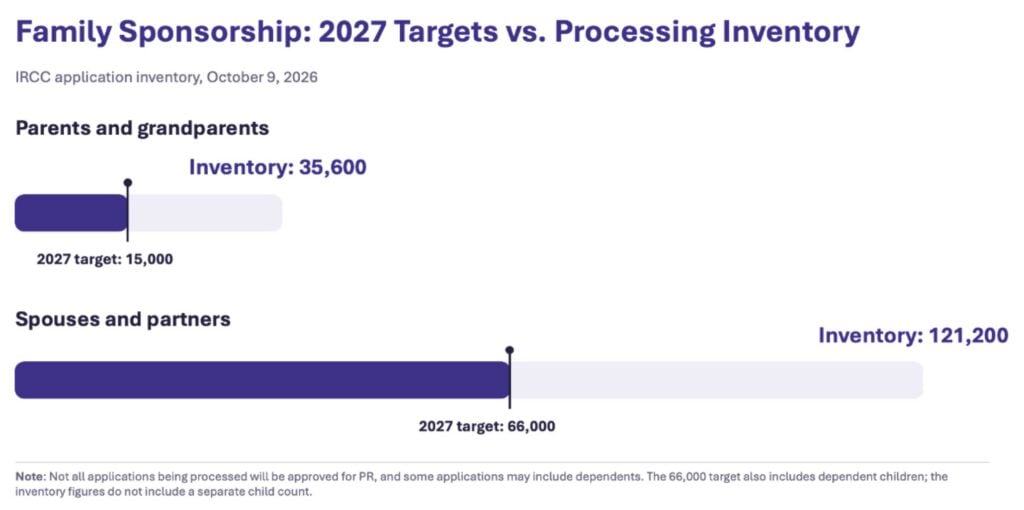
However, the additional permanent residence spaces announced for 2027 could help tackle a portion of the backlog for spouses and partners.
Additional 45,000 PR Spaces for Spouses and Children in 2027
Although Canada’s regular family sponsorship target will fall in 2027, the government is introducing additional spaces to help reduce longstanding application backlogs.
Under a new one-time measure, Canada will allocate up to 100,000 additional permanent residence spaces to family reunification and humanitarian applicants in 2027.
According to a Toronto Star article, immigration officials confirmed that 45,000 of these spaces will go to spouses and children of Canadian citizens and permanent residents who are already awaiting PR decisions. These admissions are separate from the regular annual immigration targets.
IRCC has said the measure is intended to bring processing times for eligible spouse or common-law partner applications destined outside Quebec closer to 12 months.
However, the measure is focused on processing existing applications rather than creating new opportunities to apply for permanent residence.
Refugee and Protected Person Targets Remain Unchanged
Canada will maintain its overall target of 49,300 admissions annually for refugees and protected persons in 2027. However, there are changes within the category.
- Government-assisted refugee admissions will decrease from 13,250 in 2026 to 11,750 in 2027.
- Privately sponsored refugee admissions will increase from 16,000 to 17,550.
- Admissions for protected persons in Canada and their dependants abroad will remain at 20,000 annually.
Additional Spaces for Protected Persons Will Continue in 2027
Canada will continue a one-time initiative announced in the 2026–2028 Immigration Levels Plan, providing additional permanent residence spaces for up to 115,000 protected persons in Canada and their in-Canada dependants over 2026 and 2027.
Of these, 46,000 admissions are planned for 2026, leaving up to 69,000 for 2027 under the two-year initiative.
The initiative applies to people who have already been granted protected person status and their eligible in-Canada dependants.
These admissions are separate from the regular annual immigration targets and the time-limited 200,000 PR spaces for 2027.
Humanitarian and Compassionate (H&C) Admissions Decrease
The admissions target for the Humanitarian and Compassionate and Other category will fall from 6,900 in 2026 to 5,000 annually from 2027 to 2029.
This represents a reduction of approximately 27.5%. The category will account for just 1.3% of Canada’s overall planned permanent residence admissions.
The reduction comes as IRCC faces a substantial backlog of humanitarian and compassionate applications. According to IRCC, approximately 58,800 people are currently waiting for a decision on an H&C application, with estimated processing times exceeding 10 years.
However, the government has announced additional permanent residence spaces for up to 12,600 people who have already been found eligible for PR on humanitarian and compassionate grounds.
These spaces are separate from the regular annual targets and could help IRCC finalize applications that have been delayed by the backlog.
What Do the 2027–2029 PR Targets Mean for Applicants?
Economic immigration will remain Canada’s priority, accounting for nearly two-thirds of planned permanent residence admissions.
For non-economic immigration categories, the new Immigration Levels Plan brings few changes. However, the additional one-time measures could make a significant difference for applicants already waiting for permanent residence.
These measures will allow IRCC to process more applications outside the regular annual admissions targets. This could reduce longstanding backlogs and help families reunite in Canada sooner.
For protected persons and humanitarian applicants, the additional spaces could also provide a faster path to permanent residence after years of uncertainty.
Ultimately, this year’s Immigration Levels Plan focuses on sustainability. IRCC aims to achieve that by keeping admissions targets steady and reducing processing inventory to a manageable level.
Want to stay up to date on Canada’s Immigration Levels Plan? We’ve got more coverage coming over the next few days. Join our email community to get the latest.
About the author

Sugandha Mahajan
She/Her
Content Marketer
Born and raised in New Delhi, India, Sugandha moved to Canada as a permanent resident in early 2020, just weeks before the pandemic shut everything down. She has first-hand experience with many common newcomer challenges, including navigating the Express Entry system, finding a job without Canadian experience, and figuring out small talk. To deepen her understanding of the field, she is currently pursuing a Graduate Diploma in Immigration & Citizenship Law at Queen’s University.
Read more about Sugandha Mahajan
Citation
Mahajan, Sugandha.
"Canada Cuts Family Sponsorship Targets for 2027, But Additional PR Spaces Could Reduce Backlogs."
Moving2Canada.
Last modified November 11, 2026.
https://moving2canada.com/2026/11/canada-cuts-family-sponsorship-targets-2027/.
Copy for Citation
Featured Stories
Express Entry • Nov 11, 2026
How Long Will Express Entry Draws Be Paused For?
Read more

Work • Nov 11, 2026
Tracking Canadian Jobs By Industry: A Province By Province Analysis
Read more

Immigration • Nov 11, 2026
The Demographics of Canadian Permanent Residence Admissions
Read more

Immigration • Nov 11, 2026
A New Startup Pilot? Budget 2026 Wants to Bring Innovators to Canada
Read more