IRCC recently started publishing more data on how many people are receiving permanent residence in Canada. This means you no longer have to wait until year-end to see how Canada is tracking against its immigration targets.
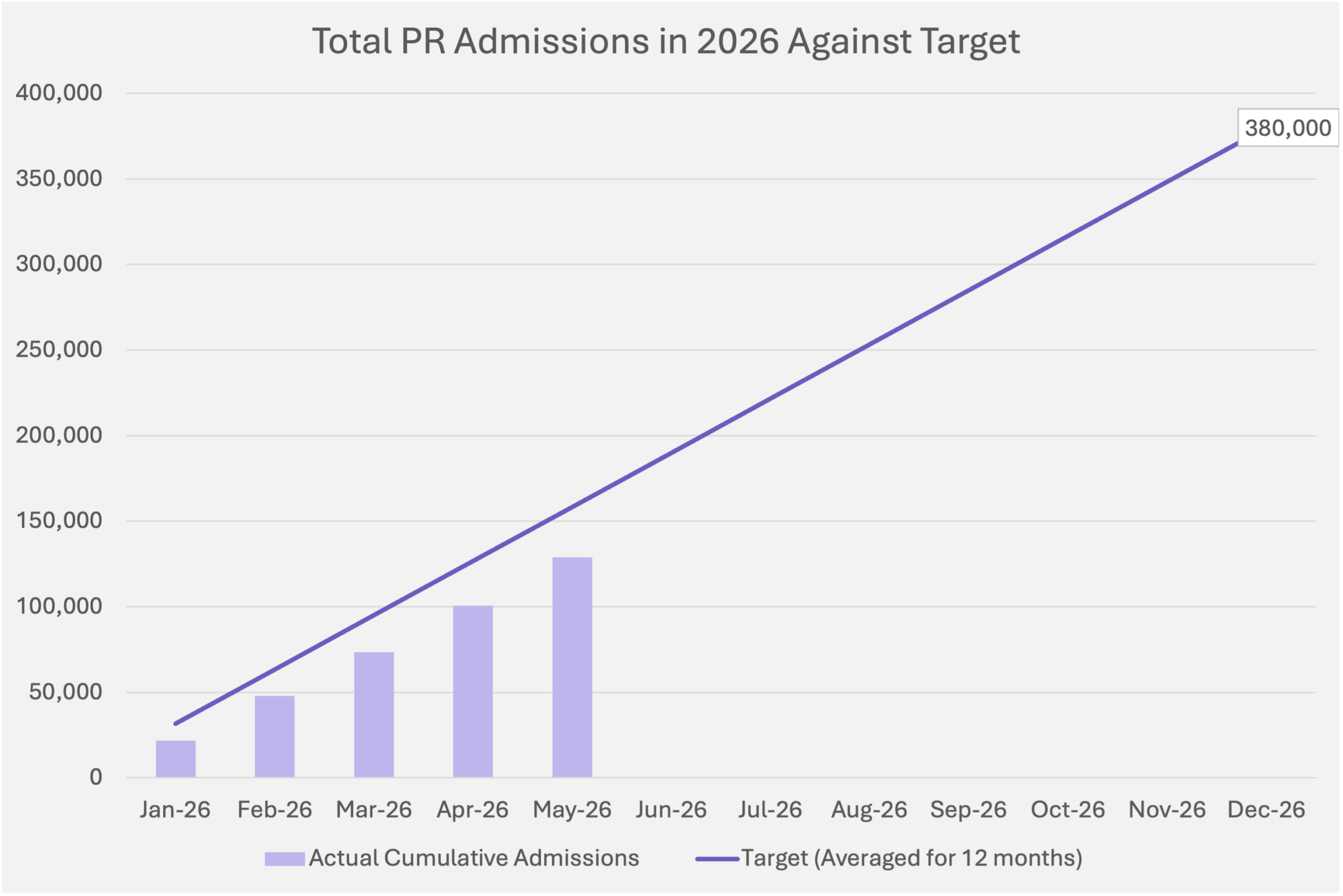
The first batch of data, current as of May 31, 2026, shows that fewer than 128,900 people became permanent residents between January and May 2026. The data is broken down into PR admissions by category, and IRCC is expected to update figures monthly. Economic immigration, which includes Express Entry, Provincial Nominee Programs, and more, accounted for 73,600 new permanent residents, over 57 percent of the total.
Key Takeaways
- IRCC admitted 128,865 new permanent residents between January and May 2026, toward its overall 2026 target of 380,000.
- Economic immigration accounts for most permanent residents so far, with 73,600 new PRs admitted toward the 239,800 target for 2026.
- Family class is at about 45 percent of its 84,000 target.
- Nearly 9,900 French-speaking permanent residents landed outside Quebec between January and May 2026, putting IRCC at 33 percent of its target.
New Permanent Residents in January to May 2026 Down 24 Percent Over 2025
Canada’s 2026-2028 Immigration Levels Plan sets an overall target of 380,000 new permanent residents for 2026, with a range of 350,000 to 420,000. IRCC has admitted 128,865 people toward that target between January and May, achieving roughly 33.9 percent of the annual goal in the first five months of the year.

Our Immigration Consultant
Rebecca Major
Moving2Canada offers transparent Canadian immigration services with advice you can trust. Led by Rebecca Major (RCIC #511564), we deliver professional, regulated, and efficient support with one clear goal: to guide you confidently through your Canadian immigration journey.
Schedule a consult
That pace is behind where IRCC would be if admissions were spread evenly across the year. Five months is 41.7 percent of the year, so a proportional pace would put year-to-date PR numbers closer to 158,300.
PR admissions in the first five months of 2026 are down about 24 percent from the same period in 2025, and down about 39 percent from the same period in 2024.
PR Admissions by Month, Y-O-Y Comparison
| Month | 2024 | 2025 | 2026 |
|---|---|---|---|
| January | 47,785 | 34,055 | 21,715 |
| February | 39,115 | 35,275 | 26,115 |
| March | 34,875 | 34,985 | 25,745 |
| April | 42,615 | 28,055 | 27,000 |
| May | 46,855 | 36,430 | 28,485 |
| June | 44,700 | 39,045 | 27,115 |
| July | 47,870 | 38,735 | 32,565 |
| Jan-July Total | 303,815 | 246,580 | 188,630 |
| Annual Target | 485,000 | 395,000 | 380,000 |
Part of this reflects lower overall targets in each successive year — 485,000 in 2024 to 395,000 in 2025 to 380,000 in 2026. But even accounting for percentage of annual targets, IRCC is lagging in 2026. By May 2024, PR admissions were at about 44 percent of its annual target, while by 2025, it had reached about 43 percent. This year, it has reached about 34 percent.
The lower targets, and resulting slower pace of admissions, fits within the goals of the current Levels Plan. IRCC has said it wants to keep new permanent residents at less than 1 percent of Canada’s total population after 2027. There is also an ongoing focus on transitioning temporary residents already living and working in Canada to permanent resident status. In recent years, roughly half of new permanent residents have come from this in-Canada pool.
In-Canada transitions aren’t only happening under long-standing immigration programs, but also through two one-time initiatives running in 2026 and 2027. These numbers are counted separately, and we’ll cover these later in the article.
Economic Immigration
Economic immigration, which includes Express Entry, the Provincial Nominee Program (PNP), regional programs such as the Atlantic Immigration Program, and federal pilot programs, remains the largest of the four immigration categories.
Under the levels plan, economic immigration is expected to contribute 239,800 admissions, or roughly 63 percent of the overall PR target for 2026. As of May 2026, 73,600 people had become permanent residents through this category, or about 31 percent of the year’s goal.
Although the IRCC numbers only cover admissions, Moving2Canada’s analysis suggests that two of the largest economic programs — Federal High Skilled and Provincial Nominee Program (PNP) — look well-positioned to reach their targets this year.
The Federal High Skilled category, which includes the Canadian Experience Class, Federal Skilled Worker Program, and Federal Skilled Trades Program (including category-based selection), is delivered through the Express Entry system and has a target of 109,000 admissions in 2026. Federal High Skilled candidates received roughly 83,700 invitations to apply in the first half of the year, well ahead of last year’s pace. With current processing times running around six months for Canadian Experience Class candidates and seven months for Federal Skilled Worker candidates, most ITAs issued through at least April should reach the permanent residence stage before the end of 2026.
The PNP, targeted at 91,500 admissions in 2026, also has a large pipeline of applications to draw from. As of July 7, 2026, IRCC was processing 103,800 base PNP applications (outside Express Entry) and 12,100 Express Entry-linked PNP applications.
Based on IRCC’s processing time tool, roughly 68,500 of these combined (58,000 base PNP and 10,500 through Express Entry) are expected to be finalized by December 2026. That said, not every finalized application will lead to an admission this year, especially for applicants living outside Canada.
Family Class
The family class category has a target of 84,000 admissions for 2026. The category covers sponsorship of spouses, partners, children, parents, and grandparents. IRCC reported 37,900 new permanent residents in this category between January and May, or about 45 percent of the year’s target, ahead of the overall pace.
Recently, IRCC paused intake of applications under the Parents and Grandparents Program (PGP). The department clarified that it still plans to grant permanent residence to 15,000 people through the program this year, in line with the target.
Francophone Immigration Outside Quebec
Canada has committed to a francophone immigration target of 9 percent of all new permanent residents outside Quebec in 2026, rising to 10.5 percent by 2028. That works out to 30,150 French-speaking (or bilingual) permanent residents for the year.
Between January and May 2026, 9,900 French-speaking permanent residents landed outside Quebec. That puts IRCC at about a third of its annual goal after five months.
However, based on the French-category draw activity we’ve seen this year, we fully expect IRCC to meet, if not exceed, this target.
Refugees and Protected Persons
This category includes resettled refugees, who are referred to Canada from abroad, and protected persons already in Canada who have been approved by the Immigration and Refugee Board or gone through IRCC’s pre-removal risk assessment process.
The 2026 target for refugees and protected persons is 49,300. As of May, 14,300 people had received PR under these categories, or about 29 percent of the year’s goal.
Humanitarian and Compassionate Cases and Others
The humanitarian and compassionate (H&C) and other category is the smallest of the four, targeting 6,900 admissions in 2026. It covers humanitarian and compassionate grounds applications and Canada’s responses to specific situations abroad, such as Ukraine, Sudan, and Hong Kong.
As of May, 3,000 people had been admitted through this category, or about 43 percent of the year’s target.
Two One-Time Initiatives Running Alongside the Levels Plan
IRCC is also reporting on two one-time initiatives running through 2026 and 2027. Admissions under these initiatives are over and above the 380,000 annual target.
The In-Canada Workers Initiative (previously called TR to PR) is fast-tracking permanent residence for up to 33,000 temporary workers already living in Canadian communities, with a focus on smaller communities. IRCC plans to admit at least 20,000 of these workers as permanent residents in 2026. As of May, 9,100 had received PR, or 46 percent of the 2026 goal.
A second initiative is processing permanent residence for up to 115,000 protected persons already in Canada, with 46,000 of those admissions planned for 2026. As of May, 9,300 had been admitted, or 20 percent of this year’s goal.
What This Means for You
If you are tracking how Canada is moving toward its 2026 targets, IRCC will now give you monthly figures instead of an annual report released the following year.
Moving2Canada will continue tracking these updates on a monthly basis. Sign up for our newsletter for the latest immigration updates, news, and analysis.
About the author

Sugandha Mahajan
She/Her
Content Marketer
Born and raised in New Delhi, India, Sugandha moved to Canada as a permanent resident in early 2020, just weeks before the pandemic shut everything down. She has first-hand experience with many common newcomer challenges, including navigating the Express Entry system, finding a job without Canadian experience, and figuring out small talk. To deepen her understanding of the field, she is currently pursuing a Graduate Diploma in Immigration & Citizenship Law at Queen’s University.
Read more about Sugandha Mahajan
Citation
Mahajan, Sugandha.
"New IRCC Data Shows 128,865 Received Permanent Residence Between January and May 2026."
Moving2Canada.
Last modified July 28, 2026.
https://moving2canada.com/2026/07/new-ircc-permanent-residence-numbers-till-may-2026/.
Copy for Citation










Featured Stories

Immigration • Oct 16, 2026
Will High-Wage Occupation Points Impact Category-Based Express Entry Draws?
Read more

Immigration • Oct 16, 2026
Could the October 16 CRS Update Push Express Entry Draw Scores Above 530?
Read more

IEC • Oct 16, 2026
Working Holiday Canada News, IEC Pools and Invitations
Read more

Immigration • Oct 16, 2026
How to Update Your Express Entry Profile for Canada’s New Job Offer Rules
Read more