Canada admitted 27,715 new permanent residents in August 2026 under its Immigration Levels Plan, a 15.1 percent decrease from July.

This content is sponsored by Scotiabank. The views, opinions, and information expressed in this piece are those of Moving2Canada and do not reflect those of Scotiabank. Scotiabank is not responsible for the content, accuracy, or any representations made herein.
The latest figures from Immigration, Refugees and Citizenship Canada (IRCC) show that the increase in permanent residence admissions recorded in July did not continue into August.
Between January and August, Canada admitted approximately 216,600 permanent residents under its regular immigration targets , representing just 57 percent of its annual target of 380,000.
With only four months remaining in 2026, Canada would need to significantly accelerate admissions to meet its target.
However, an additional 46,400 people have received permanent residence through two one-time immigration initiatives, bringing total PR admissions to approximately 263,000 so far this year.
Key Takeaways
- Canada admitted 27,715 permanent residents in August, down 15.1 percent from July’s 32,645 admissions.
- Regular PR admissions reached 216,600 between January and August, representing 57 percent of Canada’s annual target.
- Economic immigration remains furthest behind, with 127,100 admissions against a target of 239,800.
- Two one-time initiatives granted permanent residence to another 46,400 people, outside the regular immigration targets.


Canada’s Permanent Resident Admissions Fall in August 2026
According to IRCC’s latest permanent residence statistics, Canada admitted 27,715 permanent residents under its Immigration Levels Plan in August.
This represents a decrease of 4,930 admissions compared with July, when Canada welcomed 32,645 new permanent residents.
July had been the strongest month of 2026 so far, raising hopes that Canada was beginning to close the gap with its annual immigration target.
However, August’s decline suggests that the higher pace has not been sustained.
PR Admissions by Month, Year-Over-Year Comparison
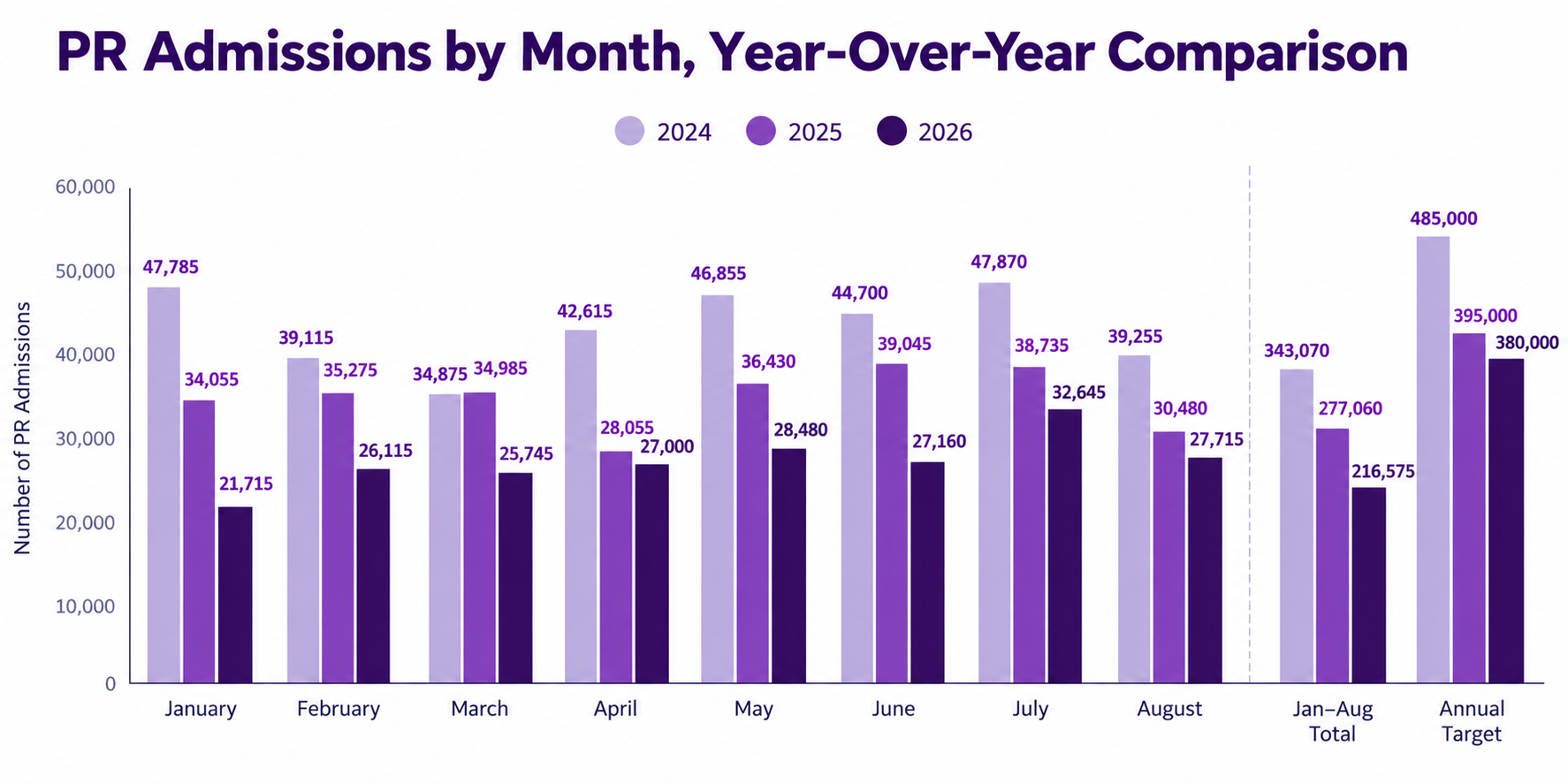
| Month | 2024 | 2025 | 2026 |
|---|---|---|---|
| January | 47,785 | 34,055 | 21,715 |
| February | 39,115 | 35,275 | 26,115 |
| March | 34,875 | 34,985 | 25,745 |
| April | 42,615 | 28,055 | 27,000 |
| May | 46,855 | 36,430 | 28,485 |
| June | 44,700 | 39,045 | 27,115 |
| July | 47,870 | 38,735 | 32,565 |
| Jan-July Total | 303,815 | 246,580 | 188,630 |
| Annual Target | 485,000 | 395,000 | 380,000 |
Source: IRCC. Figures for 2026 exclude admissions through the two one-time immigration initiatives. The January–August total is calculated from the monthly figures and may differ slightly from IRCC’s published cumulative total of 216,600.
The difference is significant when you look at year-over-year numbers. During the first eight months of 2024, Canada admitted 343,070 permanent residents. That fell to 277,060 during the same period in 2025 and 216,575 in 2026.
This means regular permanent residence admissions in 2026 are approximately 21.8 percent lower than in 2025 and 36.9 percent lower than in 2024.


Canada Is Falling Further Behind Its 2026 PR Admissions Target
Canada’s 2026–2028 Immigration Levels Plan sets a target of 380,000 permanent resident admissions for 2026. This relatively low target aligns with the government’s goal of keeping annual permanent resident admissions below one percent of the population.
But so far, we’re behind even on this target. By the end of August, IRCC had admitted approximately 216,600 permanent residents (not accounting for one-time initiatives).
That represents 57 percent of the annual target, in the first two-thirds of the year.
To reach 380,000 admissions, Canada would need to welcome another 163,400 permanent residents between September and December. That works out to an average of 40,850 admissions per month.
For context, Canada’s highest monthly admissions figure so far in 2026 was 32,645 in July.
If Canada continues admitting permanent residents at the average pace recorded between January and August, it would finish 2026 with approximately 324,900 admissions, well below its target.
The Immigration Levels Plan does provide some flexibility, with a lower admissions range of 350,000 for 2026.
However, even reaching that lower threshold would require another 133,400 admissions during the final four months, or an average of 33,350 per month.
A late-year increase is still possible with many RCICs reporting a rise in PR application approvals in October, but IRCC will still have to pick up the pace to hit its 2026 target.
Economic Immigration Remains Well Behind Target
Economic immigration continues to account for the largest share of Canada’s planned permanent resident admissions.
This category includes programs such as Express Entry, Provincial Nominee Programs, and the Atlantic Immigration Program.
Under the 2026 Immigration Levels Plan, Canada aims to admit 239,800 economic immigrants (63 percent of the total PR admissions).
However, only 127,100 people had received permanent residence through economic immigration programs between January and August — approximately 53 percent of the annual target.
To meet its target, IRCC would need to admit an average of 28,175 economic immigrants per month for the remainder of the year. Notably, this is higher than the total PR admissions in August.
Family Class Immigration Remains Ahead of Schedule
Unlike economic immigration, Family Class admissions are currently ahead of the pace needed to meet their annual target.
Family sponsorship programs allow Canadian citizens and permanent residents to sponsor eligible relatives, including spouses, common-law partners, dependent children, parents and grandparents.
Canada admitted 59,100 permanent residents through family sponsorship programs between January and August 2026. This represents approximately 70.4 percent of the annual target of 84,000.
With two-thirds of the year completed, Family Class is slightly ahead of schedule.
Refugees, Protected Persons and Humanitarian Immigration
The Refugees and Protected Persons category has an annual target of 49,300 admissions.
By the end of August, Canada had admitted 25,500 permanent residents through this category, representing approximately 51.7 percent of the annual target.
Meanwhile, the Humanitarian and Compassionate and Other category has a target of 6,900 permanent residents for 2026.
Canada admitted 4,900 people through this category between January and August, reaching approximately 71 percent of its annual target.
French-Speaking Permanent Resident Admissions Outside Quebec
Canada also has a separate target for French-speaking permanent residents settling outside Quebec.
Under the 2026 Immigration Levels Plan, IRCC aims for French-speaking immigrants to account for 9 percent of permanent resident admissions outside Quebec, equivalent to a target of 30,150 people.
Between January and August 2026, Canada admitted 16,500 French-speaking permanent residents outside Quebec — approximately 54.7 percent of the annual target.
Although admissions remain below the pace needed after eight months, IRCC has issued a significant number of French-language category ITAs through Express Entry this year. This will likely help increase admission numbers later in the year.
However, these invitations will only be reflected in permanent residence admissions once applications have been approved and applicants become permanent residents. So not all French draws will count towards PR admissions in 2026, some will only count towards the 2027 target.
One-Time Initiatives Accounted for Another 46,400 PR Admissions
In addition to its Immigration Levels Plan, Canada is operating two one-time initiatives to transition eligible temporary workers and protected persons to permanent residence.
These admissions are counted separately and do not contribute toward the regular 380,000 target.
Together, the initiatives granted permanent residence to 46,400 people between January and August 2026.
The In-Canada Workers Initiative aims to transition at least 20,000 eligible workers to permanent residence in 2026, with a further 13,000 planned for 2027.
By the end of August, 15,100 workers had received permanent residence through the initiative, representing 75.5 percent of the 2026 target.
The second initiative focuses on eligible protected persons and their accompanying dependants already living in Canada.
IRCC aims to grant permanent residence to 46,000 people through this initiative in 2026.
Between January and August, 31,300 people received permanent residence through the initiative, representing approximately 68 percent of the target.
August saw a particularly sharp increase in admissions under the protected persons initiative, with 10,360 people becoming permanent residents compared with 5,865 in July.
Including both one-time initiatives, Canada admitted 40,155 permanent residents in August and approximately 263,000 during the first eight months of 2026.
Can Canada Still Meet Its 2026 Permanent Residence Target?
Canada still has a realistic chance of meeting its 2026 permanent residence target, despite the slower pace of admissions so far.
IRCC would need to admit an average of 40,850 permanent residents per month between September and December to reach its target of 380,000.
While this is considerably higher than the monthly figures recorded so far in 2026, admissions could accelerate during the final months of the year.
Canada has issued a substantial number of Express Entry Invitations to Apply (ITAs) in 2026. Many candidates who received invitations earlier in the year (January to April or May) could become permanent residents before December, as their applications are finalized.
Admissions through other immigration programs could also increase as IRCC processes applications already in its inventory.
August’s decline is not necessarily a sign that Canada will miss its target. With four months remaining, there is still time for IRCC to close the gap and potentially meet its 2026 immigration goal or at least land within the range indicated in the 2026 Levels Plan.
About the author

Sugandha Mahajan
She/Her
Content Marketer
Born and raised in New Delhi, India, Sugandha moved to Canada as a permanent resident in early 2020, just weeks before the pandemic shut everything down. She has first-hand experience with many common newcomer challenges, including navigating the Express Entry system, finding a job without Canadian experience, and figuring out small talk. To deepen her understanding of the field, she is currently pursuing a Graduate Diploma in Immigration & Citizenship Law at Queen’s University.
Read more about Sugandha Mahajan
Citation
Mahajan, Sugandha.
"Canada’s PR Admissions Drop 15 Percent in August 2026."
Moving2Canada.
Last modified October 21, 2026.
https://moving2canada.com/2026/10/canada-pr-admissions-drop-15-percent-in-august-2026/.
Copy for Citation










Featured Stories

Immigration • Oct 21, 2026
Ontario Relaunches REDI Immigration Initiative in Six Communities Through 2027
Read more

Immigration • Oct 20, 2026
Alberta’s Referendum Results Pave the Way for a Wave of Anti-Immigrant Policies
Read more

Immigration • Oct 19, 2026
What I Would Tell Applicants Preparing to Claim Express Entry Job Offer Points
Read more

Immigration • Oct 19, 2026
Is It Worth Getting a Job Offer if You Qualify for the CEC
Read more